Should you hire a CFO?

And if yes, which one, and how.

A 15-page workbook for biotech founders and CEOs. You have a molecule, a runway, and a raise that everything is pointing at. Somebody has to own the numbers that carry it.

PDF, 15 pages. Direct download, no form. The six templates come by email.
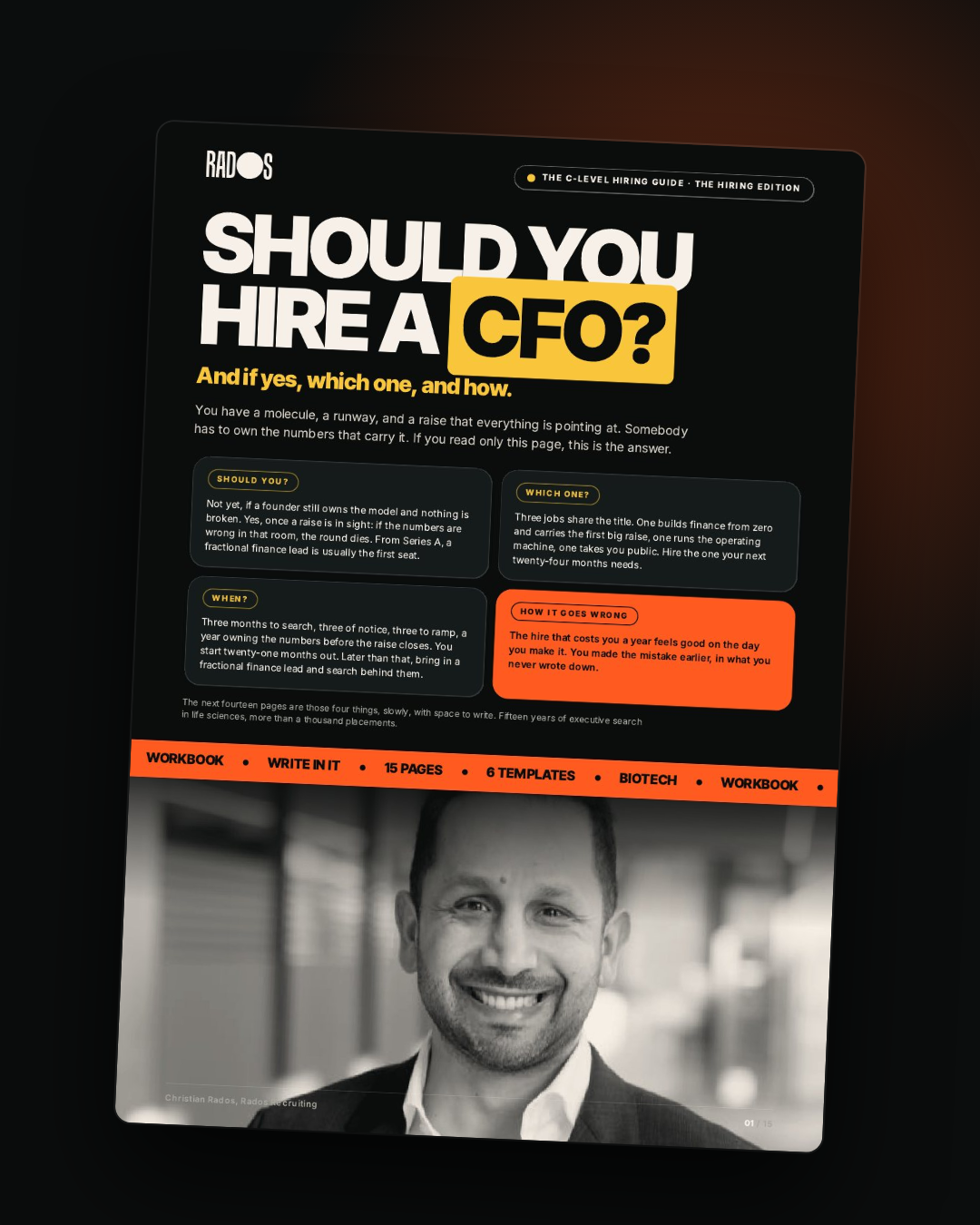
Cover of the workbook Should you hire a CFO? by Christian Rados

The answer, in four lines

If you read nothing else, read this. The guide is those four things, slowly, with space to write.

Should you?

Not yet, if a founder still owns the model and nothing is broken. Yes, once a raise is in sight: if the numbers are wrong in that room, the round dies. From Series A, a fractional finance lead is usually the first seat.

Which one?

Three jobs share the title. One builds finance from zero and carries the first big raise, one runs the operating machine, one takes you public. Hire the one your next twenty-four months needs.

When?

Three months to search, three of notice, three to ramp, a year owning the numbers before the raise closes. You start twenty-one months out. Later than that, bring in a fractional finance lead and search behind them.

How it goes wrong

The hire that costs you a year feels good on the day you make it. You made the mistake earlier, in what you never wrote down.

Which one is your company?

Three real companies, names changed. Nobody in them was incompetent, and in each one the problem sat in plain sight for a year.

P

Paul kept the model to himself

He built the seed model alone and never gave it away. When the Series B started, investors asked who owns the numbers. The CFO arrived fourteen months later, into a runway four months shorter than the board thought.

L

Lena arrived two years early

She joined as CFO at thirty people. There was nothing to own yet. She built controls for a company that did not exist, and left four months before the Series B.

M

Marc left after twelve months

He was the right hire and had the best year of his career. Then the job became quarterly reporting and audit committees. Twelve months in, he resigned.

The guide shows what to do about each one.

What is inside

Fifteen pages in the order you need them. Every page has space to write.

2Where you are now, and what the goal is
3Paul, Lena and Marc
4Which CFO you actually need
5When to start, counting backwards
6Fractional, interim or permanent
7What to do if you already have a CFO
8The six places CFOs come from
9Interview questions for non-finance founders
10Need fit: what the seat feeds and what it starves
11The offer
12What month six looks like
13Reference calls are not a background check
14Six templates for the search
15Easy, advanced or pro

Get the six templates

The small versions on page 14 of the guide, as fillable PDF documents: time plan, job description, interview questions, personality and human needs, background check, score sheet.

Leave your name and email, and the file comes from Christian personally, usually within a day, with one question back about your search.

No newsletter. One email with the templates, and a reply if you want one.

Thank you! Your submission has been received!
Oops! Something went wrong while submitting the form.

What standard are you hiring against?

The one decision the guide asks you to make. Same three levels on page 6 and page 15.

Easy

Two candidate suggestions who have the skills. Salary, location and need fit: gut feeling. You run it yourself, with the templates.

Advanced

Two candidates, with salary and location checked on top of the skills. Stage fit and need fit: still gut feeling.

Pro

The entire available market. Salary and location checked, stage fit and need fit tested.

Want me to run a search with the pro hiring standard?

christian@rados-recruiting.com
Christian Rados

Written by Christian Rados

Christian Rados is a Munich-based executive headhunter for venture-backed biotech in Europe and founder of Rados Recruiting. Since 2011 he has placed permanent and interim leaders in biotech, pharma, and MedTech, over 1,000 placements from Director to C-level and board.

He hosts the podcast Willing to Win, Biotech Leaders Against All Odds.