
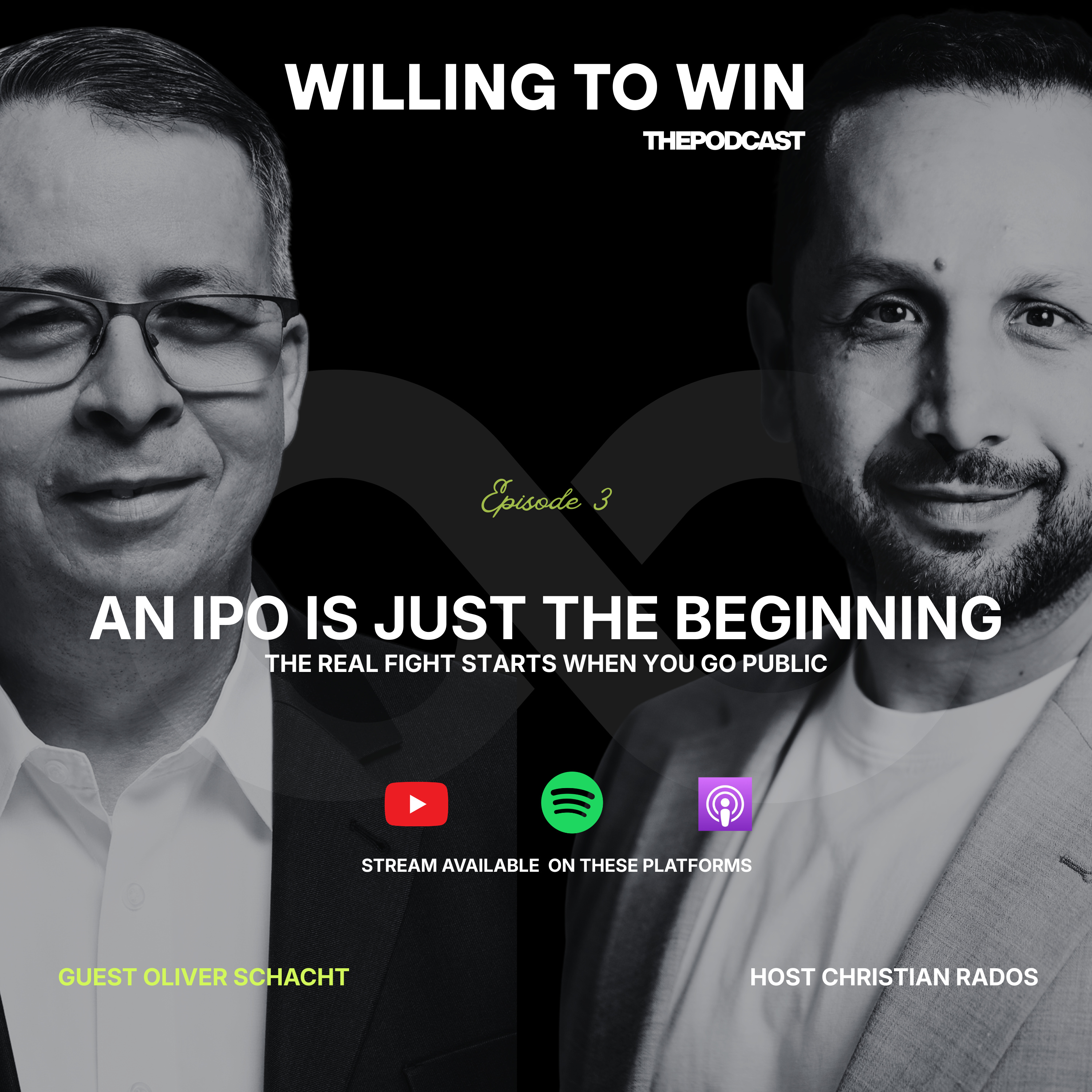
The conversation as it happened, lightly edited for reading. Christian asks, the guest answers.
Christian: Hello, Oliver. When you think back to a younger version of yourself, a young Oliver, before all the fame. So you were studying, you went into consulting, then stepped into biotech. What was driving you back then?
Oliver: It's an interesting one. I had wanted to become a biochemist like my dad. My mother was a lab tech. I had applied to the University of Tübingen in the 1980s to study biochemistry and received a letter from the university while I was in the military, essentially saying, thanks for applying. However, what you need is a GPA, German 1.0, which is the highest GPA you can get under German scores, plus three waiting semesters. And by the way, your Abitur, your high school diploma, is from the state of Hessen. You can reapply in a few years' time, unquote.
And that at the time, it frustrated me. So I decided to go into business school instead, in Germany and then in England. And I'd done my master's and PhD on strategic alliances in biopharmaceuticals. So I was always interested in the industry. And then I ran into a young PhD student, Alexander Olek, at a conference in New York, really during a party. And that was how it all started. He said, look, I'm starting a biotech company. How about you join? And I was like, whoa. Now you got to think back. This was early '98, startup.com, boom. It was exciting.
And it was just like, hey, startup is what everybody really wants to do. So let's just give it a try. And I didn't think twice. After starting, I never looked back. 27 years and counting, never looked back. I've been in the industry ever since and love it. Although I'm still not a scientist, obviously, with a business degree, it gave me the opportunity to become a version of myself that has the privilege of working with super smart science people all day long. And that's really my backdoor way into biotechnology without ever having gone to university and done biochemistry.
Christian: Brilliant. I like the way how you describe a version of you. So what other versions could have been possible?
Oliver: Well, I could have obviously, if it had worked out, I could have become a biochemist and then ended up, like my father, working in a big pharmaceutical company. If anybody had asked me as a high school student or even in college, I would have probably said, in all likelihood, I'm going to work, even after consulting, I'm going to work for a large corporate. A lot of our clients, obviously back then, were large corporates. We did a lot of work on organizational optimization, restructurings, process re-engineering, whatever the euphemisms were for cutting jobs, essentially.
And that, to me, would have been the far more likely version, going with a big corporate. But nobody in my family had ever been an entrepreneur. Nobody had ever done business. The combination of doing a startup would have been unthinkable for, I guess, my parents or anyone in my family. So it was pure happenstance. It just occurred.
And it was such super fun, despite all the ups and downs and all the hardships that fortunately nobody tells you about when you embark on the journey. So I kind of went in there probably naive and just super optimistic, and it became a way of life, became a lifestyle and became a career. Ultimately, and I never regretted it. So I don't know, but it could have been probably a scientist, a small cog in a big wheel in a large corporate.
Christian: Maybe not. Maybe not. From what I know from you, you would have found a way to do something else. But when you look at your own journey, I mean, it was a long journey, 25 years. And I think every leader has a few key moments, a crisis, a responsibility that shaped them afterwards. And when you look back at your own journey, what were the moments that demanded something from you that you didn't have?
Oliver: Well, first of all, as I said, when we started Epigenomics in a backyard in Berlin, there was five of us in the founding team, a biologist, a chemist, a bioinformatics guy, an engineer, and myself as a business person. We never dreamt of, I mean, our biggest business plan probably envisaged us growing to maybe 20, 30 people. Within 18 months, we were 130 people. We had grown during the dot-com time. We had acquired a company in the U.S. We'd gone through the '99, 2000 boom. We were on the verge of taking the company public.
And then the bubble burst, the dot-com bubble burst, the Neuer Markt in Germany fell apart. The IPO didn't happen. And we went through a process where we had to raise more private capital. And that was the first really, the ice age of biotech funding back then, 2001, 2002, 2003. And we were on the verge of running out of money. And we had a strong investor syndicate from the 2000 era. Of course, everybody was underwater because the valuations had dropped and we needed capital.
And I was in the board, we were in a board meeting, and we were out there fundraising for months and months and months. And every time we had an investor who came with even term sheets, they put a term sheet on the table, which was even at a valuation that was somewhat better than what our inside investors had offered us. Miraculously, that term sheet always, a few days before agreeing or signing, disappeared. And it was like, well, we rethought, we looked at it some more as a new investor.
And then we had this board meeting. At some point, one of our board members, who was a partner in a very well-known venture fund, said, isn't it amazing how transparent the capital markets are? Which really, I blew a fuse. I got up and said, look, if you guys want to have a shareholder meeting instead of a board meeting, that's fine, but we're just wasting time. And so in the end we ended up doing an insider round at a massive down round valuation. But that again saved the company, for the first time after only up and up and up before, and enabled us to eventually go public in 2004.
And that IPO, it was on really shaky grounds. I mean, 2004, there hadn't been any IPO in biotech in frankly all of Europe. It was the first one, actually not just in biotech, the first one in high tech after the bubble burst, and everybody had looked at everybody else. I know Intercell in Austria, a couple of others, and Epigenomics. And our CEO eventually lost his cool. And the only bank, the only bank that in 2000 had refused to come and pitch, which was Morgan Stanley, because the analyst in 2000 said, look, thanks for inviting us to pitch, and we know that you had UBS and Salomon Smith Barney and Deutsche Bank and JP Morgan, everybody else had come and pitched, we as Morgan Stanley, we don't think that we're going to be able to pitch, we don't think you guys are ready for an IPO, so we're not going to come and pitch.
That was 2000. He called us out of the blue in 2004 in spring and said, we followed your story, we now believe you're ready, we would like to talk about taking you public. And so we did an abbreviated version. We took the company into the process. And back then you could still have the analysts and the bankers in the same room. So we had a whole day analyst briefing, three banks, three sets of bankers, three sets of analysts. We got sort of a bake-off all day.
And this was the Tuesday after my wife and I had gotten married. We got married on Saturday. The Tuesday, we were sitting there and at the end of that day, I looked into the group and I said, and it was only gentlemen, so I said, gentlemen, if you're telling us that this IPO is actually going to go forward, I got married on Saturday. I gotta go home to my wife and tell her that we're canceling the three-week honeymoon to the Maldives. And they said, yeah, this IPO is happening. So that's what I had to do. I walked back home in shame. And now we're still married, almost 25 years on. So it did endure. But that was a decision, obviously. Essentially you have to put the company and the journey that the company is on ahead of pretty much everything else in your personal life.
Christian: I wish I could look in the head of your wife at this point. What are you thinking?
Oliver: No. I think it was not the usual first week after the IPO.
Christian: I can imagine. But leaving outside right now the story of your wife, of your marriage, how did your professional life look like a week after the IPO? I think everybody remembers the IPO, but I want to know about the week after, the champagne didn't taste anymore, you know.
Oliver: Well, first, what happens after an IPO is the so-called quiet period. So I'm a dad, I've got a now 16-year-old son. Everybody talks about it, but nobody can ever prepare you for that millisecond when you hold your child for the very first time. It's the same thing with an IPO. You have a private company, you've built the business, you know the company inside out, but nobody can prepare you for that split second, one moment you're private, all of a sudden you're a public company. From one day to the next you're on remote control. You have your banker on one side, your lawyer on the other, your auditors, your IR firm. Every single word that you're allowed to say gets scrubbed and scrutinized because it's potentially a forward-looking statement. Are you possibly disclosing anything that's material non-public information? Literally everything you say or do.
I'll never forget, so this wasn't a week after the IPO but about a year after the IPO, which goes to show how long this journey of getting used to things. Our CEO at the time, I was CFO, Alex was the CEO, and he was a true entrepreneur. He had a gazillion ideas and he had started another company which I'm a co-founder of, a chain of kindergartens and schools, Phorms. Today it's available all across Germany, but we had just founded that in 2005. And he'd given an interview to the Tagesspiegel, one of the biggest daily newspapers in Berlin, and I was sitting there on a Sunday morning having breakfast, reading, and I opened this newspaper. It was always an interview of a quote-unquote famous Berlin person at their favorite spot.
And I opened this thing and I said, you know this guy, that's your CEO. And he was wearing, it was summer, so he was wearing shorts and a T-shirt, and he was standing inside a fountain. And I read the interview and it was all about how this new company, I'm like, shoot. You've got a CEO of a publicly traded company giving an interview about the latest and greatest new startup he'd done. Maybe not. And then I look at the caption of the photograph and it said, Alexander standing in the Märchenbrunnen, the fairy tale fountain. I'm like, that's not good. Some of those harsh lessons learned, every single word you say gets tracked and has a reaction, and sometimes it's good, sometimes it's bad, but whatever you do on day one, the next day you may or may not see it in your stock price.
Christian: You're a public person.
Oliver: Exactly.
Christian: Is this part of the story that you had to learn that nobody could prepare you for?
Oliver: Yeah, I mean, it's because of course, and it's a million times more brutal today with social media and everything. Back in 2004, 2005, yes, we had internet, but it wasn't like you're spending your life essentially on Twitter or now X or Instagram or what have you. But yeah, whatever you do will be remembered and will never be forgotten. I mean, you can Google today about Epigenomics IPO and brothel. Literally brothel. And why is that? Because the Spiegel, the day after the IPO party, Alex had apparently given them his cell phone number, so they called him and said, Alex, how do you feel? Exactly the question you just asked. How do you feel? And again, the internet never forgets anything. 20 years, those things. But it was literally the day after the IPO party, that was a harsh lesson learned on day one, and there were millions more to come in terms of running a public company.
I've taught a class every year at my alma mater business school together with a friend of mine who became an investment banker, so he's done plenty of IPOs as an investment banker, and I've now done two IPOs, one at Epigenomics and then later on with Curetis. We were teaching a class to final year undergrad students about corporate finance and IPOs. And I always tell students, doing an IPO project, doing an IPO is like having great sex with your girlfriend. And I mean, look, it's exciting, it's fun, usually doesn't last all that long, it may have consequences. But running a public company is like being a parent. It's a 24/7 job. It never stops. Not after a year, not after 10 years, not after 20. It never ever stops, and there is no turning back really. Of course you can theoretically delist, you can eventually sell the company.
And that part is, I mean, everybody looks at the IPO as sort of an end point or an exit. It's not. The IPO is the starting point for a totally different journey, a totally different version of what the journey might have become had we sold the company, which with hindsight we probably should have and definitely could have, four or five years earlier to Roche. Instead of doing a hundred million plus strategic partnership, we could have, should have sold the company, which would have been the better exit for everyone. We chose to go public and then live as a public company.
Christian: What I would like to deepen is how you saw yourself as a leader shaped by the IPO. I mean, you mentioned a couple of things now. You also teach about that. I think it's a leadership lesson that we can take from here.
Oliver: Certain leadership principles probably don't change. I mean, you've got to be true to yourself. If you try to become an actor all day long, that usually doesn't work. I think, and Alex and I had that conversation often. At some point, if you're really good at being an entrepreneur, having all these great ideas and starting something, odds are you may not be the best person to become essentially an executive officer, a manager of a publicly traded entity, because that is a wholly different life. Although the company was still relatively small, 150, 160 people, but we had a US subsidiary. And you're running, whatever you're running, you now have to tell the world what you intend to do in the next three, six, 12 months. You give guidance to the public markets and you will be held to that.
We had a large Swiss institutional investor, the fund manager there was sort of an old-fashioned Swiss gentleman, and he would have his black booklet and you'd meet with them and he would keep notes. And you met him again, six months, nine months later, and he'd go back to his notes and flip back in the black book. And he'd go, well, Alex, Ollie, nine months ago, you told me X, Y, and Z. And Alex, at one point in 2000, he leaned forward and he said, but you didn't take all of this for real, did you? And I still hear this from this fund manager today, 20 years on, do you remember that time when you guys sat across my table and you told me that you didn't mean what you said?
So you've got to, and if things do go wrong, things change, it's still biotech. So the science gives you curve balls. Clinical trials don't always work out. Partnerships don't always work out the way you thought. But if things change, and especially if they change in a bad way, you have to adjust. And at that point I had actually determined that, look, the way the company was being run, I still felt it was like Alex's company. As a CFO, I just had a hard time saying you cannot run a public company like this. So I essentially resigned.
I told the board, I'm doing something else. I'm going to do your next annual audit. I'm going to spend the next six months. I'm going to find my own replacement. And all of that was agreed. And then the board must've had second thoughts. In a board meeting in '06, we walked in and I literally had signed paperwork for my own exit. I had talked to the chairman earlier that day. And everything was signed, sealed, delivered. And the board must've had a closed-door discussion, and they called us back in and they said, you know what? We've just taken a decision. Alex, you're no longer CEO of the company, but Oli, you've got to stay.
And I'm like, and they literally that night, the board decided, oh, what do we do? Well, we can't make Oli the CEO. They took the least threatening guy of us. They took our bioinformatics guy and made him speaker of the executive board and hired a recruiting firm and said, we got to start a process. But we were without a CEO for nine months. It took nine months until we had a CEO join the company. And during that time, because things hadn't worked out the way we had planned, we had to massively restructure. We went from 160 people and a cash burn that was north of 20 million a year. We cut down the company by about half, in one fell swoop. It was a restructuring. We cut programs, we cut jobs, we cut whole departments.
And we had a board that consisted of retired pharma executives. The CEO of Boehringer Ingelheim was our chairman. The CEO of Roche Diagnostics was on the board. The former chairman of Dade Behring, who was sort of an advisor to Siemens, was on our board. And they'd all done, of course, in a big corporate, every now and then they do massive restructurings. None of them had ever run a small company though. And they told us, yeah, you're going to feel bad for a while, but you know, you're going to get over it. But it's like that day when we walked in knowing, and because we had prepared it for several weeks, you are going to sit across from 80 individuals, all of whom you've selected yourself, all of whom you've hired yourself. And you've got to tell them that, sorry, we've got to let you go. Don't have a job for you anymore.
It was brutal. It was certainly nothing that you ever wanted to do, but it essentially saved the company. The company would have probably crashed if we hadn't done that. It gave the company another lease on life. It allowed the company to then, in a restructured form, regroup. We found a new partner after Roche had dropped the partnership. We partnered up with Abbott and QIAGEN and Quest Labs in the U.S. in a much smaller version.
Christian: At least you did something to survive.
Oliver: Yeah, but that's sometimes, I mean, again, as a founder, as an entrepreneur, you like building stuff. You don't like tearing it down. And that lesson that sometimes cutting jobs, cutting the company, trimming it and doing it in a brutal, really one fell swoop fashion is the only way to continue to move forward, because otherwise investors will not. And again, we were a public company. Everybody could see, everybody could look at our balance sheet. The world knew how much cash we had left, how much runway we had left. So the capital market essentially put down their thumb and said, we're not going to fund you unless, and that unless meant we had to reinvent ourselves and restructure the company and then re-approach the market with a different story and a different burn and a different business case.
Christian: It wasn't the last restructuring you went through.
Oliver: I mean, several years later, I'd actually left Epigenomics. I'd run the US subsidiary for seven years. And then I joined another small startup team at Curetis, which was also a molecular diagnostics company. This time around, it was infectious disease rather than oncology, still molecular diagnostics. And we did the whole journey again. I joined initially the board. We built that company from series A, series B, series C. We did an IPO in Euronext. And then again, two and a half years after the IPO, similar story, sometimes a product development doesn't pan out. The trial took longer. And the European capital markets, while they usually allow you to take a company public, do an IPO, and it doesn't matter if you go to Frankfurt or Switzerland or Euronext, we were in Amsterdam and Brussels, Paris, it's all the same. European capital markets don't like follow-on offerings.
The question you get in Europe is how much more capital do you need? When are you going to break even? How much more dilution? In the US, the capital markets typically ask, well, if you had an extra $50 million, how much bigger, faster, better can it get? We were out there fundraising in 2018 for a follow-on on Euronext. The target was, I believe, 18 million euros, and we ended up raising nine. It was half. And we were faced with a stark choice. It was like, okay, nine million is money, but it was only half the money we needed to execute the story.
And we had built, we were a commercial stage company. We had products in the market in Europe. We were in the clinical trial and in front of the FDA for approval in the US, had already started building in the US. And we said, well, the money is half of what we need. We can either keep selling in Europe and give up on the US, well, we planned everything for the FDA approval and the US launch, or we do the US marketing and sales, but then we have to cut everything in Europe. And that's what we ended up doing. We closed down our sales and marketing teams in Germany, in Austria, in Switzerland, in France, in the Benelux, in the UK. We had subsidiaries in all these countries, closed all of them down, let everybody go and gave the European commercial rights to Menarini, a large Italian corporate, a pan-European distribution partnership.
But again, it was like, given the amount of money was less than what we had hoped for, it was probably the only choice. And then we ended up selling and marketing in the US directly.
Christian: How did you make that decision? I mean, you have several options on the table. Please bring me back to that moment. How do you make the decision?
Oliver: Well, how'd you make that decision? I mean, again, the maths is simple. You have 9 million versus 18, so we can afford essentially half. And so it wasn't like there was 10 options. It was really either Europe or US. We can't do both. We can't afford both. And when you then look at the facts, I mean, the United States is a single, large, homogenous market. Same language, same regulatory, same reimbursement landscape. It's brutally expensive. I mean, salesperson for salesperson, marketing manager by marketing manager, it's X, maybe two and a half X of what you pay in Europe. But again, the prices in the market for the product are higher. The reimbursement situation is more straightforward.
In Europe, it's one country at a time. While we do have a regulatory pathway with the CE marking in diagnostics that is pan-European, commercially, you don't. Every single country is different. Every reimbursement system is different. So in the end, it was like, okay, you put all your eggs behind the US basket and we're going to drive that ourselves. And in the end, it helped the company get to where it needed to be from a capital market perspective. We never gave up because we were listed in Europe. We never gave up on the idea of what we had originally wanted to do. We'd wanted to take Curetis public on NASDAQ. Euronext was second best only, but the US capital market had told us in 2015, look, it's a great story, it's a great product, but come back when you have FDA approval. So now in late 2018, with that decision of going in the US, and we got the approval in '18, we launched in the US.
We never gave up on how do we bring the company to the US capital market and being now a US commercial stage company. Yes, the headquarter was still in Germany. Listing was still on Euronext, but in 2019, through an introduction by a mutually friendly banker, we got introduced to a US NASDAQ listed molecular diagnostics company, OpGen. And we started talking, and it was clear very, very quickly that, look, two small companies, both struggling in the capital markets, both subcritical in size, rather than talking collaboration or partnership, let's put the two companies together. And that was our path in 2019 to bring Curetis onto the US capital markets, by rolling into and merging with OpGen.
And overnight, we then became a US NASDAQ listed company. That was my second stint going back to the US. So from 2020 to 2024, we were essentially a US headquartered, US listed company. And at least the fundraising became somewhat easier, because NASDAQ is so used to fundraisings that we probably raised about a hundred million dollars between 2020 and 2024, before the capital markets essentially crashed on everyone and on the whole market. But it was an interesting time during COVID, during the pandemic, especially since we were in infectious disease testing. It was a very interesting time.
Christian: What was the toughest financial conversation that you had to have with bankers, within fundraising, or maybe with some of your founders or some of your boards?
Oliver: Well, there were a couple. Start with a funny one. Funny with hindsight. When we took Curetis public, we were on the road during the IPO roadshow. We had gone a week in Europe, and then we were in the US for several days, New York, Boston, and the bankers in Boston, and this was almost the end of the IPO roadshow, they looked at the book, how the book was coming along, and they said, you know, this is really touch and go. We're missing a big anchor order. This is tough. Look, Ollie, you're going to fly back to Germany. You've got to call your board, your VCs tomorrow morning, and you're going to tell them that we need another, I believe it was either 3 million or 5 million commitment across five VCs. So it wasn't a huge amount for each investor, but we need that additional anchor order to get the book.
So I flew to Germany. I landed, picked up the phone and called my friend and longtime VC acquaintance, Jörg Niemann, who was back then still at Life Science Partners. And it was a Saturday morning. And I said, Jörg, I just come back from Boston. Here's what the bank is telling us. We need an additional commitment from you guys of say 3 million by today. And he said, okay, I'm going to talk to my colleagues, I'm going to call you back in an hour, which he did. And he said, okay, Ollie, I spoke to all the other VCs and we're willing to do it under one condition. You as the executive board, so you personally, but also your colleagues, your chief operating officer, chief technology, your co-founders on the board, you all each have to commit as well. And the grand total was, I believe, something like half a million. Again, it was a sizable amount.
And so, okay. I called my colleagues and I said, guys, here's the deal. And literally it took us less than two minutes on the phone and everybody said yes. But somebody had to come up with the money because you were actually subscribing to these shares. And so three days later, the company was public. So my wife and I, at the time with our son, we were in the process of buying a house. So we had put away a sizable amount of cash to be able to finance the house. And so I got home that Saturday after those phone conversations, and I walked into the house, which we rented until we could move into the new one. And I told my wife, look, don't ask any questions. We just got to take a half a million and wire it to the bank because we're subscribing to half a million. It's not just me. It's like four of us.
And we're going to get a good chunk back, but none of the others had that sort of cash lying around. It all worked out. The IPO worked out. It was the most successful IPO in Europe, in biotech, in 2015. Everybody paid up their fair share. We bought the house, everything. But again, remember, she had been through that cancellation of the honeymoon, which was 11 years prior. So she kind of gotten used to those types of things.
Christian: How would she tell the story now?
Oliver: I have no idea what she would say. She would probably roll her eyes and go like, ah, well. She actually, so that's another funny anecdote. When we left Seattle for Epigenomics to move back to Germany, when I joined Curetis, we were sitting down with our tax advisor. And at one point she stopped me and said, oh, shut up. I'm the only one in our family who knows how to run a profitable business. Touché. I mean, her business, she trades in space coins, silver coins, is profitable, has been from day one. So good for her.
But another really tough one with banks in 2018, that follow-on offering at Curetis that I talked about earlier, where we targeted 18 million, ended up getting nine. We had a banking syndicate, three banks. The first one imploded. Lead bank walks away, banking syndicate implodes. I said, okay, happens. I rebuilt a new syndicate. Then having run public companies for a number of years, you have enough banking relationships. So I called some other banks and said, hey, look, we're trying to raise a follow-on. So we put together a second syndicate. And I was actually on a one week cruise with my parents-in-law, my wife, my son. And I got a call from the lead bank in that second syndicate, essentially saying, look, we looked at the market. It's just not happening. We're stepping out.
And I was like, this is the second syndicate that's completely imploded and gone away. Third time's a charm, I guess. We found a single financial broker and advisor who stepped up and said, look, we believe we can get it done. And that's how we ended up getting the $9 million deal done. It wasn't $18 million, but it was $9 million. But yeah, that was tough.
Christian: It was a big time of uncertainty, right?
Oliver: Absolutely. Again, we'd been in rooms with institutional investors as a public company where everybody knew, the market knew, we knew that we were getting to the finish line of a clinical trial. We were blinded. Nobody knew the data. And the investor looked at our team and said, look, I'm sure you guys have a bottle of champagne in your right hand, a bottle of vodka in your left. And one of my colleagues said, no, no, no, we just have a bottle of champagne. Of course, we were optimistic, but we were blinded to the trial. And of course, the investor took this to mean that probably these guys already know the data is good.
And then the data came back. It wasn't black, but it wasn't white either. It was sort of gray, checkered, what have you. And the investor had done a $20 million follow-on two years earlier as a single investor. And that to them was sort of the exit point. They sold everything. They exited now. They tripled their money. So they were happy. But again, it was that loss of trust or faith of saying, well, I sort of felt misled when somebody said, no, I only have a bottle of champagne. Again, it goes to show that every single word you say as a public company counts.
Christian: Okay. I think this is one big lesson. I think another lesson that you didn't mention actively, but what I hear between the lines is you have to have your family aligned and committed. Otherwise, nothing works.
Oliver: Absolutely. And again, if anybody told you, and I sit now in my new role at Life Science Nord, I sit across the table from startup teams all the time. And it's a great part of my job now that I have the privilege of working with a lot of young startup teams. And some of them have just started. Some of them are still in academia thinking about starting a company. Some of them have already raised their first capital. And of course, nobody at that time will tell you that you may have a business plan for three to five years, but what you're really talking about is 10, 15, 20 years. It's a generation.
Generation today is, of course, there's people who are still willing to put in a lot of hard work, but it's still Gen Z, Gen Alpha. And you've got people thinking of work-life balance. And there is no work-life balance when you run a startup. There is no work-life balance when you take your company public. It's work seven days a week, which only works if you have your family behind you.
With OpGen, we were in a fundraising and the family and I, we were down in Florida for just a couple of days. We were in a tiki bar in the Florida Keys, having dinner, there was a cocktail on the table and then the phone rings and we literally closed a $20 million financing over the phone that evening. And while my wife and my son were sitting there enjoying the cocktail, having their food and my food was getting cold and I was just sitting there, but we got the deal done. So it was kind of like we celebrated later that evening. But yes, without the family, without the backup, you just couldn't do it.
And you will miss. I mean, my son, when he was little, whether it's the first time they swim, whether it's the first time they do whatever, you're going to miss a lot of these moments because you will be on a roadshow. You will be talking to investors. You will be at a gazillion conferences. You will be traveling all across the globe. That's the price you pay. But again, you're being rewarded, not just financially, which of course running a public company is financially very attractive, but you're also being rewarded by the ability to take the science, the technology that your company is all about, and turn it into a product and then a public story and share those public stories.
Christian: I mean, what you're telling me now is of course condensed 25 years, but I think there were months of uncertainty sometimes.
Oliver: Oh, sure. I mean, yes. And there were years. I mean, 2001, '02, '03 was three years in a row. That was just one rough, rocky ride. If you go to the 2007, '08, '09, after the financial crisis broke. I mean, I had taken Epigenomics public with Morgan Stanley and Lehman Brothers. Now in 2008, Lehman ceased to exist. And '08, '09 were tough. Yes. It's usually not days or weeks. These cycles in the biotech industry or in the public capital markets are usually multi-year cycles. That's the thing. Again, I can tell founders today, it's like, yeah, it's crappy out there right now. But you know what? 2025 is a little bit better than 2024. 2024 is definitely better than 2023. 2022 was when the market kind of collapsed.
So the good news is we're probably at the bottom or even slightly past the bottom of the cycle. If you start something now, odds are three years, five years from now, it might be frothy and it might be very positive. Don't get distracted from right now. It's tough, but again, the time span, the lifespan of any biotech company is going to be 10, 12, 15, 20 years. You will see cycles in that period.
Christian: So understandings of patterns and those cycles, as you say it, does it help you to keep your conviction in terms of uncertainty?
Oliver: Yeah. And again, it's almost like, I mean, it's a bit like in sport. You've got to trust that you do the right thing and you do it over and over and over again, you will get wins on the board. That doesn't mean you're not going to lose games. It doesn't mean that you're not going to lose championships. It doesn't mean you're going to feel really shitty after a bad loss. You may even get relegated, right? You get relegated from NASDAQ to the OTC market, or we ended up having to sell all three companies of the OpGen group in three separate M&A processes. That was certainly not plan A, but it was plan B that did work. We sold Ares Genetics, our Austrian subsidiary, to bioMérieux. We ended up selling the German Curetis diagnostics business to a Singaporean family office and the US NASDAQ listed shell to a financial investor, who now turned it into a Malaysian fintech.
Sometimes plan B, that's certainly a lesson that my chief scientific officer used to tell me. Ollie, you have a middle name and that middle name is plan B. So always have a plan B and maybe even a plan C, because things will be different. And that conviction has got to come from deep down inside. I mean, if you're not intrinsically motivated, then you're not going to enjoy it and you're not going to last in this business.
And to me, that intrinsic motivation, and again, I bring it back to that, while I would have loved to become a scientist and work on sciency things that bring innovation to patients. The thing that you never see, you don't see it in your stock price, you don't see it on your bank account, is the letters that you receive from patients or patient families telling you that, look, your product. We developed the world's first blood-based test for colorectal cancer diagnostics, early diagnostics, at Epigenomics. We had developed a test to diagnose pneumonia, life-threatening pneumonia. I had an acquaintance from the biotech industry, a dad himself. He called me up and said, you guys, don't you have like a test for pneumonia? Because my 10-year-old son is in hospital. He's running a fever at 41 and a half centigrade, and it's really touch and go.
We sent a sales guy there, picked up a sample from the boy. The doctors were unwilling to change the antibiotic therapy because they said, no, this is, well, sure enough, four hours later, we had a test result. And I was lucky because I had a key opinion leader from the United States on site. And I said, could you take a look at this? And she looked and said, yeah, this drug can't work because of this, that, the other. And I said, would you mind? I'm going to put him on speed dial, call the doctor and tell him. Long story short, they did change the antibiotic therapy that evening. And Tuesday, the following week, the dad calls me and said, you know what? My son's getting out of hospital tomorrow. He's fine. He's doing better. And the doctors essentially told me, had we not changed the therapy, your child would not have survived this weekend.
So it's very real. I mean, we develop products that have the potential to save lives, massively impact lives. And again, while you don't take it to your bank account, that's something you're going to take to the grave with you. It's stories you're able to share with your children, maybe even if we're so blessed one day, your grandchildren. And those are the moments when you realize that's why I'm really doing it. That's why I'm willing to put in the long nights, the weekends, the canceled holidays, whatever it is, because that's what it's all about.
Christian: And now looking ahead in the future, your future. I mean, you're still a public person. I think all biotech companies in Germany know you. What does the future want from you now?
Oliver: I think I really grappled with that in 2024. While we were doing these M&A processes, it became clear that as we were selling the US NASDAQ listed company, my time with OpGen and my time in the US would come to an end. When we did that deal and restructuring, I restructured myself out of the equation. And I said, that was the last day here. What are you going to do? And I said, well, I started getting calls from recruiters and VCs saying, hey, we've got this great late stage private company, Series B, they want to do either an IPO or M&A. And I thought about that. I looked at three, four things, but then consciously decided, having done three IPOs, one in Germany, one in the Benelux, one in the US, run three public companies, I don't want to do a fourth one. No IPO, no publicly traded biotech.
And then I did co-found a number of companies along the way. I co-founded another biotech company in the clean tech space, clean energy space. I could have taken that. I said, well, you're in your mid fifties now. Do you really want to go to Ikea, purchase two desks, screw them together, hire person number one? I was like, that's a young man's game. Let's let the next generation deal with that. And then, as you said, I've been publicly involved in the biotech industry on the board of BIO Deutschland for over 12 years now. I was treasurer for six years, president for six years. Now I've passed on the baton to Roland Sackers as president, and I'm just a regular board member. But both at BIO Deutschland at a national level, but then at a regional level in Northern Germany with Life Science Nord, I really want to help build the ecosystem of biotech and life sciences for Germany.
Because while we have world-class research and technology, we have fantastic ideas. We have founders who are motivated and we're sort of doing okay with early stage startups. I mean, the High-Tech Gründerfonds being Europe's most successful early stage fund, but we're still really lousy at scaling companies. So if I can contribute to create the environment in which companies are encouraged and teams are emboldened to think big and think about scaling, and at the same time, the environment, the ecosystem is such that investors in Europe, especially in Germany, consider doing rounds like we've just seen with Tubulis in Munich. I mean, phenomenal. Largest ever European round. That would have been unthinkable. $401 million Series C. Would have been unthinkable 10 years ago. 20 years ago, we had not even started, it would never have happened.
And so we're starting to see U.S. capital, U.S. institutional investors, venture, private equity, but also institutional investors look at Europe, given the geopolitical environment in the United States. They're realizing that Europe is really attractive from a risk return and from a cost base. You can actually develop companies and develop technologies in a far more cost-efficient manner. So I think we're going to see more of that. And I want to be able to help the next generation and put them on their paths. And that's what we do pretty much day in, day out at Life Science Nord. If you ask me today, I could very well see myself for the next, whatever it is, 10, 12, 15 years.
The other thing in Germany, it's so funny, because we're still a country where, and I followed the debate this morning about the pension reform in the German parliament, people in this country say, oh, we've got to work until we're 67. I mean, oh my god, maybe one day we'll have to work longer. My oldest employee in the United States, our chief medical officer, was 84 years old. He didn't have to work. He didn't need the money. He was rich. But he worked pretty much as long as he could, because he loved what he was doing. He was working with a young team. He worked three days a week, but he came into the office, shared his experience with us young people and he inspired us. My head of HR at OpGen was in his mid seventies and nobody ever talks age there. It's like this notion of telling you to retire. I've never considered this being a job.
It's like you take it from A to B, maybe to C. As long as it's fun, as long as I enjoy it, I could easily see myself doing it however long I can, however long people consider some of the advice and the stories you share and the guidance you can provide as beneficial and valuable.
Christian: Thank you very much for being that role model. And one last question I would like you to answer. If you think about your career, your life and everything, what's the one advice you wished someone would have given you earlier?
Oliver: Don't overthink it. People, and especially students in college, get all revved up about making that initial career decision. The only reason I went into consulting after my master's was frankly because I had no clue what else I wanted to do. So it was a good decision. And I might've stayed, I could have moved into a big corporate. Don't overthink your first move. Do something that you enjoy and then life will find you. A career will find you, because while it may sound all strategically planned and well executed with hindsight, in reality, the start of Epigenomics, the move from there to Curetis was all a series of coincidences, personal meetings at conferences, at parties, at events. One thing leads to another. Don't overthink it. Don't try to strategize your long-term career. Just go with the flow and if you stop enjoying what you're doing, move on, do something else.
That I think is, there's so many opportunities out there. Opportunities are going to find you. Life is going to find you. And as long as you're happy with it and enjoy the ride, it's going to be right.
Christian: That was a joy talking to you. Thank you very much. See you soon again here or somewhere else. Bye-bye. Thank you, Olli.
Oliver: Thank you, Christian.
If you think you need to talk to this guest, reach out to me and I am happy to make a connection. Christian Rados, christian@rados-recruiting.com
All episodes and the problem pages