
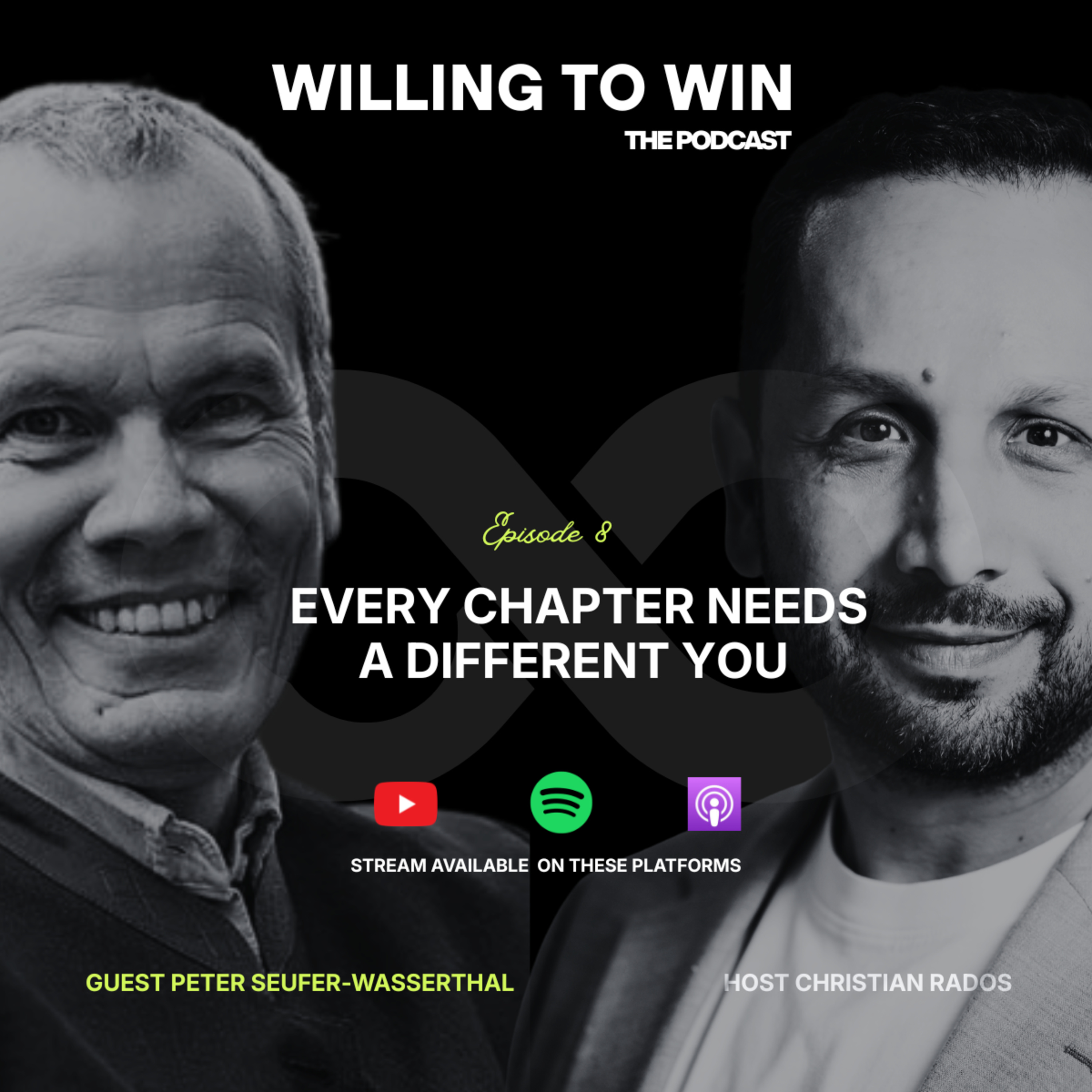
The conversation as it happened, lightly edited for reading. Christian asks, the guest answers.
Christian: Peter, tell me about your experiences in sailing and how it shaped some of your wisdoms in life.
Peter: Sailing is one of the things where you are exposed to the weather. It's something you can't control. The only thing you can control is when you go out, if you're in a harbor, or what to do with your sails when you're already out. Because when you are out and the bad weather is coming, you need to deal with it. And learning from people who are really good at that, teaching you what a boat can do for you if you treat it the right way, that really showed me that sailing is not as tough as many people think it is. It is a sport, and I admire people who go around the world, maybe on their own. It's just incredible.
But sailing also helps you on some other things. There's this one famous saying that I was told when I did my first license. When should you reef your sails? Meaning, when should you make your sails smaller? And the guy said, do it the first time you think about it, and not when the storm is coming. And that is very similar to many situations in life. Very often, when you have a feeling that a storm comes, there's no need to do anything because the storm is not here yet. But when the storm comes, it's usually too late. So had you reefed, had you done something, when you had this first feeling, you probably could have handled the situation differently. So that's probably one of the things that I was taught by sailing.
And another one is you cannot change the wind, but you can change the direction of your boat. And that's also something, deal with it. There's nature out there. There is the world out there. You cannot control it. You need to work with it so that you can continue to go ultimately in your direction. Even if it means you need to tack, which means you go not in the right direction, at least to somebody who doesn't know, but it gets you ultimately there, even against the wind.
Christian: Tell me something about your time before the titles back in Austria, before all the responsibilities. Who were you as a person?
Peter: I was one of seven boys in a little village, a little town in Austria, where we had a fantastic childhood. This was talking the 60s and early 70s here. So we could go out and do things. Our parents supported us, like on sailing, mid-70s or something like that. My dad bought the sailboat. He was not a sailor at all. And he just let us play with it. It was a little local lake.
Christian: Which lake?
Peter: Irrsee. It's close to Mondsee. We had this boat that we called a bathtub. When you're 15, 16 years old, the one thing you really like to do is just turn it around and see what you can do. We played with that. Then I did a license when I was in school. We had one of these sports weeks. So I did my inshore license. And then I didn't sail for about 30 years, 20 years, something like that. And then a group of guys from the village started to do these trips to Croatia and to Greece. And at one point I came with them and we did all these things that you do. And then I decided at one point, well, I want to do my own license so that I can go sailing where these people usually don't go. So I made a license. And by now I do like the long trips. So we sailed from Spain to the UK. We sailed from the Azores to Portugal. And my longest trip was from Hawaii to California.
Being out there for two weeks with nature, we decided not to get the password for the Starlink. We used it to get the weather files and all these things, but not for other things. And you really get into the flow with almost no wind, with a lot of wind, day in, day out. So it's two hours on, four hours off. And that's how you live for two weeks. That's all you think about. What's in the fridge? What can I cook? Can I sleep? And all these things. Nothing else matters. And that's what I really like to do.
Christian: You're a very ambitious person, from what I know, but still very humble. Was it difficult for you to live so frugal like that?
Peter: No. We were seven people and five berths. So it's hot bunking. After you're two hours on, you look which bed was empty and which sleeping bag was empty. And you just go in and sleep. I don't have a problem with that at all. I do like plush hotels and being treated and fancy dinners. But I also like being out there and I don't need much. And you need good gear. That's what I've learned. That's what I invested in a little bit, because if you have wet feet for a couple of days, that's no good fun. If you are soaked wet, it's not good, no fun. But if you have all that, well, let the weather come and you don't need much more.
Christian: You were ambitious and humble at the same time, that mirrors in your story about the sailing as well. You are ambitious. How is this mix visible in your early career and your career choices?
Peter: My early career, I didn't have an idea where the career was. I'm an organic chemist by training. So I have a PhD in chemistry. I kind of knew during my postdoc, which back then not many people did. When I called the agency that did the funding, what my chances are, the person said, well, don't tell anybody, but we have more money than applications. That changed three years later. It was the process that it is today. But back then, it was just not normal. And I always said, I want to do that. Maybe I'm influenced by my PhD advisor who just came back from a year in the States and was full of ideas and liked the atmosphere and things like that. And I said, I just wanted to. And then we did that. That's my wife and I, my wife was eight months pregnant when she came over. So our oldest son was born in Toronto, which was all a learning. Did we know what to get into? Did we know how to do it? No, but it was again one of these life traits that one of the guys, the wife of one of the guys in the lab had just delivered a baby. So we took everything over from them, from the doctors to the hospital, to the courses, to everything.
So that was pure luck, but you just need to take luck because once in a while it's there. And if you don't take it up, well, it passes and then you're still stuck. So we enjoyed the time in Canada and actually I wanted to stay over there, but back then, we're talking the early nineties now, nobody wanted to hire a chemist because everything will be done with biology. Obviously a few years later, people realized that chemists are not too bad to develop processes and things like that.
But by then, I did have a job very close to where I live. I lived and now live again in a local company and it was easy for us. We could live with my in-laws, so we didn't have any money. We didn't have to pay rent and things like that. And we said, OK, I need to get started. I don't want to be a postdoc for the next five years. I want to go to industry. And one of the things that people asked me, what do you want to do? And I said, well, I'm a chemist. So I will go to the lab and then take it from there. But there was a new thing coming up in this company. They switched from being a commodities chemistry business to custom manufacturing. And one of the things they looked for were chemists to move to the business side. Because the discussion was it's easier to teach a chemist the bit of business that you need for custom manufacturing as opposed to train a sales guy the chemistry you need to assess a potential project, whether it fits on.
So that was my switch to the, as people call it, the dark side, the business side, after only having been six months in the lab and industry. So PhD, chemist, and then you go to the business side. And back then I was asked, especially in Europe, so you're not a good scientist that you need to go to the business side. My answer back then, not knowing anything about it, was, well, I like it. And I believe it makes sense that in our industry, business is done by people who understand what the subject matter is. And I've seen that change. If you now look at companies, it's all scientists on the business side, or not all, but a lot of scientists, at least scientific training. And then you learn the other things you need, the business things, the contract things, whatever you need.
So that was my first major change. And the second, that was probably the real change, was my step out of the Austrian system. And that started with a print ad back then, because we are still talking almost before internet time. So 95 was a print ad. I copied it and I showed it to my wife and I said, these guys are looking for me. There's nobody who will tick all the boxes in that. And that ad was from a company in Cambridge, Massachusetts, looking for a chemist who understands what enzymes can do in chemistry and wants to work for this small American company. I was employee number 16 to develop the market in Europe. And a couple of other things. It turned out there was a second person that ticked also all the boxes, but I did get the job. And that was when I started to work for companies outside of Austria, from a home office back in the mid nineties, which was something that nobody knew about. Not even the financial authorities. They did an audit and said, you cannot work for a company in the US from here. It's impossible. Then I showed him, well, we have email. We had these telephone cards. Oh, well, you had to punch in long numbers and we had telephone conferences. So it all worked and he said, okay, I see this is working. So that was this challenge. And that's when I learned I can work for companies abroad, even from this little village in Austria. So that was really the start and getting into the industry that I've been in ever since.
Christian: What was the first opportunity that really surprised you?
Peter: What I just described, because that was so out of the blue and it also was the CEO. They made a very scientific interview process. So it was with role play and whatever. I had to present the company to them. This was back with overheads and they did sneak some overheads in that I didn't know what the picture showed, and I left it in anyway, but they wanted to see how does this guy deal with questions and all this kind of things. So that was really the jump out of what I thought was a clear career path. Because back then you started with a company and you probably retired from the same company. That changed by having to do many more things myself.
If you are part of a big company, everything is there. Does everything work well? Maybe not. I don't know, but you get your computer, you get your, by now, telephone. If something is wrong, you just call IT and all these things. There's a travel agency. And everything is working. I had to start to work almost like self-employed. I was fully employed, but I had to act like that because back then it was six hours time difference. Then it was nine hours. If you don't do things yourself, it just doesn't work. And it's also the small company mindset. If you like something to be done, you need to do it because otherwise it doesn't get done, but at least you need to start. And then you need to get others in the boat.
And third, maybe, and is that the most important? I don't know. I had to learn to get things done without authority by hierarchy because you are an outsider to an extent. You are in this early case, there were two BD people, one for the US, one for Europe. The US guy did sit in the office and I went there back then. It was probably once a quarter and over the course of not many months, I did get the same, if not better, things done than the guy in the office by just spending time with people when I was there. Because when I was there, it didn't matter what my time was, I could be there at six in the morning meeting the cleaners or the production people, and I could go out to do some sports with some people from the lab in the evening.
So you get to know people, not just nine to five, but outside as well, which can be more difficult if you are working from home, like you go to the office. Because then you want to go home when your work is done at, I don't know, five, six, seven, you want to go home. You don't want to hang out with people at this, not every day. And using the time when I was in the office, that really helped to be integrated into these companies very, very well. And that is probably something I learned, that it's not always necessary to be the boss. You need to convince people that what you want them to do is meaningful. And that may have helped me in further jobs as well.
Christian: Was there a moment where you were uncertain about a possible outcome or about a situation?
Peter: Always. Always. The first, and that didn't have to do much with leadership, but the first real uncertainty was with this company in Cambridge, Massachusetts. I flew over the day before I started and being jet lagged, I woke at four in the morning in this little apartment that they gave me because I spent three weeks there to be integrated. And I woke up and said, what do I do here? This little boy from rural Austria and now I'm in Boston and I need to establish my spot in a biotech company, when all this didn't mean that much to me, because we didn't know that much. It's so good to see, and we'll talk about that later, some of the founders today, what they know. We didn't have an idea about the world out there because it was just not there. You couldn't just quickly search for something, look at a website, and this was still write letters and maybe send a fax. And all of a sudden you are there in the US, you are on your own. There's nobody around. You have met some of the people during the interview process, but you don't know anyone. There's no backup. There's no safety net. It's just you.
Christian: So how often did you go back and forth?
Peter: Back then, not that often, maybe once a quarter. I guess initially it was two times three weeks, like three weeks there, then a week home and then another three weeks to really get to know the technology, the people. And after that, I was part of the company. Doing this fresh start in an environment I didn't know, again, gave me the confidence that I can do it again. So if I look at my CV now, it's certainly not the CV that I thought I would have if I thought about it back then. I changed companies. I started new positions. I started in areas that I didn't really know.
I'm coming from the production side. Then I worked for companies in small molecule drug discovery. I knew something about enzymes. Then I worked with companies doing strain development, pathway development, fermentation. I was part of a company that brought one compound almost to phase 1, and then money ran out. So it was very, very diverse on the subject matter. And I tried to bring my knowledge in. It helps to have a reasonably scientific brain.
But then it's this know-how on how to do contracts. How do big companies make decisions? What can you stand really firm on? What do you need to put on the table to be negotiated? And learning that, learning to do contracts as a chemist and then no formal training on this side. I was lucky with some of my managers who were just really good at that. And so took me by the hand and showed me how to do that. Initially, they did it and I just watched. Then they still did it and I watched over their shoulders to see what they did and why they did it. Then it was the other way. I did it and they watched over my shoulder and at one point you say, well, many things I can do. For a lot of things, I want a lawyer to have a look because ultimately, these are big contracts and you want to be safe.
But what I describe now, what I always did, is commercializing technology. Doing that from early on, trying to find combinations like, yes, it's a great technology, but there's a competing technology over there. We need to do it a little differently or we need to add something or we shouldn't go there, but stay here. That's really growing into something that back when I started, I had no idea even existed. So talking about career plan and things like that, I couldn't offer that.
Christian: It has to do a lot with your mindset around, am I able to learn? Am I able to trust the people around me? Am I going to use the opportunity in front of me and do the best out of it, right?
Peter: Correct.
Christian: Who were the people who believed in you when you didn't?
Peter: It certainly always was my wife. She said once in a while, well, let me talk to them. I will tell them that you're the best. So that's really good to have somebody to fully trust you. But then it was also other people. There was one example in a company I've worked, and being the European guy, not in the office, obviously limits your career to an extent. Yes, it's exposure. So there was, I think it was three or four people that I trained when they became my bosses. And then one of them was promoted to the next level. And then he said, well, I will not hire my replacement. You've trained me. You have trained three people before me. Now you run it. And that was the time then when I spent a lot of time in California.
Christian: How was that for you?
Peter: The person who promoted me, he said, I need to be careful now what I say because my success rate for my jokes went from 40% to 100% because I'm the boss now. Everybody laughs at my jokes and they're not good. And that is something to learn as well, that I needed to start watching what I said, because some people just take it and run with it. Or it could be, well, if he says that, I can say that. So that was really this particular situation when you go from an influencer to somebody who runs. That probably was the biggest change for me.
There is one phrase we did forbid. "That's above my pay grade." That was a fantastic team. Somebody from that team called it the ski period because we decided to go on a ski trip once a year. And it was not clear that the company pays for that. People still came. So that's the rare combination where you have people you like and you like to work with. And there it was this rare combination to have both, not just with single people, but with a full group. That probably describes a leadership style that I try to use, whether at work or also, I was the head of the Upper Austrian Gymnastics Association for a while. And it's the same thing with one big difference. There you have no money to distribute. So you need to be even better on convincing people. And that's what I took between the private business, the gymnastics and the real business. What can you learn on this side that you take to the other? And what can you learn from the business side that you take into your sports life?
And again, that was a big change from when I started many years ago. Now, if you don't run a club like a small company with marketing, you need to watch your money. Having both worlds, the little village town in Austria and the world of biotech, the global world of biotech. That's probably another thing that defines me. I don't want to miss either. And I don't want to work in or live in only one.
Christian: You're speaking from gratitude. What were the moments where you doubted yourself that you are on the right path? You gave that picture of sailing just before the storm is coming. Is there a moment that resembles that picture?
Peter: Yes. There were some where I probably did ignore it. The telltales were there.
Christian: So you went into the storm.
Peter: I went into the storm and ultimately fell overboard. Usually for me, these things happened when I was far away. And then you sit there on your own and big contract is canceled or your own contract is terminated. And you sit there and say, what do I do? The good thing was that most of these things, all of these things, opened other doors that I didn't think about. Like what I do now started with something like that. We agreed to stop an employment and it allowed me to do what I do now. What I always wanted to, not always, but for the last 10, 15 years, wanted to do, to work with young companies and help them be successful. But when you have three kids, and that's where I probably didn't dare early enough to make this change. That's where likely my Austrian soul came through to say, ah, you know what? That's a bit too much risk. I do have a good job and I want to get the kids through university and so that they can stand on their own feet and things like that, which they do now.
Looking back, I probably could have done that earlier. I'm glad that it came in time and not too late to get this change. That's again for me very often for myself, but also when I look around, people, including myself, are not super happy with a given situation, yet they don't do anything about it. And that's something I try to tell people. And we're back to the reefing situation. If you get a feeling and you don't feel well, there's no need to quit your job. I'm not happy, I'm out of here. Just open your eyes and ears and look for something else. And then maybe something comes looking around. I can see that now that some people have done that and it works for them. Is the grass greener on the other side of the fence? No, but it's a good change. And you have the chance to start fresh. And especially when you are early in your career, you need to do a change. Many companies are not good in growing people internally. Some are really awesome at that, but some just see you as the one that you were when you joined the organization. And if you start in a new environment, you are the one you are today.
Christian: So you don't have to stick to your old identity.
Peter: Exactly. And you can even, I've seen that, not for myself, for others, if you don't like a particular nickname, you can introduce yourself the way you want in a new environment. And you can be a new person because this old nickname that you never liked is gone. And you are Joseph again.
Christian: You told me about the moment you fell overboard. I need to hear what happened.
Peter: I was interim CEO of a company and it was a difficult situation. It was really a change, a change in the direction of the company. And we were reasonably successful, but it was a very challenging time on the investment side. So we were not successful in raising money. That was the one situation where I really think it was that I was not there all the time because I underestimated internal discussions based on the outcome of that, because that was the kick that I could do. That I dared to do what I do now. I think the outcome ultimately was a good one because I was prepared to say, this is not working for me. So I did see that it's not there. I did underestimate how close the storm was, but ultimately it ended. It brought me to the situation I'm in now and where I'm super happy.
Christian: But in the end, it wasn't a storm, right? For you personally, because you gave it a different meaning.
Peter: No, but in that time when you go overboard, it's like going overboard. And then swimming, the storm passes and you see this fantastic island in front of you. That's an island where there's nobody, but.
Christian: So you jumped into water deliberately or not in order to get to this fantastic island, which you saw later. There is one piece of advice that is really helpful here. It's changing a past story in order to get along and to get the sense and a meaning out of it, right? Because you change that past story.
Peter: Yes. And that's the one thing. And the other thing is, and again, we can use the sailing analogy. You cannot change the wind. You cannot change the environment you are in, but you can steer your course. You should be at the helm of your own life. For that, you should at least have an idea what the course is. And again, a little analogy to sailing. I learned a good part of my sailing in races. Because if you do, on a Sunday afternoon, say, it doesn't matter where you go. If the wind shifts a bit, well, you shift a bit as well. It doesn't matter. If you're in a race, you need to go to a certain marker or around a certain island and things like that. And you need to do it as fast as possible, ideally.
Well, if your situation changes, if the world changes, you still can try to make the best out of it for you and yours. And that is an important thing for me. And yours can be wider. It's not necessarily only family. Obviously, family is the closest. But it could also be companies you're working with or people in companies you're working with. Try to make the best for them.
Christian: Yes. Totally agree. And I think we all wait for that big moment, changing the world. And as I say, change one person's life. And that's enough for the moment, right?
Peter: And it's probably the only thing you can do. Changing the world, if we stay in the industry, there are the super brilliant scientists who do that. But then it takes many really good and talented people to get that to the world from a lab. And there's a good amount of work in that, right time, right place and all these good things. And other people who are as good or even better never get to such a place. So they are always the ones who work on compounds that never make it to the market. They are as good. There are just other reasons to do that. And they still are motivated by doing a good job in their little world or changing the life of their neighbor in the lab or their neighbor at home, by just being nice or helping them. And that does help as well. It's not always the business win.
Christian: Yes. And I believe success also comes with sacrifices. Maybe you can help me understand what the sacrifices were in your life with the big successes and something that people don't see.
Peter: What you don't see is the many hours that you sit alone somewhere. When you say, well, this week I was in London, Paris and Berlin. Oh, wow. Great. Well, I saw the airport. I saw a taxi. I saw a meeting room and yes, I did walk back from dinner so that I had the feeling I was in Paris. So that's certainly one. The other thing is that you are possibly not home when things really change. And that could be a good thing. I was home when my kids learned to walk, because that was the nice thing. Working from a home office, I was home. But I was not home when there were some things when they are teenagers, which are completely normal. But I was not home. And you get a call in the middle of the night, you're somewhere, you don't realize that it's already morning at home. And then you cannot go to sleep again. And that's something I had to learn again.
It was so normal to be on the road all the time. And now I'm still allowed to travel a little bit, which I still like, but it's not this every morning at the airport, everybody knows you because I'm close to a little airport and everybody starts to type when you approach. I thought I would miss that a lot and I missed it for a while. That's gone. And that's probably, being on your own, you need to be able to do something with yourself, but the many hours you sit in airports or have dinners on your own or whatever, and then not being there when good or not so good things happen at home. In the wider sense, it could be the closer family, that could be somebody passing away and you didn't have the chance to be there. That is a big price. But again, looking back, it's a price that for other things was possibly worth it because I'm lucky that I'm sitting here like I'm sitting here. You see that left and right that people say, well, I do that when I'm retired, and then all of a sudden, boom, they're gone. And that's why I consider myself really lucky to have gone through that and still get the chance to do many things that I possibly couldn't do.
Christian: As I said, today, family and giving back play a much bigger role for you right now than before.
Peter: Yes, it always was important, but I didn't realize that was not good enough at times.
Christian: And now, are you happy with your priorities now?
Peter: I'm super happy. It's this mixture of family. And still, being in the sports club, I'm not managing anything anymore. I'm a coach of 10 to 15 year olds. That's very satisfying. And it's also on the business side. I am advising, mentoring very early startups and help them through this first year, two years, three years of their life, taking things that they've never done before. Could you look at this confidentiality agreement? Because a lawyer is expensive and I've seen one or the other of such agreements. So there are a couple of things that a lawyer that I've worked closely with always said, look out for these three things. If they are like that, it's fine. All the others, yeah, they may not be nice, but they're not necessary to change. So take that away from them. Help them through this process.
Probably the most important step in the startup life is getting the first management hire. Because that means you need to let somebody else into the life of your baby. It's easy to hire scientists and technicians and salespeople and all these things. But all of a sudden, somebody is next to you, maybe even above you. And helping companies and people. It's not companies. This is really people, through that transition to make them successful. It's challenging. Frustrating. But ultimately very satisfying.
Christian: How do you help those companies change their mindset around giving space and giving away responsibility and trusting?
Peter: Usually with a lot of talking. Also with helping them. I do things and then at one point I say, I'm not there all the time. There was a harsh sentence, but I use it once in a while jokingly. He was told by a VC at one point, he said, well, you should ask the question, do you want to be king or do you want to be rich? If you want to be king of your little kingdom, good luck. If you want to be rich, take the help you can get, and you probably can do another startup and another startup and another startup. Take somebody in to really help you to that.
Christian: Would you say that it is difficult to hire someone who is more experienced than yourself?
Peter: I always recommend that, because why would you hire somebody who is less experienced? Then you cannot really push the company forward. You want to learn from somebody. You don't want to make all the mistakes that you can make. If you can avoid one or the other because you have hired somebody really experienced, go for them. And don't hire people who always are of your opinion. You need to, even if they're below you, hire people smarter than you are, which is easy in my case, to point things out and learn from them and let them do it.
Christian: So you build your kingdom, you're not getting rich.
Peter: You build your kingdom and at the end you find that you don't have any clothes on.
Christian: So to wrap this up, is there a book or a movie, something that influenced you in the last couple of months?
Peter: A book, it's The Speed of Trust. Trust everyone and then you are disappointed probably two or three times. And the other thing is, there was an article at one point, it's the power of not taking credit. If you always want to be the one, well, I did it. And without me, that never would have happened. No, it's important that the thing is done. And give others credit. Again, in my situation today, I don't need the credit. Yes, I would like to do it with another company and things like that. But it's important that the company, the founders, the new hire gets the credit.
And then maybe one tool that I always have in my mind that somebody told me at one point. If you have a group of people, direct reports or other people in the company, write a list of how much, in a ranked order, how much they contribute to the success of the company, the most important at the top and the least important. And then write another column where you rank them by the time you spend with them and then connect the names. In an ideal world no line should cross. You spend the most time with the person who contributes most. In reality you spend most of the time with people who contribute less and almost no time with people who contribute most. I've probably never done that on paper or in a spreadsheet, but in my mind I often do that and try to act accordingly. It's not always possible, but at least I try. So that's three things that come up very often in my thoughts.
Christian: Good. Thank you very much. I think every startup is lucky to have you as an advisor. And hopefully we see each other again somewhere else. Thank you very much.
If you think you need to talk to this guest, reach out to me and I am happy to make a connection. Christian Rados, christian@rados-recruiting.com
All episodes and the problem pages