
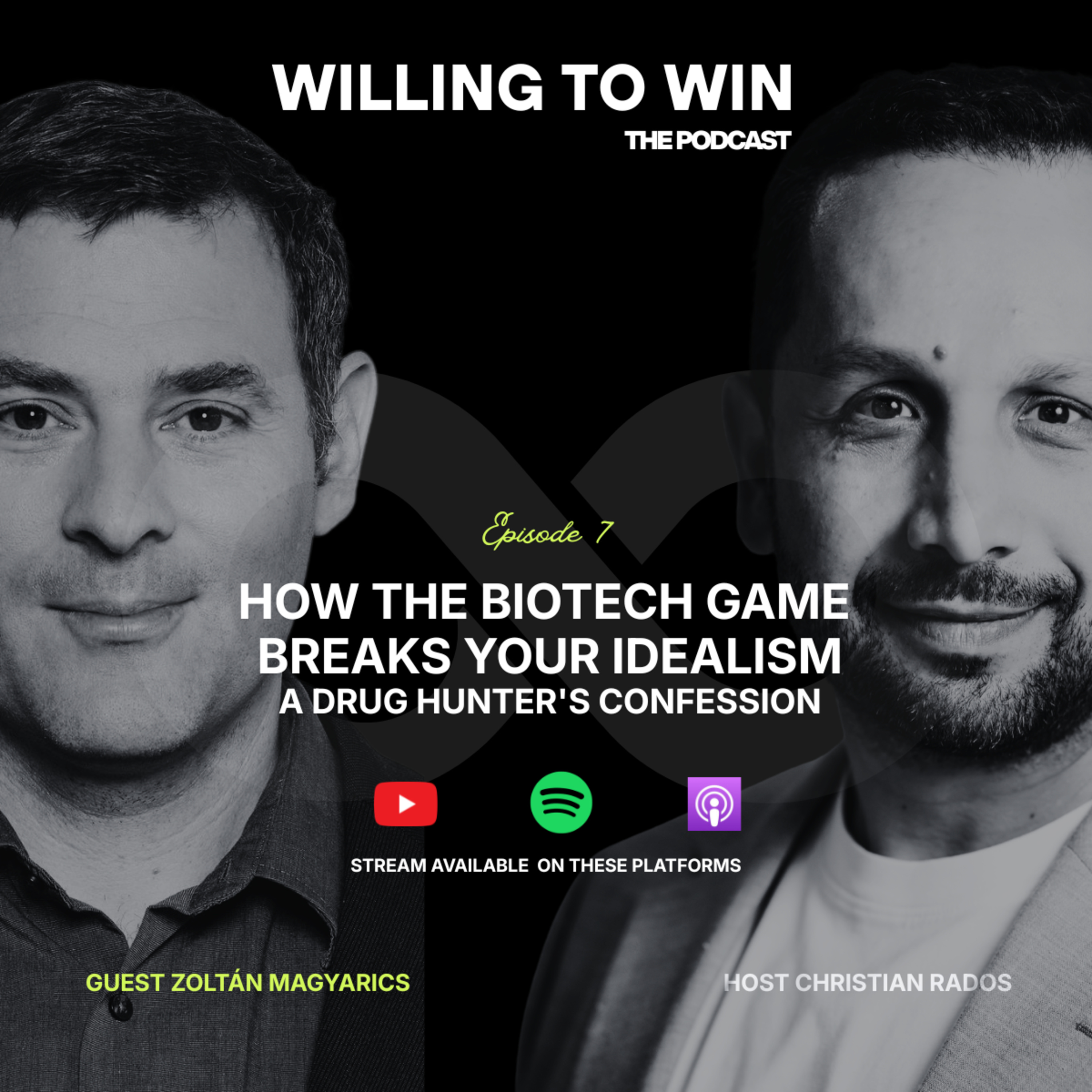
The conversation as it happened, lightly edited for reading. Christian asks, the guest answers.
Christian: Let me start with the first question, an easy question before we go into the heavy stuff.
Zoltan: Let's go for it.
Christian: Thinking back to the 12-year-old version of you, what did the person want to become later in life?
Zoltan: I think the 12-year-old me wanted to become a brain surgeon and was pretty convinced about it, or convicted, if you want. But yeah, life moved on and I never became a brain surgeon. I think I had a broad vision of, okay, I want to become a doctor. I want to become a doctor that does something really impactful, so to say, something really visible and impactful, not just working in the shadows somehow, and something that's spectacular.
Probably that's the right word. Surgery has this classic atmosphere of you always do something visible, right? You cut. We always make these jokes that surgeons like to cut. Yeah, I think I had this notion of being a physician. You have to make things happen. You have to cut, after all.
Christian: What shaped your sense of optimism and conviction that early in life? Let's say teenager, early twenties, in those uncertain times, what shaped you?
Zoltan: That's a very good question. I think during my high school years, what really shaped me is my scientific interest and also my teachers, who really helped me to develop an interest in natural sciences. I had a really good teacher in biology, and in chemistry. They were both really engaging. The biology one was really a tough teacher, but we still liked him. Although we had to learn a lot of stuff that we never used later on, like the scientific name of animals, I mean in Latin, which he always corrected, that it's not Latin, it's scientific. But he was still very engaging.
And he was one of those very committed teachers. He wanted all of us to become a biologist or physician or something. He always assumed that we want to do something with biology, and even the guys who went on later to study economy or something completely different, they were taught biology as, like, this is the most important thing in life. So he was really committed. And then my chemistry teacher was also a great guy and very engaging, and I had kind of a natural tendency towards natural sciences. But I think during my high school years some of my teachers really helped me to shape this.
And honestly, this was not, people like to say, okay, this was totally committed already, or totally decided. I don't think I was very decided after all as a teenager. I was thinking about a lot of stuff, and brain surgery was the main thing, but obviously I was contemplating, okay, what if I deal with economy? I also liked economy generally. I still have a keen interest in political sciences, economy and stuff like that. And then I was contemplating on that too.
But as a teenager, life is an empty page, and your teachers help a lot to shape this and write on this empty page. And somehow I drifted into natural sciences, and becoming a physician was a straight way forward. And becoming a physician was one of my preferred ways.
Christian: I like that. Speaking of role models, do those teachers know that they had this impact on you?
Zoltan: Yes, yes. I think they know, although I'm not sure to what extent. And this is one of those things that you start to realize later. Maybe you don't even like them at that point in time, like, why do I have to learn all this stuff? And then you go on to med school and you realize, okay, life in med school is relatively easy in the first year or two in some of the subjects, because you've learned so much already in high school. And the guy who was teaching you was almost giving university lectures, university quality studies. You didn't realize as a high schooler, you just hated it.
So I think it's one of those things where they are aware, but the extent or the depth of it they would never become aware of, or probably I've never clearly spoken out the depth of it. But again, this is one of those soft vectors that is really hard to quantify, right? Being a physician has always been on my mind and I had these good teachers, so it's like sequential steps. Again, as a teenager you're not necessarily so self-conscious to say, okay, this is my life. Some people are extremely self-conscious. I have some friends of my kids who are absolutely self-conscious at 14 years of age. They very perfectly know what they are looking at.
Christian: Looking at yourself today, who are you as a leader right now, beyond the title? How would you describe yourself as a leader?
Zoltan: I've been thinking about these types of questions earlier, because right now where I'm working I'm leading quite a few people, and I reflected on this, and this is actually my 15th anniversary. I have a direct responsibility for four people in particular, so I'm not just a bench scientist, so to say, but I have a team. So it's been 15 years I'm leading people, and it's a really good question, which I think honestly I can give you a few self-reflective ideas on, but ultimately this should be best judged by the people I'm leading. They are the people who should really judge who I am as a leader.
I think honestly I'm a pretty self-reflective, very analytical leader. I'm also a very patient leader. Everyone has a limit to their patience, but I think I have a relatively broad limit or tolerance, so to say. And again, it's best judged by the people I'm leading, but I like to think of myself as a pretty open-minded, sometimes demanding, especially scientifically demanding leader. I like to lead by example. There is this famous cartoon where people lead from the back or lead from the front, push leaders and pull leaders, so to say. And I like to think, and this is the reflection I got from a lot of people, that I'm more a pull type of leader than a push type of leader, and I think that's probably an important part of my identity as a leader.
Christian: When you think about the hardest decision you've ever made, what was it, and who did you have to be?
Zoltan: This is a good question. In hard decisions I had to be analytical. Everyone has this kind of phenotype or this kind of personality which we use in a stress situation, and in a stress situation I'm becoming more analytical. I don't like to make snap decisions, quick decisions. I try to analyze the hell out of it, and when it comes to hard decisions this is typically the fallback personality I'm using, the analytical one, which is pretty difficult obviously, because then you can become a bit paralyzed in terms of decision making. But that's where I'm usually getting back to, let's collect the facts, let's walk through scenarios, and let's choose the path which seems to be the best overall.
Christian: Yeah, can you give an example? Is it possible?
Zoltan: I think yes. For instance, when I left one of the companies, it was a really tough decision to leave the company. Because of the financing situation there was no way forward. I really liked to work for the company, and it was a really hard decision. I knew I'm going to leave, I knew I have to leave, there is likely no future, so to say, in the company.
Christian: Yes.
Zoltan: And the question was really the when, and how do I time this decision. What's my benefit, what's my team's benefit? Am I leaving the team in good shape? And am I leaving too early, too late, am I getting stuck with this job? Yeah.
Christian: The typical considerations that everybody has, of course, if you work for a certain time at a company which is not coming forward. I mean, you worked for Arsanis, Bloom and Leyden before AOP, right? And I did a bit of research, and Arsanis lost its lead program and merged into X4 Pharmaceuticals. Bloom proved feasibility, but it's not scaling as much as they wanted. Leyden Labs is a very good example of a biotech that has to prove itself clinically. Looking at Arsanis, Bloom and Leyden, three companies, three different outcomes, three different versions of you, probably?
Zoltan: I think so. Yes, absolutely. I think three different stages of leadership, I must say. I was a very different leader at Arsanis versus Bloom versus Leyden versus where I am right now. And then I reflected on the 15 years. 15 years is not a long time as a leader, after all. Some people do this for 40 plus. But on the other hand, it's more than a handful. You have different stages of your leadership as well, how conscious you are. And honestly, in the beginning I was absolutely not a conscious leader. And I think this kind of leadership consciousness is something that comes with every new experience, every new situation.
Christian: Where did those experiences overall push you further than you thought? Where did you go beyond your comfort zone?
Zoltan: Yeah, I think self-reflection and self-awareness, and getting coaching and getting leadership feedback. I think this is really hard in some of the leadership roles. Everyone thinks that if I'm appointed as a leader, people trust me as a leader, I have the right leadership skills. Everyone has it inherently, everyone has a leadership style, it's kind of fine, it's something inherent. If you're being promoted as a leader, it comes naturally, it's flowing naturally.
And then over the years you realize, I made a mistake here. I should have done this better. I should have done this differently. And okay, how can I be a better leader? What kind of experiences do I need to have? What kind of courses do I need to take? What kind of coaching do I need to become a better leader?
Christian: Do you need a bad outcome in order to realize that?
Zoltan: I think so. I think failures shape us. And this is a practical example for the differences between, let's say, the European business culture and the American business culture. What I've seen with Americans a lot is, failure means a lot to them, but on the other hand doesn't mean a lot. What I mean here is, they can tolerate failure. They are eager to learn from failure. If you have failed in US business culture, that only means you have more experience. In Europe, if you failed, yeah, you failed. You're a fallen angel in a sense.
And I think, yes, you have to experience some failures. You have to experience some setbacks. You have to experience some blunders, and that will all shape you. And going back to this question about the leadership stages and the different companies, the way you're different after each role is that you build these experiences into your leadership.
Christian: Tell me about one of those failures in the past.
Zoltan: I think one of the failures, and this was more or less a collective failure, so to say, but I'm also personally involved in this, is how you build a biotech company, for instance. This was a very nice story, but at some point it became one of those classic one-trick pony biotech companies. And I think we made some decisions regarding the phase 2 study design which inevitably killed the lead product in a sense, plus the biology was very complicated. But I think some of the business decisions we made, we were pretty stuck. We couldn't make a modern decision, really. We didn't have options. So we made the most plausible, or the most straightforward decision, which after all turns out to be a failure. It turns out this was not the right decision to make.
And I think we learned a lot from that failure. I also learned a lot about how much you really have to have options on the table, real options. You can't slide into a situation where the decision makes itself, right? You have to be able to control the decision, because if you have two options, but one is, because of the circumstances, not truly available, then the decision makes itself. And I think that's one of the failures, potentially, as a leader, that you walk into one-way streets where you feel you still have decisions, but there's actually no decision.
Christian: Tell me more about that example.
Zoltan: For instance, in this case, and this is very typical for biotechs, not just Arsanis at this time point, we had to choose between two phase 2 designs. One phase 2 design was a relatively clean, very select population, which takes very long to enroll. It's much more money and effort. And the other one was the more common approach: lower the enrollment criteria, make the enrollment criteria not so restrictive, get the study done faster. It's a more heterogeneous population, a more difficult population biologically, but this is what we can afford. Every company has a cash runway. Every company has an amount of financing. So this is the study design that we should ideally do, and against that we have a study design which we can afford. Which one do you choose, right?
It's a very, how to say this, a very tough question. And honestly speaking, I've seen this for many, many biotechs ever since. I think most biotechs at one point in their life face a very similar decision, either this or a slightly different decision.
Christian: I mean, that's tough, the conversation where somebody says, well, we can't afford this design, we have to go for a cheaper one. Does this happen very often?
Zoltan: I think it does. Very consciously admitted, that's another thing. And this is one of those leadership challenges, that you have to face the situation and you have to admit what your situation is. You have to admit that, hey, I'm a biotech and I have a cash runway of X, and although there are different study designs I could do, this is the only study design I can afford. This is a very uncomfortable truth, so to say, a very uncomfortable situation, right? No one really wants to spell this out. No one really wants to put a tag on their forehead that, hey, I'm facing a finance-driven decision after all.
And honestly, again, it's not every biotech, but probably more than half, I must say. I'm working very actively in evaluating assets for my current company. I've worked very actively in sourcing, outsourcing at other companies. And honestly, this is more often the case than not, with biotech companies at some point in time. Typically at the phase 2, they have to make a really tough decision which is not just driven by pure science or pure operations, but also driven by the financial reality and the operational reality of what they can do. Either we admit it or we don't, sometimes we don't even realize, but that's my very analytical take on building a biotech.
Christian: What has to change?
Zoltan: Yeah, it's difficult to say. I think this is the broader industry context, right? And if you take a step back, what we see is a lot of smaller companies. So, one step back: in the good old days, as people say, big pharma companies also did early stage research and development, right? They had a lot more resources. They could typically do the ideal program. This has changed with the different financing models. What happens right now, and this is the reality, is that most early stage R&D is done in small companies, project companies if you wish. Most biotech companies are essentially one-trick pony companies. Even if they have a portfolio, their front running candidate, their lead candidate, is so high in terms of the valuation within the company, the relative valuation, that they are functionally one-trick pony, even though they have a portfolio.
And at the same time, the finances are always limiting. So after all, they have to run way bigger studies and way later phases than a biotech company is ideal for. A biotech company can ideally run a phase 1 study, maybe a phase 2 POC study or a small phase 2a study, not really even a big proof of concept study, but a phase 2a, or a pharmacokinetic study, and ideally towards phase 2 POC and phase 3, you're handing it over to some larger company, the pharmas. They have the resources and all that stuff. This is not really happening. A lot of biotech companies get stuck with their assets up to phase 3 or even commercial stage, and this is where it gets really tricky.
Christian: Yeah, I understand. So this means for the sake of a better clinical study design, it would be better to sell the assets earlier. Would this be your outcome?
Zoltan: I think at least an earlier partnering with a company which has the commercial understanding, the development muscle power. It's a mutual interest. What we right now see on the receiving end, from a pharma perspective, is a lot of assets which are scientifically good, but the development is broke, because it's exactly the reverse problem. There's a biotech company which was pushed to bring it to phase 2, but they don't really have the downstream understanding. They don't really have the understanding which endpoints matter commercially. They designed the study scientifically, first of all, and second, their cash runway dictates the study design, and they are just trying to toss it over the finish line at phase 2. And what you get at the phase 2 stage as a pharma company, as the licensor, is a half-baked program, or a half-broke program if you want.
You may have to go back, you may have to fix it. And I think this is where a more intensive and early interaction between the smaller companies, the early phase companies, the biotech startuppers and the pharma companies actually would help a lot. There are a lot of initiatives for that. We are also engaged with one of the local investors. We are also engaged in a dialogue where startuppers actually come to us every year and we talk about drug development with them, the downstream stuff. They know the science, they want to start a company, we tell them what it takes to actually bring a drug to the market. So they can put the two together and say, okay, I have the science, but I'm going to start a company and I understand what's going to be the long term of my drug, and I can make better decisions.
Christian: Tell me about one of those conversations. What misassumption are those biotech companies having about bringing their asset to market or partnering with a bigger company?
Zoltan: I think the first and biggest one, and this I've learned through my own mistakes honestly, or my neighbor's mistakes so to say, or people I observed in my vicinity, is that as a scientist and as a startup person and as an academic person, or just a pure drug developing scientist, we have a romantic idea about how much the science was. And we have much less appreciation of what it actually takes to sell the drug. What's the commercial infrastructure you need? And what's even more important, what makes the payer stick? What makes the health insurance companies pay for the drug? What makes reimbursement happen? Seriously, when I was a scientist in drug discovery, I didn't know anything about this. It was all below my radar. And it's kind of fine, but you need to have some degree of understanding.
A lot of conversations I have recently, for instance, were about, okay, this is a great drug, it's great science, it must work, it must find a way. Yeah, maybe. The question is, do you have the right endpoints? Do the endpoints that you're assessing matter to the payers? It can be a great drug for patient convenience, but do health insurance companies really pay for patient convenience? Sometimes they do, but most often they don't necessarily, or they don't pay the price you want to see, or they don't pay just for patient convenience alone. This kind of understanding early on, also from a discovery perspective, is largely missing. And I think if there's one take-home message for early stage company builders, I would say please, please also talk to people who will actually sell the drug later on, and talk about the attributes that will really make a difference for your drug, and then build this into the science.
Christian: Understand who your client is, but still be patient centric. Yes, the most difficult part.
Zoltan: This is the most difficult part, and we have a lot of discussions about this. The European Union HTAs, the health tech assessments, are also going towards this direction. You have to find the golden middle between the pure patient interest, quote unquote, and also the payers' interest. I mean, there are a lot of drugs which help a lot of patients, but for this or that reason it's a really hard set of payers. I worked on a rare disease program where the incumbent drug was superbly expensive, massively expensive. It was the only thing available, so patients really liked it, but even countries like Australia made a decision that we can't reimburse it. It's just so horrendously, massively expensive. Plus the administration is so complicated that we just can't.
Christian: Yeah. And how do you explain it to patients?
Zoltan: How do you explain it to patients? And that's an evergreen with cell therapies, gene therapies. There are always these headlines about the $2 million drug, $2 million single dose and stuff like that. Yeah. And I think this level of understanding, or this level of sophistication, even early developers ideally have.
Christian: Yes. Tell me about a moment when your belief in the biotech world was truly tested.
Zoltan: Yeah, I think going back to the Arsanis days, when we failed in a phase 2 POC study, proof of concept study. I think this is where I felt like, okay, this model might be flawed. I actually took almost a sabbatical, if you want. I worked for a contract research organization for some time afterwards, so I left the biotech circus. The biotech friends became clients. And this was a time when I reflected really on, is this model working, guys? Can we develop drugs like this? What's the path forward for the biotech world, so to say? And yeah, I think that's one moment.
And the other moment is recently I've helped a startup biotech to get funding, and the climate is really tough. So I asked the question myself. I was more an observer, just helping them. And I saw the conversations as almost an independent observer in a sense. And I was like, wow, this is really tough, guys. Is it worth the effort, to bring, as an academic founder, a potential drug to this market? Because yeah, it's really difficult. I mean, people are looking for the yellow unicorn, as I used to say. We all know unicorns are white, but people are even looking for the even rarer species, the yellow unicorn, so to say. It's not enough that it's a unicorn, it has to be a particular color.
So yeah, that's another of those self-reflective moments. And honestly, during my career I switched sides in terms of biotech and then contract research organization, and I'm a bit pharma. So at least one advantage is that I see the different viewpoints. I've worked a lot with venture capital firms as well, so if there are people around the biotech table, I can put myself in almost everyone's shoes, so to say, and that helps me a lot.
Christian: I'd say if you're a crazy biotech founder who believes in a drug, changing perspective and understanding everybody would hurt my conviction and would hurt my drive to push through.
Zoltan: That's an interesting perspective. I think my conviction is a pretty data-driven conviction, if you want. I like to understand what I believe in, kind of, and I think these different perspectives really help me to understand better what I'm doing and then believe better in what I'm doing, right? So bringing new therapies to patients, that's the conviction after all. That's what we are after. We are drug hunters, as we used to say in the industry. And you can be good in hunting, so to say, or developing new medicines.
If you understand all stakeholders around the table, then your conviction is even stronger, because you know it can be done. I've seen a lot of success stories. It can be done. And step by step you reveal the winning traits, so to say. You get more and more understanding of, okay, this can actually work. If you combine this and that, that could work. That could be a formula. And this is not something predefined, so to say. For different drugs the formula can be very different, and if I'm having this broad background, I have a better conviction that, okay, I can find a formula for my particular situation, my drug.
Christian: And I like that, opening the door now to curiosity. Staying curious very early in the process is actually positive.
Zoltan: Absolutely. And Bloom Diagnostics had one of these core values, for instance. We were always proud of the team being curious. We had a really good relationship with the team, and we were a very young, very energetic team, and curiosity was one of the drivers. Even though some people, or the majority of people, did not bring 40 years of experience in the field, because the field was brand new almost, or we were walking a pretty uncharted territory path, I think the curiosity everyone really had, and that's a very important point.
Christian: What would be your top three pieces of advice for biotech leaders?
Zoltan: I think one of the top ones is, be self-reflective. Never fully believe your own dream, so to say. Trust but verify, as they say. You trust your dream, but you verify the facts, and be self-reflective and change course if it needs to be. You can be super convicted about your idea, but if the facts are aligning against you, you really have to have the self-reflection and say, look, I'm walking a non-walkable path.
The second piece, I would say, probably is the optionality piece. We have seen that in a lot of situations, that you need to create that real optionality, that you can't let yourself slide into a situation where the decision is making itself. You have to think very early on about different scenarios, about optionality.
And the last piece of advice I would probably give is, this is a long-term chess game. This is a marathon run. It's very rarely a sprint. In a lot of industries we think in sprints, like software development. I work with software developers at Bloom, for instance, and I saw the sprint logic. Drug development especially is a real marathon run all the time. There are many sprints, but after all it's a marathon. So my last piece of advice is really, and this is a really important piece of advice, the long-term planning, and you always think through the whole chess game to the end.
If you're discovering a drug, sooner or later, usually a bit later than you want, or a lot later, it will have to find a way through the payers. It has to have the endpoints that tick the patients but also make it a long-term chess game. You find a mechanism of action in a test tube or something. There's a very long chess game ahead and you have to think that through early on. So that's my third one. Be very conscious on this long-term journey.
Christian: Would you say you're good at this chess game?
Zoltan: I don't think so. I don't think so. I think we are all developing in this chess game. I'm definitely better than I used to be. I still see a lot of people who are way better at the chess game, but I'm learning. I'm trying to do my homework and leading the people and trying to learn the chess game by playing.
Christian: Going back to my first question, what is the advice you would give to your younger self right now, knowing what life is about?
Zoltan: Do it again. Do it again, and do it with more grip, more sense of urgency, more grip and more consciousness. More conviction is the wrong word here, but do it with more purpose. Don't just take an opportunity, see what happens, but be very conscious about what you want with that particular opportunity. How long are you committed? How long are you committed to an idea? What makes you change? What are the pieces of data that make you change? Be much more conscious about your choices and decisions. I think that's the piece of advice.
Christian: Very good. And my last question is, is there probably a book that you would like to recommend?
Zoltan: Yeah, there are a few books. Radical Candor from Kim Scott is one of the pretty well-known leadership books, I think. Initially I found this book a bit intimidating, but the more I was reading the book, the more I was practicing the book, the more I got it, the more I started to use it and benefit from it. The other one is Authentic Leadership. It's a really, really fantastic framework to think about your leadership.
And the last one is not really related to leadership, but generally it's scientifically very interesting, and I was rereading this book very recently. This is why it comes to my mind. It's a book called Linked by Albert-László Barabási. It's network theory. And the examples he's bringing are really, really powerful, they change your thinking. This is why networks are important. This is why networks are encoded in all your life, wherever you look. These are the basic mathematical principles, or physics principles, if you want. And it also helped shape my leadership thinking after all.
Christian: Thank you very much for this open and trustful conversation. I'm looking forward to seeing you maybe soon here or somewhere else.
If you think you need to talk to this guest, reach out to me and I am happy to make a connection. Christian Rados, christian@rados-recruiting.com
All episodes and the problem pages