
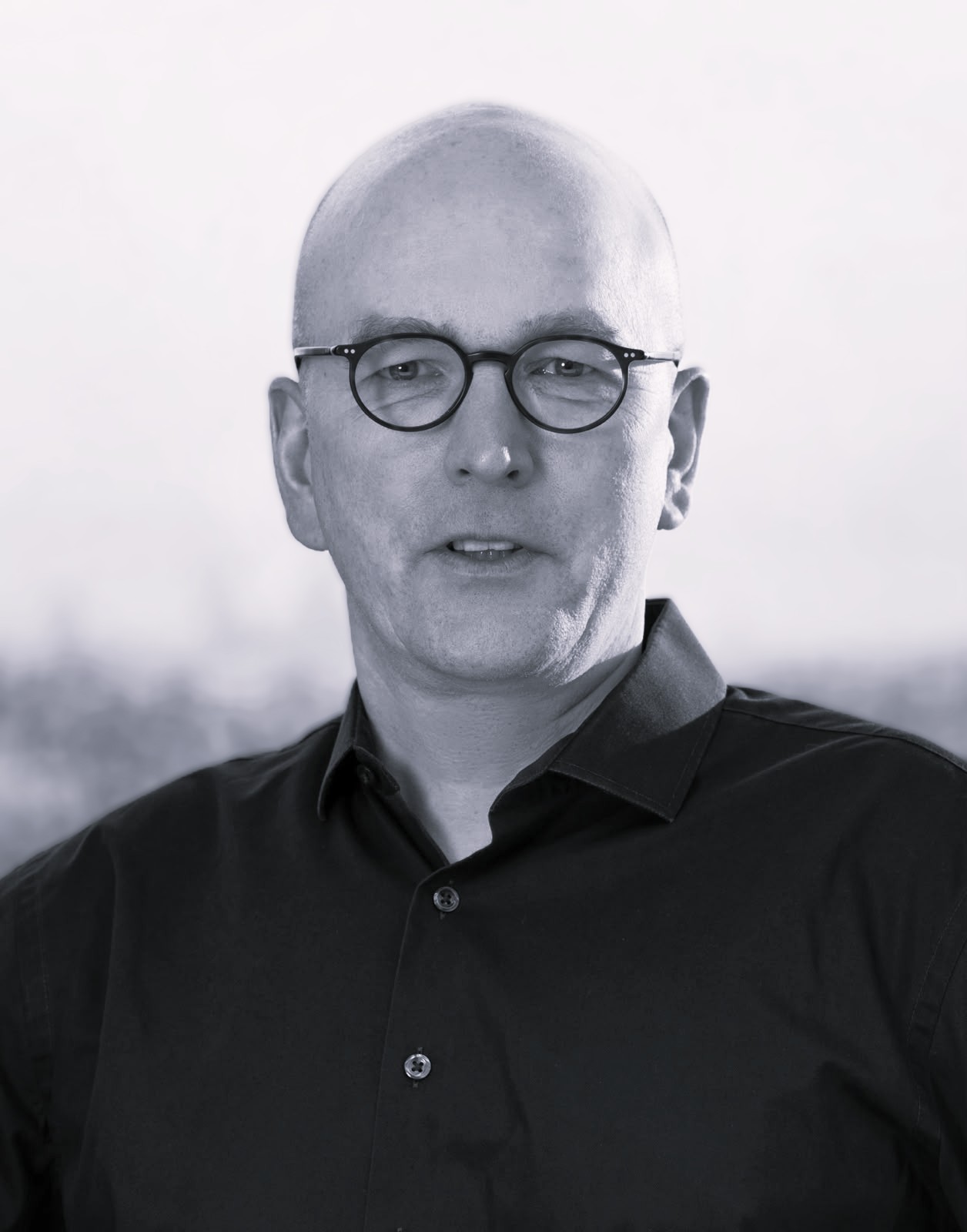
The conversation as it happened, lightly edited for reading. Christian asks, the guest answers.
Christian: I've always thought that life only makes sense if you look backwards. It's a chain of moments. So let us do this game together. I would like you to take me back through your life and start at the beginning, in your childhood. So what was your childhood like? And can you describe a moment that shaped you?
Wolfgang: It wasn't actually a moment. It was, as with everybody, a journey, right? So on the face of things, when I tell my story, it's a very streamlined story. I'm born in Holland. I grew up in London as a son of a diplomatic family.
Christian: So look, you grew up in London. I think that's an interesting childhood. You said your parents were diplomats, so you were only in London or traveling around the world also?
Wolfgang: No, no. My father was with the diplomatic service. He was there as an agricultural attaché, and the agricultural attaché is not fixed with the Foreign Service, but they get seconded for a certain time. So that's why we were in The Hague first, where I was born, and then in London, and then he was sent back to Bonn.
Christian: Okay. I see. So it wasn't continuous traveling around the world. So the next moment, you came back to Germany. At a point you decided to become a medical doctor, scientist, right?
Wolfgang: Yes.
Christian: How did that shape you?
Wolfgang: Well, the question is more how did I get to becoming a medical doctor? I was curious about the world. I had read books by physicists, by biologists who were talking about the next frontiers of what we want to find out. I was an incredibly curious kid.
And I got infected by these books, and it seemed to me, and I could have studied biochemistry or biology or chemistry or physics, any of these. Why did I end up in medicine? Again, you know, hardcore scientists would say medicine is not a science, but somehow it contains elements of all of the above.
And I just took interest in the science of medicine. And that's why I ended in medicine. And then within medicine, no coincidence, probably, I was more interested in the science of medicine than in treating patients, which many people say, you know, why did you go to medical school then if you don't want to treat patients? On the other hand, I think you also need physicians who are interested in the science of medicine. And then this got me into thinking about genetics, which is where I went to the Harvard Medical School and started working on gene therapy, the early days of gene therapy, trying to make dangerous viruses, in this case HIV viruses, into some useful tools, which was fascinating.
Christian: Yes, absolutely. About medicine, did you have a certain idea in which direction you wanted to go? Where did you want to go with that?
Wolfgang: Well, I was really interested in the fundamental scientific questions. And I still am, by the way. This whole discussion today, which we have in the context of AI, what's consciousness. At the time I was thinking about what is life, you know, what actually makes life?
Christian: As a child, as a young adult?
Wolfgang: Young adult, absolutely, adolescent. Those were questions which I was always fascinated about. That led me into the science of medicine.
What actually on the way there almost held me back in clinical medicine was a strong interest, actually, and an inclination to look for critical situations. I don't know where I got this from, but my initial period as a training physician, I spent half a year on an intensive care unit, which was one of the most fascinating times in my entire short medical career and medical school.
That was the only time, I have to tell you, when I seriously thought about staying in clinical medicine, my time in the intensive care unit, because that was high energy. In this time on an intensive care unit you felt how you could really make a difference from moment to moment with patients. And probably it was patience, not in the sense of the patient, but the patience that you have. I was lacking patience. I wanted fast results. I wanted things to move. So that's why intensive care units seemed to be very close to my heart.
But still, I think in the end I was even more fascinated by basic science, which is why I turned away and went to Boston to the Harvard Medical School, where I had a fantastic opportunity to work with a very well known professor who ultimately went on to crystallize the surface proteins of HIV, and as one branch of his work we were working on these HIV-based gene therapy vectors.
Christian: What's the name of this professor?
Wolfgang: He was Joseph Sodroski.
Christian: Right. And is he still alive?
Wolfgang: Oh yes, absolutely. Absolutely. I see him every few years when I'm in Boston. A great guy. And one other thing that he taught me was systematic working.
He had this incredibly systematic approach with which he made, a bit slightly technical, with which he made mutations in the surface proteins of HIV, which are notoriously difficult to crystallize. So nobody was able to do it. But he had this massive industrial approach, which today we would call design of experiments. It's actually a very timely concept, which he did. I don't think the concept of design of experiments was around in that time.
But he put a lot of effort over many years into crystallizing the surface protein, because it was important to get this crystal structure in order to make useful vaccines. And everybody asked him, why are you doing this? Why are you spending all this time? It's never going to work. And he just stayed on it and on it and on it. And in the end he managed to do it. That was an important lesson in perseverance. I admire him for having done that. And I took this learning with me and I've applied it in other situations.
Christian: Why do you think that a systematic approach to ambiguity is necessary? Because I think that's the essence, right? Although you don't know exactly what the experiment will bring, but you have to be systematic about it.
Wolfgang: Well, just having more data to understand the space of where you're working in is always useful. Going back to medical school, I often think of a professor in microbiology who said, and I disagreed with him at that time, just intuitively I thought that has to be wrong. This professor thought doing more lab analyses with patients is useless, because he said all you generate is masses of data and you get lost in them and you don't know what you're looking for.
I think it's completely wrong. The more data you have, the more holistic your picture gets, and you can derive a lot of conclusions from this for whatever it is, your next scientific experiment or the treatment of the patient. I think in the case of this microbiology professor, I don't know what drove him, but there was an intuition that the human intellect has to be on top of everything and you have to be extremely sharp in drawing conclusions from single data points. But in a world where data is ubiquitous, having masses of data points gives you a large shape of a universe that you're looking at, which gives you a much clearer picture in terms of what you're trying to inspect.
And so Joseph Sodroski, he used this principle where other people were doing individual mutations and trying to do this and that. He just said, we need an industrial approach. We need to do a thousand mutations and then look at the entire picture, and this will tell us something. And he was right. He was right.
Christian: So the ICU taught you how to make quick reactions and quick decisions, and now the academic field taught you how to create better outcomes from data.
Wolfgang: Yeah, not badly put. I would somewhat agree, and both were very important in my life so far. Starting with the energy of the intensive care unit and the systematic approach that I learned with Joseph Sodroski. Absolutely.
Christian: Okay, good. What other mentors did you have afterwards?
Wolfgang: I was lucky to have many. My mentor for my medical thesis, she was an incredibly energetic, dedicated person with whom I often had inspirational discussions until three o'clock in the morning in the lab. She was my supervisor, she was always sitting there reading papers, planning experiments. And I got infected, I did the same. And so we met and had these late night discussions, something about how much energy you want to put into what's important to you. Right? It is something that I often think about today in the work environment, how many really dedicated people do I see who put everything into their work.
Interestingly, I believe that if you put everything into your work, your life becomes a lot more interesting. And then there were individual people I met, even for a short time. I actually just two days ago or three days ago I commented on a LinkedIn post where there was a picture of a professor at UCSF at the time, he may still be there. His name is Keith Yamamoto, and he was later the president of the American Academy of Sciences. And when I was a young summer student at UCSF in 1992, probably, I was introduced to him. And he was a fascinating person who spent an hour talking to me about his science, about the stuff that I was reading. And I was really inspired by him.
So this hour of conversation where he passed on a lot of inspiration to me was very important for me. And I commented on the post on LinkedIn the other day. I think about it a lot. And it was important because it taught me the importance to pass on inspiration. I think that's what we're about. We're not individuals. This sounds a bit philosophical, but we are passing entities in the world. And one of the things we have to do is pass on the torch of inspiration. And Keith did this for me.
Christian: Well, so he's very inspirational and very influential, although he probably didn't know it at that time.
Wolfgang: Yes, he probably didn't. But it was just his personality, right? He wasn't sitting there with the torch and saying, here's the torch, I pass it on to you. It was just his personality and it was just one hour. But interestingly, sometimes it's just one hour which has a lasting effect on you.
Christian: Yeah. So you mean that his presence and his identity somewhat shaped you, or was it something that he said?
Wolfgang: No, it was his presence. And of course, it would be unfair to many other positive influences that I've had in my life if I picked him as the single influence. You know, there is my thesis advisor, and Joe Sodroski, I mentioned, who was influential. But it is something that I think about a lot. But it was his presence and the fact that he didn't do it for any benefit. Right. It was his hour. He could have spent it with other things, with his science, with somebody else. But he just said, you know, this is an interesting conversation. He's a young kid. He's enthusiastic. Let's spend the hour with him. It was free. He didn't benefit whatsoever. The only person who benefited was I. And I see it as an idea and a way of thinking that you have to pass on.
Christian: Are you doing it now?
Wolfgang: I try to. I try to. But it's also something that is best not done deliberately and not seen as a chore. Like, I don't have it in my calendar and now I have to inspire somebody. Right. I just try to be hopefully a natural person and to speak to people about what I'm fascinated about. And then sometimes you meet people who are fascinated by the same things, with whom you connect. And then it doesn't feel like work. It's not painful. It's not planned, but it's joyful and it's true. And you just have a great conversation and it passes and people come back to you and say, I enjoyed the conversation, and then, you know, yes, okay, great. This was good.
Christian: You are now the CEO of Leon Nanodrugs and you lead a team. So how do these conversations of inspiration go there?
Wolfgang: Well, first of all, if there's a conversation which inspires people, I consider myself lucky. As I said, I don't plan these things. It's fortunate if they happen. But I won't avoid the moment when I think, hey, here's a good conversation to be had. This is somebody who's interesting, is receptive, and it's always both sides who gain something. Right?
So in terms of the business, let's think less about inspiration, although there is inspiration there, but that's not the main point of the business. That's like a side effect. The main point of the business is the business functions, and there as a CEO of even a small business, it doesn't really matter if you're a CEO of a small or a large business. It's like the physicians' oath, first, do no harm. Right? So first of all, do no harm, but that's by far not enough.
You have to make the organization move. You have to see that all of the parts fit together, that everybody carries their weight, that you install processes that work together that make the whole thing actually chime like an organism. And that's a mechanical thing. But obviously it's also a personality thing and a human thing. So I don't think an organization is a robot where you just fix the screws and everything goes automatically. There's a strong communication element. You have to connect to people. You have to see that people have the right interfaces that they connect to each other. Too much friction between personalities, between functions is not good.
And so I'm actually never sure whether it's more important to have the mechanics of an organization right. Obviously, if you don't have the mechanics right, you have a problem. Or if the personalities and the chemistry have to be right. And the communication, but it's never just one. Communication is probably as important as structure.
Christian: Did you always have that picture of how organizations should work?
Wolfgang: Well, my picture comes from the perspective of the lab or the intensive care unit, and the intensive care unit patients don't talk to you. You just do things and they work or they don't. And so I would certainly have a much more mechanistic picture there. Today I realize that there are certainly more aspects, but those two, almost the yin and yang, the mechanics and the communication, they just have to work together.
Christian: Yes. You mentioned something that I think is very important, the yin and yang, the ambiguity. It's not always black and white, everything has to play together. I think in your past there are a couple of identities or a couple of decisions that you made that only make sense when you look at it backwards. For example, you worked for a long time in a corporate, then you picked a startup, and now it's a scale-up. How does this play together?
Wolfgang: Well, I had the opportunity to do what I'm doing now. And I like the technology. I like the people. And it was an obvious move. There were certain external inducers that made this possible. And looking back at my career, I've spent first six years at Novartis, then 19 years at Fresenius. So technically, I'm a corporate guy. I have started several startup companies on the way. Done others. Things in small organizations on the private side.
But it would be unfair to say that I haven't learned a lot during my time at big corporate. Big corporate has certain mechanisms worked out, typically. That's why there are these big tankers that work more or less smoothly. But in your career, in such a situation, whether it's any corporation, it doesn't matter if it's Novartis, Fresenius, or I could name all the others that I haven't been at, it's always the same. You learn both things, how they should work, and you take them with you. But if you're very observant, you learn as much about how things don't work, right?
Because also in large corporations, they work despite many mistakes being made. And if you take the mistakes that you see, and you try not to repeat them, but you learn from them, that's also great learning. So I tried to take with me both, the positive aspects about how things can work and do work and have to work in order to make large systems function, but also things that you should by all means avoid.
Christian: How was it possible for you to be ambidextrous, like both corporate and startup? You did both?
Wolfgang: Well, for me, it was an emotional necessity, I have to tell you. I had entrepreneurial hobbies, I would call them that. I always said, other people have a garden, they take care of their garden, they have hobbies that consume some time, fine. For me, a lot of my pastime was spent with entrepreneurial activities. And I needed this as a balance.
Christian: Okay. I think you also mentioned one time you worked in a tennis club, right?
Wolfgang: Yeah, I still do. I'm the president of a tennis and hockey club, but without ever having properly played either of the sports, which is kind of funny.
It's a famous club in Frankfurt. In the last 10 years, with great teams and great people who are working with me, we've managed to completely renovate it. We raised 10 million euros in a complex financing situation, invested the 10 million in completely new club grounds and a renovation of the clubhouse. We've tripled membership. And it's doing really well. And it's actually something that I'm really proud of. You know, it's no money involved for me personally, it's just because it was fun.
Christian: When people say teams have to be diverse. But still, I believe, in terms of chemistry, you cannot make compromises.
Wolfgang: If you don't get along with people, it's difficult. What can I say? And diversity. We have people in our organizations, every person we hire seems to be from a different nationality. I love it, you know. We have Romanians and Croatians and Italians and Germans and Albanians and people from all over, Indians and more. And more than half of us are female. And so there's no lack of diversity. Interestingly, it was never a goal of mine. We just pick who we want to work with and who we think has the right energy.
Christian: So let us go into team building. When you hire people and when you try to give them the best inspiration, the best access to your knowledge, what are the patterns that are repeating over and over?
Wolfgang: I talk to people and I try to be myself and to get a feeling for who the other person is and what moves them. You get it, it's a vibration, right? It's like, you know, do you jive in the communication?
Christian: Understanding what moves them is something that I think is extremely important and very underrated. When you understand what a person is moved by, what are you doing with that?
Wolfgang: Then I try to build my mental picture of how this would fit into the organization. And I think systematically around the team and who this would connect with and who it would not connect with. And I try to imagine whether there's a general fit with the organization.
But typically, people, it starts with the right positive energy. In jargon, I hate jargon, they call it attitude, right? So let's use jargon here once, and I'll try not to use jargon anymore, because I really don't like it. Just a positive attitude of wanting to move things.
Christian: Yeah, and that's very important. Yes. Let me understand where Leon is right now, Leon Nanodrugs, and where you want to bring it.
Wolfgang: Leon at the moment is at a very critical intersection, and we've had a huge success just last week, so nice that we speak today. We were in Boston with the whole leadership team of the company and we had a large launch event for our entire suite of products, which is for the manufacturing of lipid nanoparticles. We believe we truly have next generation technology that solves a lot of the problems that today's technology still leaves open. We respect today's technologies, but as with all new technologies, you know, the typewriters were the precursors of today's computers, and there was a first generation polymerase chain reaction, PCR, and now there's advanced, and there was first generation of sequencing and now they're much more advanced. So we bring the next generation of technologies for lipid nanoparticles.
We set the date. We paid the fees for the conference. It was an expensive conference. We traveled over there, booked all the travel, the trips, the hotels. We said we will be there on July 20th. And we did. So this was a huge success. We brought everything to the market. We've spent the last year creating large awareness for our technology in the market. Not everybody knows us yet, but we're reaching a level which is very solid.
And now the next phase of the company, obviously we always need to generate more data. We need to continue improving the products, but the next really, really important part is selling these machines and convincing customers that it's worth investing in our technology. I personally believe that it's the case, but we have to show it.
Christian: Yes. I think you once also told me that the CEO is the most important salesperson.
Wolfgang: Absolutely.
Christian: Or an important salesperson. Why is that?
Wolfgang: I'm not sure if I'm the most important one, but yes, the CEO is the chief sales officer, especially in a company, actually in every company. People always mistake product sales for being the only way of sales. Everybody is a salesperson. Either you sell a product or you sell an investment or you sell an idea or you sell something. So in a way our life always, and I'm sure you can agree with this, our life always consists of selling something, a service.
And if the CEO isn't in the front of selling the service, selling the idea, selling the investment, it's a function you cannot delegate. You can get support, absolutely, and I have two great people in business development, and we have a lot of people who carry the flame of the idea of our product and what it solves in the company. But if I'm not there at the front and being part of everything we're doing, chief sales officer, then I'm not doing my job.
Christian: No, that's good. I like that. You seem someone with a lot of energy who never stops, and you've done already an incredible job in your whole career. Why are you doing what you're doing? What's driving you? What's really driving you?
Wolfgang: It's fascination about the world. The world is so interesting every day, and especially we're now living in a transformative time that everybody's speaking about, which is not part of what we're doing at our company. But there's so much change, hopefully to the positive, but so much development out there. I just wake up fascinated every day. If you think about the world around you, I always think, how can you not be fascinated by what's going on? I can't not be fascinated.
Christian: I watched a speech by Florence Gaub, who is a NATO strategist in Rome, and she said the problem with Germany is that most people in Germany don't think they can influence their future and therefore they are not that optimistic. I guess you're not part of them, of that 75%.
Wolfgang: No, but I see the point. I absolutely see the point. And again, it's something that crosses my mind rather frequently. I think, you know, historically we have a burden to carry in Germany, and we're well advised to be aware of that. But the mistake that we're doing is we are letting this weigh down on us so strongly that we don't dare to want to be part of the front of things that are happening. And I deeply believe that is something that we need to change in the philosophy about how we think about ourselves. We should not forget the lessons that we have to learn from the past, but we have to dare to be part of the future.
Christian: Yeah. What is your future like? What do you think, what should it be like?
Wolfgang: Oh, I hope it carries much more fascination every day, and we'll see. I'll take it as it comes. I'm at a stage where it's probably hard to plan. I don't plan. I'm fortunate that people approach me and say, hey, I think you could be a valuable addition to this and to that. I sit on two boards. I meet fantastic people, they're extremely, extremely interesting. And so I will do whatever seems interesting.
Christian: That's very good. And my last question is, is there another Wolfgang that has never come to life, actually, that you would secretly be able to live in a parallel universe, something like that? A version of you that has never come to life, but you would like to do?
Wolfgang: Well, it's certainly the musician. As many adolescents, I stopped playing the piano when I was in the early 20s. But I always felt rhythm was something important to me, and I enjoy music a lot. I try and play the piano here and there.
Christian: Very good. Well, thank you very much. It was a joy. Great speaking to you. Hopefully we see each other again.
If you think you need to talk to this guest, reach out to me and I am happy to make a connection. Christian Rados, christian@rados-recruiting.com
All episodes and the problem pages