
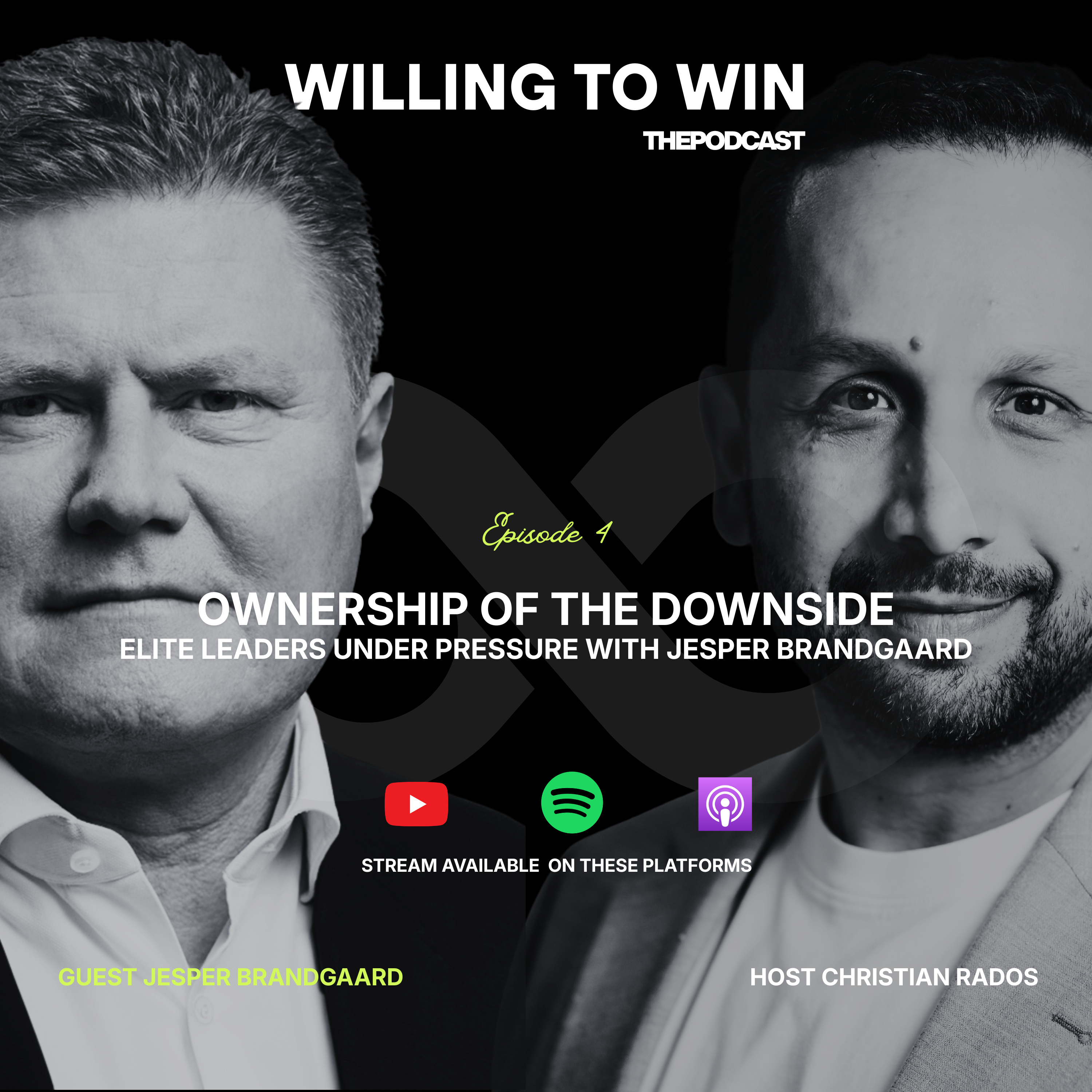
The conversation as it happened, lightly edited for reading. Christian asks, the guest answers.
Christian: Jesper, when you look at yourself today, not at the title, not at the role, but who you are as a person, what kind of leader are you?
Jesper: I'm a more patient leader than I was when I was young. I probably appreciate more having very skillful people around me, and I have become more cognizant of actually having other people doing a significant part of what I need to have done. And in that sense, I've probably matured. And I also really enjoy seeing the people around me grow.
Christian: I like that. How do you make sure that people grow? I mean, growth is a big word, right? But do we follow up on that?
Jesper: Yeah, I believe one of the greatest gifts you can have as a leader is to have people around you grow and get into new positions through the fact that they have actually worked for you in a role. One of my prime roles in my career was being CFO for Novo Nordisk for 18 years. And today, I see more than a handful of CFOs in listed Danish companies who've actually grown up in the Novo Nordisk finance organization and went on to find careers in other companies. And I find that quite rewarding for me as an individual, to see that people have learned something being in my part of the organization and have utilized that.
It gives you a fantastic network. And it gives you a huge number of people that you can call, and they will always be willing to help you and give you good advice or tell you who to contact, etc. So knowing people and having a strong network, a network of people that you've had a substantial influence on their career, I think that's very rewarding.
Christian: Curious. Tell me about the last time you called somebody.
Jesper: I think the last time I can recall calling one of my former employees was in a situation where there has been a significant layoff in Novo Nordisk, about 9,000 people have been laid off, 5,000 in Denmark. And one of them had asked for my advice, and I needed a contact at a certain company. And hence, I could easily call the CFO and say, "I have this very qualified friend from ex-Novo Nordisk who would like to see what opportunities there are in your company. Could you help me create that link?" And it was just very easy for me to connect. So I helped another friend, and it's a personal friend, his son and my son have been playing soccer together, so I was pleased to help him.
Christian: Very nice. What is one belief you never compromised on throughout your career?
Jesper: I would hope that most people would say that my ethical rules are pretty strong in terms of how I work, how I find reasonable solutions. I would argue that I haven't. And I think that people who have compromised on ethics or have been seen as compromising values, I think I've learned that in Novo Nordisk, a very value-driven company.
I see it as a big help when you have to take decisions that you have a moral discipline, a moral foundation to stand on, on which to take decisions. But I guess it's my moral, so whether others would anticipate them or view them the same way, that's probably maybe a question.
Christian: Yes, it is. I mean, if you have three people, you have four opinions, right?
Jesper: Yeah, exactly.
Christian: I think value-driven is the most important part that you can have as a leader, but you also have to be flexible in certain situations. Can you tell me about this trade-off of values and immediate needs? Because sometimes, I know it from my personal environment, we always hope to jeopardize our values in order to fulfill our immediate needs. There's always a conflict between needs and values.
Jesper: Yeah, I think in that instance I would err on the side of being pragmatic instead of being dogmatic. And if you stand very, very firm on certain values, it sometimes will guide you into a situation where you can't create win-win solutions. And I think often when you're dealing with people, you also have to find solutions. Solutions which are not only according to your own values, but also try to find common ground between the values of the person you're sitting in front of and what you could still fit in with your skeleton of values.
I think I would view myself as a pragmatic person. And with that, not saying that I walk away from my principles every second, but just basically try to find solutions together with other people that make people not feel that they significantly lost face in being encountered with me.
I had a significant learning. I had three years early in my career in Singapore, being a board member in a portfolio of Southeast Asian companies. And I really learned there the importance of not letting individuals lose face and finding ways to work with that. I think I've actually benefited from that later in my career in terms of developing a bit more emotional IQ than what I would otherwise have had, being quite a result-focused individual.
Christian: It seems like a pivotal moment, a leadership lesson.
Jesper: I think I have had a couple of incidents in my career. One, of course, in situations where business fortunes weren't as expected and I had to send out a profit warning. That is a very difficult moment for a proud CFO, how to deal with that.
But I think I've come through that very much with the view of saying, this is a fantastic learning opportunity. What can we do going forward that will ensure that we do not land in this situation, and how can we do things better? And I later made a drive within Novo Nordisk that was basically learning from mistakes, which was the drive of introducing quality discipline in the whole area of finance, legal, et cetera.
And I've learned that mistakes happen. And I often say that it's only people that don't do anything that don't make mistakes. So mistakes happen. But as long as you don't repeat them and as long as you take the opportunity of learning from them, then it's actually good. So I found a way to take this very difficult situation and, over time, use the learning from it to create a better operating activity that I was responsible for.
Christian: Yes. You mentioned now two points. One very difficult moment where you had to communicate a profit warning, and the other one is...
Jesper: Disappointment to our investors, the people I was responsible for serving.
Christian: Yes. The other thing is how you implemented the learning in your future self. But first, how did you feel in the moment you realized the numbers won't be good enough?
Jesper: Of course, there was an element of being disappointed with myself that I didn't see the signals coming. But when I then analyzed it more, it turned out, for my recollection, to be a combination of four or five things happening at the same point of time. And it was the cumulative effect of that that basically did not enable us to live up to the expectations we had. So it was not so that I was very hard on myself, but I basically learned from the individual events, saying, how can we do that better?
So I felt disappointed to some degree, but I also felt that, well, the way you should get out of this is to be clear and transparent about what the factors were that led to this and be very open in communicating about it. And in addition, following up in subsequent quarters on those exact events that led to that effect, how are they standing today? And I think that is a way of regaining the confidence of your, in this case, investors.
Christian: And also confidence in your decision-making and in the signal detection in the future, right?
Jesper: If I may add one thing here, what also followed was that we introduced, back in the early 2000s, a quite comprehensive risk management system that basically enabled the organization to report into a central function that overlooked all of the major risks. And that turned out to be quite useful. So it provided, again, an opportunity to do things better in a smarter way. And I think that later became a general standard of reporting and management systems within large organizations.
Christian: I think that's a masterpiece of leadership. You didn't take it personal and try to hide it. You took massive action and changed it into a better outcome for the future.
Jesper: I think that's somewhat right. I do also actually see it as one of my skills as a leader that I'm actually willing to accept responsibility also for things that sometimes go wrong. And in reality, as a leader, that will make the people that work for you more comfortable working for you, because they know that if something goes wrong, I will shoulder that this went wrong. My gut instinct is not to turn against my individual employees and criticize them and distance myself from the thought, but basically accept responsibility for my team and say, "We did this mistake, we will learn from this, and we will use it to become better."
Christian: Yes, very good. I think it's very, very important as a leader that you are willing to accept that mistakes happen, and that you are to blame for some of those mistakes. We should all talk more about that vulnerability and that openness. But another question. You've held 29 board roles, 17 as a chair. Why isn't it boring?
Jesper: Well, I think first, why did it happen to me? Well, I think the way it works is that generally responsibility ends with the one that takes responsibility. So I think quite early in my career I was seen as one that basically took responsibility for different difficult situations and found a way to make them be handled and solve them. And if you take that approach to the challenges that you face in your life, you're very likely to be given more responsibility for different roles. And I think that's how it's worked out most of my career, that I've continuously been entrusted with more responsibility, not necessarily because I've been looking for it, but because that's what happened. When you solve people's problem, they would want you to solve other problems for them.
Christian: I think that's true. Very good. I think it also gives you the opportunity to have a bit of versatility and a bit of challenge also to grow.
Jesper: Yeah, I think the board roles I've had has certainly helped me leverage my skill of understanding more than one industry. So I would pride myself on not having solely a good understanding of the pharmaceutical industry, but I've actually been involved in a number of other industries, both a software activity, I think it was the eighth, at the point in time, the eighth largest software house in Europe called SimCorp, an asset management system that was sold internationally. I was also chairing a company that was selling engineering services, mainly in Europe. So I've been entrusted with overseeing different businesses in different industries. And I think through especially my MBA, I've learned to basically have a relatively quick grasp of the value chain in different industries. And I find that intellectually stimulating.
And I still today in my portfolio sit on an advisory board in a smaller Danish venture fund that invests in all kinds of activities, mainly industrial business to business, but also a quite significant part of that is applications, IT, software, et cetera, and services, which I've been involved in. And I find that stimulating to assist with. Is it a good idea to invest in this company or is it not a good idea? And make a quick analysis based on a 10-page memo on the specific company and apply that skill in understanding various businesses. I think that has been very useful throughout my career. Also in the senior executive roles I have in pharma, because you will have suppliers, and having an understanding of how the value chain is and how the business stream is for your suppliers, which is a different business than yours, I think that has helped me in multiple situations reach better solutions with our suppliers.
Christian: That's interesting. So it is a source for your creativity and innovation somehow, if you try to dive into other business models, into other industries.
Jesper: Yeah, I find that inspirational. And I've throughout my career with Novo Nordisk tried to work with partners in a way where I generally like that we typically had one or two very good partners in various areas and not a handful, because the only way to create a really good solution is to create a business model where both are actually making a reasonable living out of the relationship in a transparent way. And I've used that in Novo Nordisk to have lengthy and good relationships with trusted partners.
And I've also significantly been using it in LEO, where we have totally restructured the business model of LEO Pharma over the last four and a half years and still very much draw on this learning that it's not all about a cutthroat price negotiation at each point in time for each deliverable, but it's rather having transparent, good relations with partners you trust. And where the partners also know that if they continue to deliver on what you had agreed, there's very likely to be additional business coming down the line. And that's creating this win-win atmosphere with your partners that you should generally pursue.
Christian: And you came from consulting. Very soon you came into positions of big responsibility as a CFO. And you also led the Novo Nordisk Hemophilia Foundation. Can you tell me something about that time?
Jesper: It actually occurred at a quite fortunate point in time for me to take on the role of becoming chair, because it happened at a point in time when Novo Nordisk was going through some financial distress around 2016-17. And which meant that there were limitations to the donations that Novo Nordisk could do to the Hemophilia Foundation. The Hemophilia Foundation was based in Switzerland, and that's a very costly place to operate out of. But that was where the biopharm business, the hemophilia activities of Novo Nordisk, was headquartered out of. So that was why the foundation was also in Switzerland.
And I basically had to go in and look at the operation, saying, okay, we are currently spending more than 50%, actually significantly more than 50% of our revenue on administering the funds we are giving away. And only having a fraction of the money that was donated every year to actually go to projects involving hemophilia patients in the low income countries of the world. So it was basically a clear situation where the foundation was not effective in creating bang for the buck in actually supporting the projects, because our setup was too expensive. So I worked closely together with a very competent managing director of the foundation, and we created a new setup, much more relying on people being out where the projects were, be it in South America, be it in Africa, and that you could actually have good competent resources there at a fraction of the cost. We made very, very clear ambitions for how we could reduce our operating costs. And then through that, ensure that we could give more directly to help hemophilia boys with poor treatment. Helping them with better treatment setups around the world.
It was very rewarding, and at first, they were a bit frightened in the organization of what I was up to, but in reality, I think they quickly learned that what we were trying to do is basically be able to do more with what we had. And over time, we were also quite successful in getting additional contributors to this hemophilia foundation and thereby multiplying the effect we had on hemophilia treatment in low cost countries. So I think it was quite rewarding, and it was an interesting time for me to work with key opinion leaders in the hemophilia industry. So very, very clever physicians that were actually doing the treatment with patients in Brazil, in US and in Africa, et cetera.
It was an interesting experience and a completely different area. I had not been responsible for a foundation ever before, and even though it's not a for-profit business, I think you can learn a lot from finding out how we could run this activity in a way that we deliver more, and here the wish was from the ones who donated money to us that we generated a significant difference for patients in countries where it was not easy to get high quality hemophilia treatment.
Christian: You cared about the cost, but you also cared about the efficiency. Most of the nonprofits have difficulties in creating higher efficiency. How would you understand creating higher efficiency in nonprofits right now?
Jesper: I was involved there from something like 2017 to 22. And I think my learning really was that it was all about creating clear measures for how much value we can give out. How successful do the partners that we work with rate our projects? And the only way to get additional funding so you could do more was to be extremely transparent on the effect of the money they gave every year and what value we brought back to them, and how we could show that we were becoming more efficient year by year. And that of course involves, as I mentioned, just one thing, where we located the people responsible for projects, how we handle administration. Did we do that onshore or did we do that offshore? So all the principles you use in running a normal business, you can also apply. A lot of the mechanisms you have for lowering your cost base, you can use in a foundation as well, and then make it transparent to the ones that donate what effect, what bang are they getting for their bucks.
So to me, it's a little bit like explaining to a board or a CEO, are we doing okay with finance in our corporation? And of course, one ratio there is what percentage of sales do we use on doing finance for the whole organization? I introduced that number quite quickly in my career as CFO, and it's standard today, but it wasn't at that point in time. It was quite cumbersome to get together all the numbers, all the costs for all the individuals in a global corporation. What is our annual cost for running it, and how is it relative to turnover, and basically documenting that we were becoming ever more efficient year by year. And it's exactly the same thinking I applied then to a foundation. How can we document that for each Swiss franc, we were actually doing that at a lower administrative cost every year, and the ones donating understand that and appreciate it.
Christian: Let us look at your motivation. What I understand is that curiosity always drove you and will be driving you to some degree.
Jesper: To some degree, it's also driven by an element of fixing things. So let me use LEO Pharma as an example. When I came here, something was clearly not working. The sales had been flat for five years. The company was making a very, very significant loss, a negative operating margin in the area of 20%. So for each hundred kroner of sales, we realized we were making a loss of 20 kroner. That's not a sustainable situation. And it's a situation that very quickly will drive a company into bankruptcy. So it won't work. So basically I have also a dedication to fix problems. And I think what challenged me in LEO was finding a solution to that problem. I think we've come a very long way to solve that problem. And I think that's very motivating.
There was also this special situation about LEO that the founder of LEO Pharma was actually, he was a pharmacist called August Kongsted. He was the first to provide finance for the start of Novo Nordisk in Nordic Insulin Lab, where he provided the finance to the two key persons, the local lawyer August Krogh and a Danish physician called Hagedorn. So he provided them with the money. So basically what you could say I was doing, as an experienced Novo Nordisk officer, was going out and fixing the old company. And I think that's a very, very important part of the founder of the first company in Novo Nordisk, Nordic Insulin Lab. And that's to me, we owed that to our founder's business.
And I think we're very close to being able to say that that problem has now been fixed. The way that we can really document it is that if we are successful within the next year or so in listing LEO Pharma, then it's clear that we have a viable going concern with the broad international investor base that can live for many years forward.
Christian: Talk about the founder. You talked about the founder of LEO Pharma. He left a legacy, he left some values. Of course this is too far away, but maybe there are also other people who are closer to you right now who are influencers to you?
Jesper: Absolutely. The way I look at it and the way I've dealt with that in my career is basically recognizing that if you interview people with leadership responsibility, they would typically, if you ask them how many people have had a profound impact on your career, they would probably be saying somewhere, I guess, between two to five people having had a substantial impact on your career. And I've actually utilized that myself in setting up ambitions for individual development plans and how you coach and develop your leaders inside your organization, with the ambition that the one who has been entrusted with a portfolio of people reporting to them becomes one of those five, so they will make a profound impact on the people they're responsible for. It's always been a driving factor for me that I really try to make a substantial impact on the people that I've been entrusted with.
I myself made that analysis and also came up with some four or five people that I had the pleasure, sometimes it was not a full pleasure, sometimes I had the learning experience of working with them. And actually, what I found is that some of them, I would say I've learned a lot from, and some people in my early days of Novo Nordisk. So my CEO of Novo Nordisk through more than five years, his morals and values were really remarkable. And you could only admire the way he dealt with values. So he was a big inspiration.
The former CFO that entrusted me with the role of CFO of Novo Nordisk, Kurt Anker, was also a financial genius. But he was also, in terms of setting some standards, he was good. He said, if there was one thing he hated, it was surprises. And I actually entrusted that and built that into a value that we would have no surprises. So you learn, sometimes you are lucky to have some fantastic leaders and you learn from them.
I also had an early boss in Arthur Andersen, where I wouldn't say all of his values were right, but he was very clever. But through that, you also learn some things you didn't want to copy deliberately, by seeing some ways of operating which were not treating people with respect. So I think you will have people that are influencing you and you take a lot of good things, but you also take some things that you want to do differently. And that's also an opportunity, but they have been important for my career. So I think I was probably having four individuals, I could say, which had a significant impact on my career.
Christian: Do they know it?
Jesper: I think most of them know it. It's not so that I've sat down, you know, I made this list, now you should hear. I haven't done that, but I think it's a good reflection that each leader in the biotech pharma space should do, is sit down and think a little bit about who has had a significant impact on where I am today. And what is it that I've learned from them? And what is it that I can take from them that I can utilize in my building of the people that I'm now entrusted with overseeing?
Christian: I think this is a very good advice. Send out postcards, maybe also to the four leaders. And say, hey, thank you. You made a difference here. Did you ever have an uncertain moment where you didn't know what to do?
Jesper: I think one of the blessings of being a good leader is having the ability to be uncertain and reflect on things. And I think I've often been in a situation where I was not certain about what was the right decision. And there's quite a few times where I've kicked the can a little bit down the road when it was not apparent to me what was the right decision to take. So you have to have uncertainty. Actually embrace it, because there will be situations which are difficult. And if it was simple and easy, it would have been solved. So often things are not that simple and easy.
And then I think I have a pretty good ability to say, what is it that I need to fix now? And what is it that I can defer to come up with a solution later when it's more apparent what that decision should be, and what things can we do in between that would make it simpler for us to take the decision next week or in a month's time or whatever. So I think I'm more inclined to understanding what is required to decide now, because very often, I think people leaders will feel that people come to you and they want the decision now because their life would be much easier if you just made a very clear decision now. But it's not always smart to make a decision now. Sometimes it's smart to await, but making it clear what the process is going to be for reaching a decision. You should be decisive as a leader, but you should only be decisive to the degree that it's needed. And you should accept that there are elements that are uncertain.
So that's one part of the answer. The other part of the answer is, as a leader, I'm pretty good at dividing, whenever there's something that's super complex, dividing it into individual components, and then fix one problem at a time. And very often, when you have good people around you that can help you fix one problem at a time, clarity will emerge over time.
Christian: You know, decompose problems into more manageable things and deal with them early on. From your, you demand clarity also in your interactions with your colleagues, with your...
Jesper: Yeah. And then I demand, and I'm very clear on demanding, "What I need you to find out is this and this and this, and I need you to get back to me by this and this," because through that, we can then find a solution in a week's time where we can take the right decision for the company if we have all these inputs coming into the situation. And I'm also accepting that in most situations, as a leader, you probably only have 80% of the perfect knowledge, and accept that. I'm entrusted by the owners of the business that I've been responsible for. I'm entrusted of making meaningful business decisions, not based on perfect information. And I think my owners know that I don't have perfect information, but if I can justify why we make the decision and we have a reasonable basis, then they expect me to take decisions, because not taking decisions is also a problem.
Christian: Let me understand your inner conversation that you have with yourself in those moments where you recognize or notice, well, I have absolutely imperfect information, maybe 50%, 40% certainty. What do you tell yourself at that moment?
Jesper: Well, the first thing I should do is basically say, if it was my money, would I embark on this project at this point in time? Because I think very much in the model of saying, who's the principal, who's the agent, what is my role? Am I here the agent for the principal, the owner of the business? And hence I take the decision that way. Would I do it if it was my money? That's a standard I very often apply. But as we just discussed, I think the rational choice in that situation, if having only 50% information, I would probably say, well, I don't think the principal, the owner of the business, would pay me to go into a casino and choose to play either red or black. So I wouldn't do it.
Christian: So that means you would rather make more research in order to have more information based on this example.
Jesper: I would accept that I would miss the opportunity unless you told me, well yes, but if you play on one color and if that color comes out on the roulette you get five times the money back, and if you play on the other color and that color comes out you lose the one coin you've thrown in, well then you and I would both agree that if I played two times I would probably make money. So again, it comes down to, is the knowledge good enough to accept the 50-50 risk? Yeah. But generally speaking, I would say then I would defer, because I don't think the principal would entrust me on going to a casino.
Christian: And so it all comes back to rationality and statistics. I think this is an important part in those situations.
Jesper: If I just may add one thing, Christian, I think there was the founder of the Danish shipping conglomerate, he actually once said something like, well, if somebody is presenting you with a business opportunity and they are not able to explain it to you on the flip side of an envelope, then it's probably not something you should pursue. And I actually have applied that logic a lot of times. I think that the best business decisions you take are some that are very easy to understand and explain to others.
Christian: I mean, in your example, it's of course about spending money or investing in a business, right?
Jesper: In the pharma industry, it's very often looking at, should I acquire this product or shouldn't we acquire this product? That's a lot to do with the pharma industry. So I think they should think of that when they are discussing with big pharma. In terms of projects they want to sell, it should be clear why it's a good idea.
Christian: Talking about big pharma, what can smaller biotech companies learn from big pharma or from bigger biotech companies? It's funny, because usually you hear the question the other way around, right? But I want to hear what the bigger companies do better.
Jesper: I think the world is moving away from fully integrated pharma companies. I think the fully integrated pharma companies was based on a logic that they could more efficiently do all parts of the value chain. They could do all parts of the supporting functions to the main value stream. That was the way to operate. I think that model is gradually falling apart. I've seen it here in the restructuring of LEO, a company with some 5,700 people when I came. Today, we are just over 4,000. And a lot of the things that we used to do ourselves is now done by our partners.
And I think this thing about learning where can you work with partners and what do you have to do yourself, I think big pharma and midsize pharma is more and more learning to work and operate more lean and work in partnership with others. And I think you could say small biotechs have learned that all along, because they basically always have been restrained, or typically have been restrained, on cash and have to find ways without building this full capability of certain elements themselves in terms of production, in terms of running clinical trials, etc. They have found ways to work with partners, contract manufacturers, contract development organizations, etc.
So to answer that question, I don't think there's so much that biotech can learn from big pharma. I think the partnership mindset that is being applied more and more in large pharma, I think small biotechs have learned that all along the way. Maybe what we talked about earlier, this long-term partnership thinking of saying, choosing one or two core partners and then work with them along the way and allow their partners to grow with the company and also have some of the significant value that emerges as biotech becomes successful. I think they can learn to think a little bit longer, and not just how do we afford to get to the next milestone, which is probably often the challenge in biotechs.
Christian: And you also spoke about the future of biotech pharma relationships. Before we come to the last question, what do you think is most essential in the next decade in the partnerships between biotech and pharma? What is a trend for you and where should the industry go in an optimistic way?
Jesper: Well, I think first, in the macro picture, I more and more see that the innovation in the pharma industry, in terms of what turns into better solutions for patients or products, I see that more and more being invested. Not in a fully integrated pharma company. It's more and more occurring with biotechs. I think part of the problems you had in the collaboration between biotechs and pharma was that historically big pharma cos both had their internal development projects, own inventions, and then the biotechs, and then they were driving both forward. And generally speaking, I don't think big pharma cos was very good in keeping the biotechs fully integrated. I think part of the problem was that biotechs were very informed and working as partners on the development of the biotech products once they moved one or two phases forward.
I think that will change significantly as the business model more and more moves towards probably the big pharma cos are good in developing products and having them registered and approved and launched globally. But the biotechs are a better place to host early innovation. But I think the ones who are going to emerge successfully are the ones that create true partnerships between the biotech company and the large or mid-sized pharmaceutical company, if they partner up with LEO, working hand in hand, a relationship where they are true partners, not only in terms of the financial model of milestones and royalties, but also actually knowledge transfer between the two organizations and participation in the development of the biotech company.
So you basically accept as a larger company that you will grow your partner. And that's why I think the ones who are better able to convince biotech companies to say, come work with us because we are going to be true partners, I believe those companies will be more successful. And it's actually, I think, one of the decisions we've taken in LEO Pharma, one of saying, we don't believe in doing target discovery ourselves. We don't believe we're the best to do that. But we do believe in working very close with biotech companies on making decisions. And we do believe that we have the ability of taking their products globally in a fast and efficient way and pursue them commercially. And that's why they should come along with the journey.
And if that journey involves that they take certain roles along the way, we should only be happy, because in a successful product, there's plenty of profits to share and there's plenty of learning to share. And you should, again, think a little bit win-win, because if you are successful, there should basically be a learning exercise for both of us.
Christian: This is a very optimistic and energetic shout-out to biotech companies aspiring to partner with LEO and other mid-sized companies, right? My last question before we close this, is there a book that you can recommend?
Jesper: I would actually refer to one I read very early in my career, which was, I think it was an American guy who was running a sports entertainment management company. And he wrote a book, What They Don't Teach You at Harvard Business School, or something like that, I think was the name of it. And that was all about being street smart.
And I actually do think there is a meaningful approach in thinking about, don't necessarily always go by the book. Invest in learning people, invest in being with people. A principle I've often applied in hiring people would be, do I feel like I would like to stand at a bar and drink a beer with this individual? Would that be a good experience? Because I do feel making those, what I would call street smart solutions, actually turns out to be a good idea very often in business. It's pretty simple, but I think it's making street smart solutions often work.
If you think you need to talk to this guest, reach out to me and I am happy to make a connection. Christian Rados, christian@rados-recruiting.com
All episodes and the problem pages