
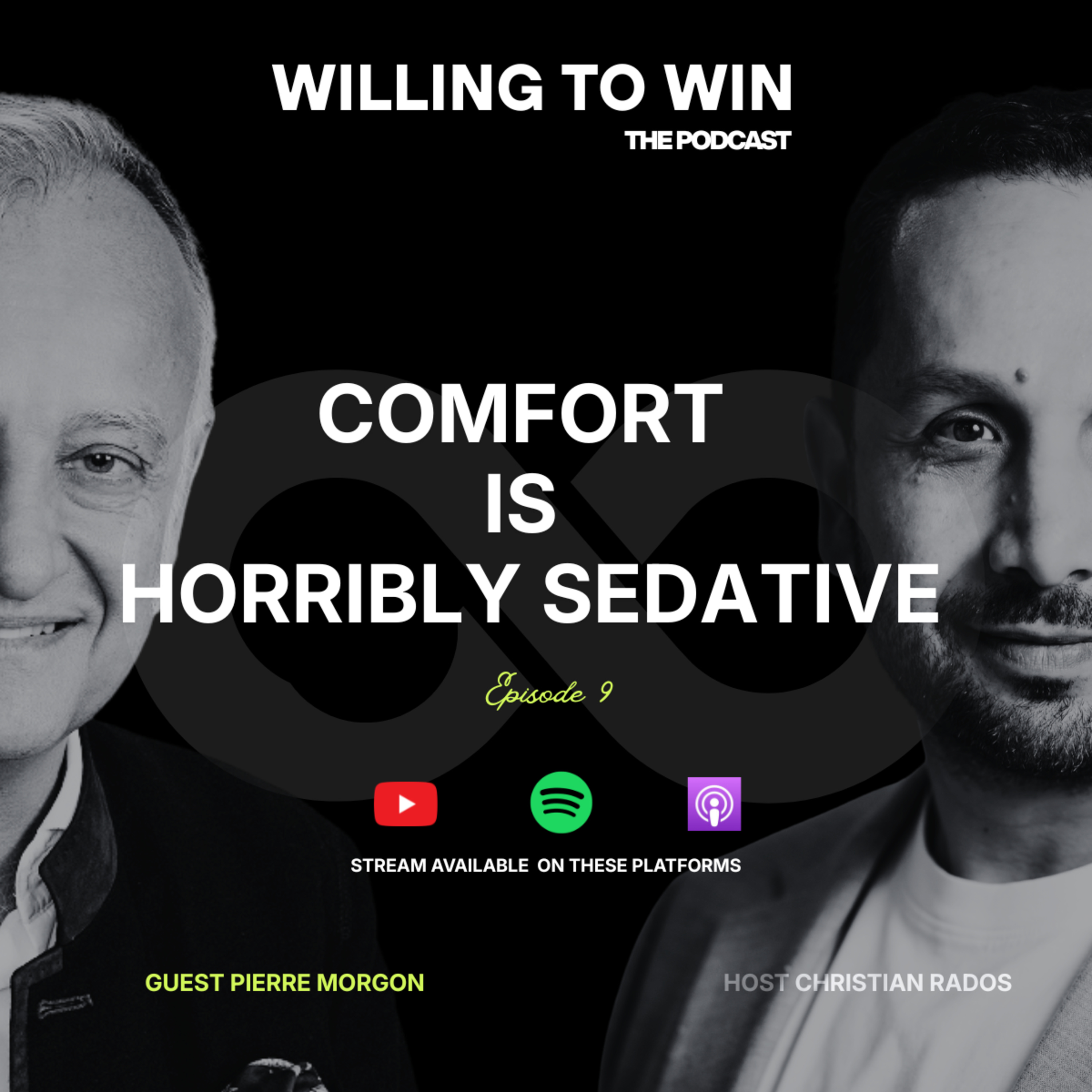
The conversation as it happened, lightly edited for reading. Christian asks, the guest answers.
Christian: Look, before we start, one question. Last time you told me that your superpower is curiosity. And I'm wondering, what's the last time when you were curious about something and you had to learn it?
Pierre: I don't know if it's a superpower, but it certainly is a driver for me. And it goes back to when I was a child, and I would try to spy through the keyholes in the doors when the doors were locked, which was driving my grandmothers absolutely crazy. I think it's such a personal thing. It's about how you feed your brain. It's about how you stimulate your neurons. And to me, it really is this search for the little things that are tastier, that give this little feeling in the brain that you would get with spicy food, for instance, on the tongue.
So I think there's nothing in particular that I would recommend other than encouraging everyone to search for precisely what is the right amount of spiciness that drives your brain in a higher gear.
Christian: Very good. Thank you. Maybe this reminds me of food right now. And this Christmas, I made a turkey, and I tried something new, salting it before. So I looked up a lot of videos on how to do it properly. So this was my curiosity.
Pierre: Very good. Very good. And was it good? Was it better this year?
Christian: It was better, actually. It was not that dry. You have to braise it.
Pierre: There you go. There you go.
Christian: You go into your rabbit hole and do things differently. You've seen it all in the biotech industry, all different roles from A to Z, operator, investor, founder, board member, and so on. How tough is it really right now for biotech leaders?
Pierre: Well, the times are extremely difficult because of the change of the general economic conditions and financing conditions. We moved from over 10 years of negative interest rates, 2010 to 2020, moving into the pandemic. So capital was actually flowing very easily before that. Before 2020.
And since then, we had the war in Ukraine, we got instability in the Middle East, you've got the energy crisis, you've got inflation picking up, and all of a sudden you have alternatives to investing in venture. And so there's less capital going to venture funds. And the second thing is also the generalist investors who had their fingers burned with the deflation of the biotech bubble. They've been burned. And so they're not coming back easily. So all of this is contributing to very tense financing times.
The IPO window is still pretty closed. And yes, there is some M&A activity. So there's still the ability to return some cash to the LPs, but not in the same proportions as before. And you do have a few big transactions that hide the fact that there are fewer of the mid to small size transactions. And all of this is contributing to a context where capital is harder to get. And therefore, very, very tense times for the companies, for the founders, for the management teams and for the board.
Christian: You've been into 20 board seats. You counted it.
Pierre: Yeah. Well, close to 20, actually. As an independent director, yes.
Christian: And you lived through IPOs and all the cycles. You were founder, co-founder. Why are you still in the game? What's driving you?
Pierre: Well, I guess I probably need more pain or still have enough energy or any combination thereof. No, no. I guess I'm still motivated by the intellectual curiosity. I get to meet fantastic people who have this inner flame. They want to make a difference in the lives of patients. So they believe in their technology. And in some cases, rightly so. I get to see fantastic new technologies. Some of them fly only on PowerPoint. Some actually deliver something, a real medical service. And so I think I'm attracted by this medical innovation.
I come from a medical background and my two parents were medical doctors. I've always been hearing stories about taking care of patients. This is how I started my career, working in a hospital. And also you work with fantastic people with this energy, willingness to make a difference. And that's awesome.
Christian: Yes. I mean, you certainly also have bad days. What do you remind yourself on when you have, let's say, maybe you have a day you don't want to wake up, you want to stay in bed. What do you remind yourself on? What gets you out of bed?
Pierre: Well, I don't know, maybe I have this sense of accountability and when things have to be done, they have to be done. And that's, to me, a powerful driver to get out of my bed in the morning. I've never been afraid of all sorts of things. But I've never been afraid also of dealing with crisis because you do have, at times, situations that go completely out of control and deserve or require a lot of attention, maybe more time, more energy, and at times a pretty surgical approach to taming the beast.
And so, so far I've never had any. But I must confess that ever since I've been a student, I've been a short sleeper. Most people need seven, eight hours or more per night. I typically live between five and six hours. And it used to be less than that. So that has always been a competitive advantage. Even at my age, it's still the case. Although again, as I said, now I need a bit more sleep than I used to need a few decades ago. But it still makes a difference. Give yourself two extra or three extra hours of thinking time per day. That's fantastic.
Christian: Probably then one of those rare birds. What I understand now, one of my last curious drives, going to rabbit hole, learning about the importance of sleep. It says seven, eight hours to get into REM phase, but probably you are one of the rare birds who don't need that.
Pierre: Well, if my recollection is correct, in principle most humans have sleep cycles of about 90 minutes, an hour and a half, and in all sleep cycles you go through all the stages, to deep sleep stages three and four, and you have a bit of rapid eye movement, REM sleep, which is when you dream. And you can say that you got more physically restorative sleep, the deep sleep, in the beginning of the night, and more mental, intellectually consolidating sleep, which is the REM sleep, at the end of the night. But if you do have a stable sleep, you don't wake up in between sleep cycles, you have a very restorative sleep.
Christian: Very good. Let me ask you about your career. You left large, stable organizations. It was comfortable, right? But when did comfort stop being enough?
Pierre: Yeah, you're right. Comfort is horribly sedative. It's the story of the frog in the slowly boiling water, isn't it? You get used to it until one day, at least I realized that even though I think I was really good at it, I was dissatisfied with the heavy, the cumbersome processes, especially in a very regulated industry like the life science industry. By definition you would assume that there are a lot of internal checks and balances and controls, and therefore the whole system is actually moving at a slower pace. Either way, companies are like mammals, right? The bigger the mammal, the slower the metabolic cycles, the longer the pregnancy, the slower the breathing rate, the slower the heart rate. And that becomes at times painful.
And probably not the only one. There's a point in time when you decide, this is it. I've had my share. I've done it. I've learned a lot of interesting things, useful things. You learn processes, you learn methodologies, you come out of this experience with a toolbox which is extremely useful. But if you feel that you need a space where there's a shorter distance between the brain and the hands, you go to a smaller organization where you're closer to the action. Where of course you need to impose on yourself your own controls, because you do not have all of a sudden all the safety nets and triple, quadruple signature on everything. But at least you feel a lot more alive. And at least I felt that I was wasting less intellectual energy in feeding the system and more into thinking about how to create some value with the assets or the best way to move forward. And also maybe wasting less of the shareholders' money.
Christian: Talking about frustration, waste, creating waste, avoiding waste.
Pierre: Dealing with the waste, oh yes. I remember, I will not name the company, moving into a committee meeting and discovering that the only purpose of that committee meeting was to prepare the agenda of the next committee meeting.
Christian: But when you're part of the system, isn't that normal? Something has to change in your mind, right? You stepped out of yourself and say, hey, what am I doing here?
Pierre: Exactly, what am I doing here? Or is it a good use of my time? Moving to committee meetings and there are 20 people around the table. Less than half of them are genuinely interested in the subject. And another half of that half, meaning a quarter, are actually genuinely knowledgeable about the subject. And all the others are there like decoration objects. And they feel so useful that they're on their laptops doing their email. What's the point? What's the big idea? Either you're in the meeting, you contribute, or you're not.
And you see, this is a kind of luxury of letting time elapse without feeling the need to reach any meaningful conclusion that the small companies do not have. Because any slippage, any delay means an extra week, month, whatever, of base burn, which takes them closer to the end of the runway and therefore makes their lives harder. So in a way, I think to me I was disappointed by the disappearance of the sense of urgency.
Christian: Did you immediately get out of big pharma, or did it take more time to realize, or to stack up the negative emotions about it?
Pierre: Well, I think I'm probably not so clever, because it took me a bit of time to figure out that I would be better elsewhere. And I did try, but the first attempt was actually not a successful one. And I was glad actually to land back into a big pharma position. I remember having this conversation with the headhunter telling me, Pierre, I understand why you would want to do this, but it's risky for you. You should hedge your bets and have a couple of irons in the fire of the type, things that are already on your resume and that you can claim you will do well. And it was a good advice.
But I think eventually, when you reach the conclusion that something is broken in there, you've lost the appetite to be a corporate beast, then it's really time to move. There's no point in trying to do some self-applied psychotherapy. It's the right moment to move.
Christian: Right. In our profession as headhunters, sometimes we get to assess fit, matching of people coming from big pharma going to biotech, from biotech going to big pharma. And company X, because they are a biotech company, they just want people from biotech. They want someone with de-risk, who thinks like them. Do you feel pressure that you have to become somebody else when you change from big pharma to biotech?
Pierre: In a way, even if you don't feel it, you discover very quickly the need to change, because the operating conditions are extremely different. It's almost like when you're moving from one sport to another. I'm not a triathlete, but I think when you're moving out of the water after swimming and you need to get onto a bicycle, it's a different sport. Because the conditions are demanding something else, whether it is intellectual agility, whether it is a speed of execution, whether it is about thinking about your own controls, as I was mentioning before, as opposed to being in large corporations where the processes are in place to keep you on track, at least on the compliance track, and you have the various checks and balances and other functions and the matrix organization that is there to prevent. This is risk management in a way. So in this respect, the risk management game is not the same. And the need to execute fast is a lot more acute in the smaller companies.
Christian: What is natural to yourself, executing faster, being more risk agile?
Pierre: Well, that's a good point that you're raising. I think the more you rise in the hierarchy in big pharma, the more you're used to deciding or recommending, depending on your position, with a higher degree of uncertainty, because you've fed yourself with so many examples, models, business situations, that you're comfortable with less data. And I think at the apex of this art are the CEOs. By definition they have to decide on the basis of missing data or assumptions that are more or less robust. Their toolbox is giving them this intellectual agility to mitigate that risk. The same situation when you're in a small company, by definition you have to decide on the basis of missing data.
And so if you have grown this ability to think of benchmarks, to think of ways of de-risking in a very procedural environment like big pharma, that knowledge is very useful. Of course, you have to apply it in a faster and more agile manner, but the principles remain.
Christian: When you are higher up in hierarchy, you can transfer that skill to a different setup.
Pierre: Yeah, absolutely.
Christian: Let us talk about your IPO experience. I'm interested in that. You have been through several IPOs. What do people get wrong about IPOs actually? And about those moments?
Pierre: Well, I think the first thing that people get wrong about IPOs is the dream about the hall of fame, the dream about the millions flowing in, which at times works. There's no question. This is the real purpose of an IPO, isn't it? But they typically, first of all, underestimate the amount of work to get to the IPO. Ringing the bell, this adrenaline surge, is one thing. You get there with, what, 18 months of hard work, misery, working with the banks, with the lawyers, and so on.
They typically underestimate the impact on the governance of the company, the degree of complexity of the financial reporting, the legal controls, because the notion of risk management changes completely. And they also typically don't anticipate the fact that you move from a private company where the value is a perceived value in the eyes of specialized investors, there are infinite numbers, and all of a sudden the value is driven by stock price times number of shares, and it's completely under the volatile controls of the street. And then the CEO and possibly the CFO do not manage the company anymore, they manage the street. And you better have a very solid team to guard the house and keep it tidy when you're on the road.
Christian: Tell me about a good and a bad experience around the IPO.
Pierre: Well, I think at first, it's always a good experience, to be honest. It's always a painful experience to prepare, to get everything ready. There's a point in time when you've been reading all those prospectuses so many times that even the words don't make sense anymore. See what I mean? You're like a cow in the fields looking at a train passing. It's just horrible. No, joking apart, it's typically good, of course, if you manage to get the amount of money that you wanted to raise in the first place. And if it's oversubscribed, that's fantastic.
Now, the bad experience comes when you realize that at times the amount that you've been raising is not sufficient to bring you to the inflection point that you wanted. It's not an immediate conclusion, it's a deferred conclusion. And because you underestimated inertia, because you underestimated slippage, you end up being still waist deep into the water and you're not yet at the level of being able to generate free cash flow that keeps the company afloat. So that's one disappointment.
I think the other disappointment is of course along the way, if you IPO on the basis of a technology which is not very advanced or very mature, and God forbid you get a negative result or even a so-so result, typically you're punished very, very quickly and in, I think, extreme proportions by the stock market. And then it becomes impossible to raise money on the new stock price.
Christian: Is this why we have seen less and less IPOs in the last years? Because that story is too public, too painful?
Pierre: Well, I think there has been, in the years between 2010 and 2020, a number of biotech companies that were IPO'd on the basis of preclinical results. And as you know the saying, right? Mice lie and monkeys exaggerate. So if you think that you can move safely to an IPO on the basis of animal data, I think it is risky. It is much riskier than moving in with human data. And it's the first efficacy signal. And then you hope that your preclinical data translates well into the clinic, but the reality is often otherwise. You do have, at least, nuances. And so, again, I think back to your question on negative experience, what could happen is you think you have something which is robust enough, but in reality it is a lot more fragile than you think.
Christian: It's still on a different level, right? People go have an IPO with phase 3 data, still it doesn't work out.
Pierre: Phase 3 data, that's a lot better, because then typically, if your phase 3 is conclusive, you're in principle ready to file for your regulatory dossier. But typically a company that reaches the IPO at that stage means it has raised enough financing to remain independent. And if the results are really promising, most companies become the target of an acquisition by a big pharma.
Christian: And how did capital markets change in the last three, four years? Because most companies don't need an IPO right now anymore.
Pierre: Well, I think, because of the IPO window not being so open, and because of the difficulty to get into an M&A transaction and the scarcer cash in the venture capital industry, I think people have been more creative. You've seen an unbelievable number of applications to non-dilutive grants of all stripes.
Christian: Yes.
Pierre: And you've seen also a bigger appetite for deals with corporates, early stage deals, option deals. They're not necessarily the panacea, but they're a good solution to keep a company afloat. Put some gasoline in the engine until you generate more data to appeal to a different breed of investors.
Christian: So is this part of the solution to cash-restricted biotech companies right now? Being more creative about the optionality of financing?
Pierre: Oh, yes. And being very creative about being able to craft a more frugal plan. I think frugal is not necessarily a word that was extremely positive in the years before 2020. So, oh, come on, we have cash, so let's spend, let's do an extra arm. When you have the luxury of doing this, that's fine. Don't take my point wrong, it is fine. But when you don't have that, and you still have to generate data that will trigger the wow effect. It's like, back to your turkey experience, right? Same ingredients, but maybe not expensive ingredients. And you still need to get to the best taste. You need to get to a pleasant experience around the dining table.
Christian: You need to get creative. Exactly. I think you also once mentioned fine cuisine in connection to capital raising, IPOs and so on. Tell me more about where do you see the references or the similarities?
Pierre: Well, it's probably because I like cooking. I like cooking only salty and savory stuff, not pastries, not sweet stuff. Precisely because if you don't have the ingredients that you want, you can think and replace some ingredients by something else and be a bit experimental in your approach, like with your turkey. Right. When you don't have what you want, but you still have to serve dinner, just be creative.
Christian: Does being starved help in becoming more creative?
Pierre: I think it does. How? Well, you know that in every religion, there's a fasting period. Now, the medical explanation behind this is that when you fast, you get hypoglycemia and it gives you a kind of lightheadedness, which is supposed to get you closer to your deity and facilitate the communication with your God, whoever that God may be. In a way, when you're a bit starved, you're hunting differently. That's what it is. It forces you to think of alternatives. Okay, I don't have the money, but I still, so either I close shop.
Christian: Does it mean that having money creates inefficiency and waste? My second hypothesis would be you need a crisis in order to be creative.
Pierre: Of course, when you say crisis, I can't resist thinking about the Winston Churchill saying, never waste the opportunity of a good crisis. But I think to your first question, yes, I think when you're a bit too fat, you become complacent. And case in point, you take any pharma company changing the CEO every five, six, seven years. What does any new CEO do when they come in? A Slim-Fast program, looking for efficiencies, reorganization. And in the process, what do they do? They trim five, 10, maybe more percent of the headcount. Is the company less productive after that? No. Is the company more financially productive? Yes, because you've been making some very substantial savings on the payroll. So it means that that fat or that dead wood was not so useful after all.
It's a bit cynical, but that's the nature of the beast. When you get to organizations that are into the tens of thousands of people, you can probably trim a few thousands. It's not going to be painless for the people, but it is painless for the organization.
Christian: Shrink healthy, I think.
Pierre: Well, yeah, or at least get to the right corporate mass index.
Christian: Yeah, correct. Is there an example from your past where you had this experience, being involved in a slimming program and seeing the company thriving after that?
Pierre: Yes.
Christian: How was that conversation with the people in the company?
Pierre: I was both in the position of the higher-ups and also having to manage my teams in the process. To me, the hardest part was to determine who should stay and who should go. And in spite of all the tools that you have to track performance, and you know who are your star performers, so those are easy to protect, you have a number of people who are actually neither outstanding nor poor. They're average. They do their job and they're not nasty people. At times when you get close to such people, it's a very difficult decision. It's not difficult to remove someone who's not performing. It's not difficult to remove someone who's toxic.
Christian: Of course not.
Pierre: But when it comes to removing people who do their job, they deliver, they're not bad people, but you're still short two or three headcounts. Those were very difficult decisions for me, especially because I always preferred in my past to have smaller teams and larger teams and to know the people personally.
Christian: Yes.
Pierre: So when you start to know the people on a first-name basis, you hear about their family, what matters for them in their lives. In a way, it makes it a lot harder to take those decisions. And you can understand why at times companies call interim managers that have no bonds with anyone and they just take a very cold surgical approach to it and they cut where they have to cut, irrespective.
Christian: Did this influence you somehow on a personal level where you thought, I don't know if I can keep doing that? Or how did you handle this personally?
Pierre: That was very painful. Those are the things that disrupted my sleep.
Christian: It did, okay.
Pierre: Yes, it did, because I knew I had to take decisions that would have a big negative impact in the lives of some people. And again, as I said, if it was someone who was not performing and had been warned for lack of performance, okay, we're not stabbing someone from behind. He was clear, it was put on paper. He was someone who was toxic and had a conversation with HR, that was easy. But again, to me the difficult part was those few people who were actually neither outstanding nor bad. And because there was a target number, you try to find a business-related rationale. You try to anchor this in numbers and you try to sort of move away from the soft aspects of the question.
Christian: You recreate stories so it makes sense, right?
Pierre: Yes. And you have to tell the story, also to explain to the people, because as a manager, you owe that to the people. But you're right, you have also to build a story that you believe in. Otherwise, you sound completely disconnected.
Christian: What was the self-talk that you had at this point? Do you recall that?
Pierre: I'm not the kind of guy who rehearses in front of a mirror, but I did rehearse the story in my mind and trying to see whether the points were actually flowing in a logical sequence. Because I was under the impression, I can remember that, if the story was not sounding logical to me, it would not sound logical and therefore be unacceptable to the receiving end.
Christian: Although it was the right decision for the company, it still makes you personally sad.
Pierre: One of my former bosses one day told me, Pierre, you love your job and that's good, but you should not love the company. And I was stunned and said, what do you mean? He said, you should not love the company because you never know when the company ceases to love you.
Christian: That's good advice.
Pierre: And that advice became very useful a few years down the road, when I was manager of a subsidiary of an international company that merged with another company. There were two Japanese companies and I lost my job in the process.
Christian: You're exchangeable.
Pierre: Yeah, exactly.
Christian: So in that moment, actually, it's also necessary not to sacrifice too much, right? I think you learned it the hard way.
Pierre: That happened to me on another occasion also, where I lost my job in a reorganization and I didn't want to take the position that was offered, so I left.
Christian: What was the main emotion then?
Pierre: Well, I think the emotions were actually softened by the fact that there was a package to leave. So that actually helped a lot. Without being cynical, I think there's this bitter taste of having the impression that you're not recognized for the commitment, all the time, all the energy you gave, you donated. Well, you didn't donate, you were paid for it. I was paid for it, but everything that you invested. And again, this is where people who actually really love their jobs get hurt probably more, because when the axe is falling, they feel a greater amount of pain because there's a perception of an unfair outcome.
Christian: Fairness. I think fairness is, in Germany, there is a word called German angst. I don't know if you know that. If you heard about it, German angst, it's the fear of being left behind or being overruled or treated unfairly. I don't know if this is existing in Switzerland or in France, but I think it's typical German.
Pierre: Well, honestly, I think it exists everywhere. I don't think anybody likes unfair processes. Except if you're a horribly manipulative person, in which case, if the bomb explodes in your face, at least you knew it. You knew it was a risk, right? But for whoever is actually playing the role, understanding what they have to do, executing, at times walking the extra mile and not being rewarded, gives you the aftertaste of being betrayed.
Christian: Let's talk about the biotech game of founders. You have to be crazy to found a biotech company right now with a chance of less than 5% success. How crazy do you have to be? The outcome is highly unlikely to be successful, highly unlikely, but still you do it because I think you are convicted. You have the conviction and you think it's the right thing to do.
Pierre: Well, typically it starts by you believe that you have something that makes a difference. You believe in the technology. You believe in your understanding of the medical need. And therefore you think, because I know and because I understand the technology and because I know my thing and I know competition, I think I can make a difference. And therefore it should work. Now let's prove it. It's always the same type of motivation. There's a need, we invent something, a technology, and then in principle, we have the key for that lock. And then bizarre things happen. The key is not as good as it is. The lock changes, the regulators come into play, plenty of conditions along the way. It's not a short journey, of course. But I think at the beginning, it's always the same. And this notion that we can fail is there, but not in such proportions that it would be a scarecrow and we won't do it.
Christian: Let's talk about what type of founders are necessary right now in this type of market. Would you say, is it winter? Is it a biotech winter? Or is it spring already?
Pierre: I wish it were spring. I wish it would be spring, because I think the winter has been lasting already for quite some time.
Christian: So what can you say?
Pierre: Well, I think some core competencies are still on the table. Maybe needed in greater proportions. You need people who have a vision, a deeply rooted belief that they can deliver something. They are capable of being affiliative, bringing people along with them as a team, involving also the investors, making a difference. That doesn't change, right? I think they probably need to be a bit more agile, because when the road is bumpy, you need to be maybe a better driver than when you're on the clean autobahn and there are no potholes and it's a smooth, smooth drive.
I think also founders of startups have always had to be aware that things could change between the starting point and when they reach an inflection point. And they need maybe to be a bit more psychologically ready to adjust to change if they can't anticipate that change. But it's an illusion to believe that the experimental conditions will not change, especially in an industry which has a long innovation cycle. The image I like to use when I'm mentoring CEOs of startups, I say, have you seen the first Harry Potter movie? So when they get into Hogwarts, the school of magicians, they walk through these two sidekicks into this big room, you have those big wooden staircases, there's this huge wall with doors and some doors have no stairs taking to them, right?
And as they start climbing a staircase, they start moving, they shift, and they take them to another door, which is not the one they were aiming at. Well, I think this is the world of life science startups. You will not end where you were aiming at in the first place. Get ready for it.
Christian: How do people respond to that?
Pierre: Well, typically at times they are amused by the metaphor, but then they realize that it is probably true, because case in point is look at the evolution of a target product profile over the life of a product. It's a living material. Why? Because it does not resist the change imposed by the data. So you have to be ready for something that will be a different animal in the end.
Christian: I've always been amazed by balancing conviction with the ability to adapt to change.
Pierre: Well, this.
Christian: I'm convinced this is going to work out. Up to a certain point, now I have to change. I've always been amazed by the ability to do that. And I think this balance is extremely difficult.
Pierre: I think you're raising an excellent point. I think one of the weaknesses of some startup, or even scale-up founders or managers these days could be stubbornness. Believing that old recipes or old visions would work no matter what. And I think linked to this is an element of myopia, not seeing change or not recognizing the magnitude of the impact of change. I think it is not necessarily the case for regulations, because typically regulations tend to be pretty explicit. And when they change, look at what happens, the change in the medical device industry to the medical device regulation, all of a sudden the stiffening was visible for everyone, right?
But take for instance a change in the competitive landscape in complicated areas. Take oncology, for instance, where you typically have, once you pass the first line of therapy, multiple combinations of different types of agents in your therapy and so on, where something happening very far in one segment, which is not yours, could have a ripple effect on yours. And typically this is what I call indirect competition. You say you build a dam on the river, someone is building a dam upstream. You'll guess you will have less water at some point in time, whether you like it or not. So whoever's having an indirect influence on what you do matters. At times, I think this is a field or a type of segment of the reasoning where most of the startup teams are failing actually. I'm very good at that.
Christian: And you should not trust the signal coming from outside too much, otherwise you run around like a chicken without a head sometimes. I think this is very, very difficult, yes. And assuming there is no capital, there is no certainty and there is no belief anymore, what do you believe a founder never is allowed to lose?
Pierre: I think if they lose faith in what they do, if they lose the sight of making a difference in the life of their clients, in the lives of patients, then it's time to do something else. Or take a break, or move to another venture, or rebuild the inner fiber that would give them the right strength, the right backbone to get back in the fight. It's interesting you would say this, because I've seen this more than once where people, especially CEOs, are psychologically worn out by how intense it is, because of the fundraising that took more time that was not as productive, or because of the negative results, or because, not necessarily negative, but results that were not exactly what we wanted. And it's sufficiently disappointing to leave a trace, a psychological trace.
And when you have an accumulation, everybody has a different degree of resilience in front of negative situations, or I would say conflicting situations. When you become an old crocodile, you have a very thick skin. But when you're a young crocodile, by definition, your skin is not so thick. And this is something that I pay a lot of attention to as a board member. When you see signs of erosion or the flame fading, those are pretty discrete symptoms that need to be carefully monitored.
Christian: So, I think that's a warning. And an opening to change.
Pierre: Yeah, and the need to do something else, something different, maybe a bit of mentoring, maybe a bit of stepping back, trying to detach yourself emotionally from the negative aspects.
Christian: After everything that we discussed, what does winning mean for you right now?
Pierre: Well, I think the politically correct answer is returning cash to the investors. And that is winning by any standard. No, I think to me, really, winning is bringing out there a technology that makes a difference in the lives of patients. I know I may sound like a scientist when I say this, but I started my career as a hospital pharmacist. And I can tell you that 40-something years ago, we did not have the kind of therapeutic arsenal that we have today. And there's still a lot of unmet need out there.
So I think if we, honestly, to me, if we win, meaning it's a nice exit, right, or it's a nice outcome, the investors are happy because they get their money back, but we do make a difference in the lives of people, honestly, that's winning. And that's exciting.
Christian: That's exciting.
Pierre: It's the same degree of excitement that you have when you get the statistical results of a clinical study. And you have a sign of efficacy. You survived, seeing people made it. And then, yes, we make a difference. And it is statistically significant.
Christian: Very good. I love that. The patient centricity element is so important, especially with investors who actually, very often, have never seen a patient.
Pierre: Yes, absolutely. I know. And this is why, to me, when I was in big pharma, I learned to teach my teams to go with me to doctors' practices, especially to hospitals, to see how it was happening. You need to understand where your product is fitting into a flow, which is a messy flow of products, of people, of information. And until you understand this, you don't know what you're talking about. It's only a PowerPoint presentation.
Christian: That's it. That's the point. You mentioned it before already. Coming to my last question right now already. Imagine a parallel universe. Where would you have been if not in biotech?
Pierre: I would have been a pediatrician.
Christian: Very good.
Pierre: I'm fascinated by babies. I've seen a lot of them when I was in the vaccine industry. You can believe me. And the potential that they represent is amazing.
Christian: I love that. It's amazing to see how much love you have for patients and how much joy you have with babies.
Pierre: And it's a bit also provocative, because by definition, when you administer a vaccine to a baby, it is to protect them against a disease that can be lethal. But in order to get there, you make them cry, because it's an injection.
Christian: Yes, of course.
Pierre: So there's always this balance. When you think about it, they have a lot of potential ahead of them and they're completely unable to fight for themselves. Take most baby mammals. They walk within minutes. They walk within minutes, okay? How long does it take for a human baby to walk? Now, the baby mammals, they recognize the smell of the mother and they communicate with the smell instantly. How long does it take for a baby to start talking to her mother? We're very different animals. What you do to protect this very fragile part of life is critical.
Christian: For me, it's even more personal. I told you the story, the baby coming soon.
Pierre: Coming soon. Fantastic. Those are the best moments that you will enjoy, I'm sure. Enjoy every second of it. And those moments, they go so fast, because now my babies are 29 and 27.
Christian: I'm looking forward to this. Thank you very much for your time and your wisdom. It was a joy talking to you. Take care.
Pierre: Thank you, Christian. Thanks for inviting me. All the best to you too. And also all the best to your wife for this fantastic event to come.
If you think you need to talk to this guest, reach out to me and I am happy to make a connection. Christian Rados, christian@rados-recruiting.com
All episodes and the problem pages