
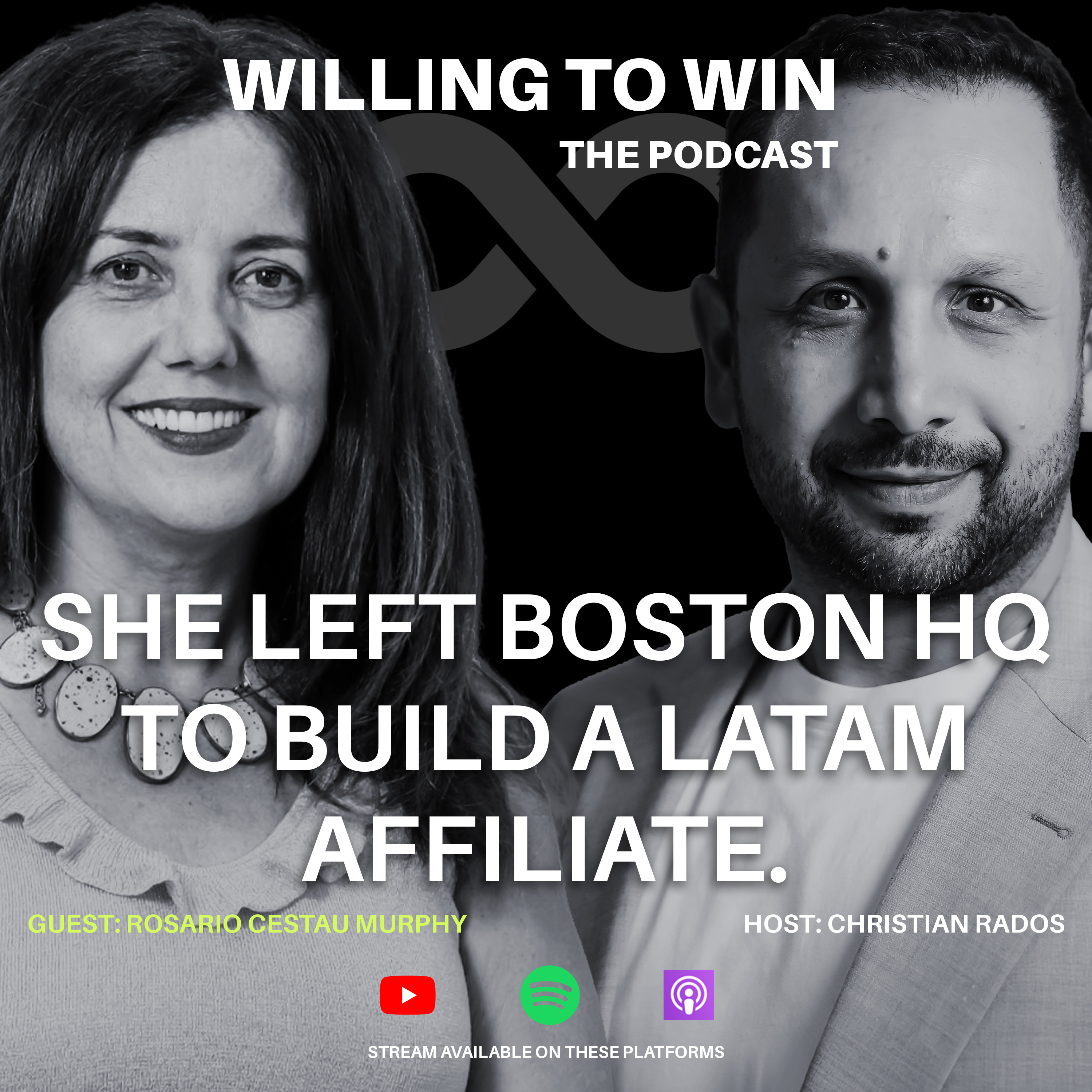
The conversation as it happened, lightly edited for reading. Christian asks, the guest answers.
Christian: Charo, welcome here. You've been through all of that progress. And a lot of things in life don't go by design, right?
Charo: As a little bit of background, originally from Uruguay in South America, I'm originally a genetics scientist, and I went to the U.S. I decided to switch gears and get an MBA. So I worked at Biogen, at Vertex, and then I was at Genzyme, and it was wonderful. I always wanted to work at Genzyme. It was the first biotech company to be fully integrated and to have a presence in LATAM. So when I was there in a global role, like I was at Biogen and Vertex, I realized that I was working a lot, and I was working very close to people in the countries.
So we had offices in LATAM, in Mexico, Colombia, Brazil, Argentina, and I was working very close to Mexico. The last part of my role there went from global, working more and more with the international, and I worked with Asia, with LATAM, and I really gravitated towards LATAM. We have a common language, we have a common culture, and the potential. The potential is huge. At the time, it was really just starting to be realized. Very large population, many countries, depending on the methodology, you can say there are 17, 20, 25, depending on how you count the Caribbean.
And I really gravitated to it, and I realized that we were so close, but yet innovation was not really getting there. We were developing these global frameworks that provided us stuff, but we had a little bit of disconnect in having them implemented. So I thought that I was missing something. I said, there's something missing. We have this skeleton, or this scaffold, as I like calling it, but there's something missing. And I think that this became evident not just to me, but to my boss, Carolina, at the time, and to the LATAM team.
And they said, why don't you join? You have such a commitment to LATAM, to having innovation and access to patients here. So I decided to do it. And I think that sometimes people take it as a step back, because generally in our industry, you have people who start in a country, and then they get a regional role, in Europe or in LATAM, and then they go to global. And mine was reversed. I had been U.S. product manager at Biogen, then went global, and then coming to LATAM.
And it just felt like it was closer to the granularity and to the patient and to the actual systems. I call this going from the Pentagon to the trenches. And there's a certain knowledge that otherwise gets lost when you are just doing the strategy and you're not seeing what's happening in the real world. So that's my journey.
Christian: Do you recall a moment when being in a global role stopped being true or good for you?
Charo: Well, the first one was when I was designing models for target product profiles at the beginning, in one of my earlier biotech companies, at Biogen. And we were running regression models. So this was a quantitative way of seeing what was missing. And something was missing. It wasn't the type of administration or the frequency of administration. There was something missing. And it really had to do with patient diagnosis, the patient pathway, and the commercial models. And I learned a lot from that. I learned this just by covering an assignment in New Jersey.
I remember the New Jersey rep was on maternity leave. And I said, why don't I jump in and cover this territory, even though I was a product manager, just to get more exposure to the real world. So I guess I was always obsessed with the real world. It was tough. I remember having to wait for a long time for the doctor to see me. And I said, hey, when I'm working as a product manager, the doctor will pick up your call and talk right away because they know I'm not going to be able to do this. They know that it's either market research or something.
Here it was a very humbling lesson and one that I don't regret. So I guess in a way you could say, Christian, that I don't think that you should move directionally. Sometimes the trajectory is more of a zigzag and you have to go sideways to move incrementally upwards.
Christian: I'm obsessed with your shift of identity in a moment where logic says to do something else, but your convictions are something else. That was logic, probably. So everything looked probably better on paper to stay in a global. But you didn't believe anymore that you could create more value there. Maybe there was a conversation that you had or a conversation with yourself. Say, hey, this is the right way to go. Although everybody says that probably no.
Charo: I see your point. Yes. So I think there was a serious moment. I was running advisory boards internationally and with LATAM, having conversations with KOLs, having conversations with LATAM leadership, with the president of our division, globally, and again with my boss. So they could see that there was a need and they could see that I could fulfill this need in bringing the global value to the emerging affiliates, the way of thinking.
But also, to be honest, on the personal side, my parents were getting older. So I also found it very attractive to come to Latin America for two, three years. I did. I took it as an assignment. I'm a U.S. citizen. So I thought, OK, I will do this like a two, three year type of expat assignment and then come back. So that was the moment I was approached and it seemed like a big win. Like Genzyme will have somebody who would bring more discipline, if you will, from adaptation of global to affiliate thinking. I could win on learning firsthand from the affiliates.
Christian: You grew up in Argentina, right?
Charo: No, I grew up in Uruguay.
Christian: Uruguay. I'm sorry. I saw Argentina in your education, I think. Tell me about your early development, when you grew up in Uruguay. At which age did you go to Argentina?
Charo: So I grew up in Uruguay and I studied biology, genetics, and then I had a scholarship to go to the U.S. So I went to the U.S. first, before Argentina. I decided that I loved science. But I switched to get an MBA because I really thought, Christian, that I loved science, but I felt like what I was doing from a science perspective, I was working on evolution in genetics, and I felt like it was very far and not really impacting me.
And I thought people who do business don't know necessarily the difference between DNA and RNA. So I wanted to be the person who can understand discounted cash flow and who can understand DNA and RNA and be that link between the two worlds. So I moved to Boston, I got my MBA, Boston University, I worked at the Brigham and Women's. So in the meantime, I worked at two different hospitals, which also gave me a lot of experience. At a public pediatric hospital in New Orleans, Children's Hospital of New Orleans, and then at the Brigham and Women's in Boston, which is private, it belongs to the Harvard network. So very different patient population and situations.
Christian: What brought you to the U.S. at this early stage of your career in education?
Charo: Because I wanted to see how science was done in the first world. I knew how it was done in Uruguay. I always think, and I even gave talks at Biogen with other people about this, you have this mindset of scarcity. You never have enough reagent, you never have enough equipment, so you have to be creative. You share across labs. It's great because you're being very creative all the time, but you don't have everything accessible.
Christian: You mentioned the point in time when you had the chance to go back to Latin America, also because of your parents. How important are parents and family for you?
Charo: Very important. I think it's in our culture, but very important.
Christian: Did you have an experience with diseases that shaped you a little bit?
Charo: Yes, of course. And in rare diseases, oftentimes they are genetic. So you see the burden of a parent. Not only has a sick child, but oftentimes they feel guilty because the child is sick because they passed the disease on to them. So this is really moving.
Christian: Can you share maybe an anecdote of a family or a situation that made you think, well, this is why I'm here. This is why I'm in the market.
Charo: Yes. So after I moved with Genzyme, we were acquired by Sanofi. With the transition, I co-led that integration, which was another learning opportunity. But then people from Genzyme approached me from Boston and they requested that I open the affiliate for a new biotech that they were opening. And I said, well, opening up an affiliate, how do I? You figure it out. We trust you. So that's what I did at the time. And I didn't tell you, Christian, that when I moved here, it turns out that I was pregnant. So speaking of stress, finding a home, I was in temporary housing by Genzyme, finding an OBGYN. Anyway, so here I was, but I was traveling a lot.
So one thing about the global and regional roles too, is that you're traveling a lot, which can be challenging in terms of family, and especially children. So these people from Genzyme, they say, hey, you're traveling a lot with this regional role with Sanofi. Why don't you open the affiliate for us? You will be based in Buenos Aires. You can build it. You can create the strategy, blah, blah, blah. And then I started looking for the patients. This was an ultra rare dyslipidemia. So it was very high LDL, the bad cholesterol levels, but very high, like 600 LDL. Total cholesterol, like 800.
It's homozygous familial hypercholesterolemia. You have the disease because you received two defective copies, one from your mom, one from your dad. And when I was looking into the literature, it turns out that there was a publication from Argentina about a 12 year old. She had had a lot of symptoms. These patients usually, before therapy, give very few years, not reaching adulthood, complications. And this patient was from Salta, in the north of Argentina. So it turns out that she had to take a bus with her mother, a 36-hour bus ride once a month, each time followed by a week in clinic. Imagine being on a bus 36 hours.
Argentina is the eighth largest country in the world. So it's really huge. And this meant the mothers had to bring this kid, meaning the other siblings had to stay alone. Okay. So working with the physician and what we had was an oral drug. So the patient had to come every month. Something like, it's called plasmapheresis. And then the physician did all the research to see if this product was applicable or not. I had already filed for it. When we were waiting for approval, you could commercialize it without promoting.
And the physician ended up, she was very tough, she's one of my heroines, a physician from a large public high complexity hospital in Buenos Aires. And the patient went on this therapy, at 17, and it changed her values. She was a very tough patient. So she became close to normal. And there's all these things, Christian, from a social point of view. So she didn't have to come and spend a full week in Buenos Aires, basically. She could go to school. The other siblings could go to school. The mother could work. So when you think of the social components, we changed this girl's life.
And unfortunately, I could never meet her because in the U.S. you can meet patients, and in Argentina it's not compliant to meet them. But I wish, you know, I could because as a mother, you relate to how this is. The impact is amazing. And that's what motivates. We created a patient support program so there were people who could meet the patient. So we engaged social workers and nutritionists. So one thing with this disease, you also have to be very careful of your fat intake.
And that's the other thing on global. When you look at the global brochures, they tell you, eat filet mignon, eat lean chicken. This is very expensive. So we hired a local nutritionist, speaking of this localization, to develop a budget-friendly type of menu for this family and for many other families. And then we built a patient support program where social workers were helping the physician and following this patient. So the therapies usually work if the patient takes them every day. We call this adherence. If you do not have adherence, most likely the disease will come back in a way.
So I didn't meet them, but I knew the anonymous stories from the patient support program saying patient number one is doing great. She's going to school. She's socializing better. So that was amazing too.
Christian: Was there a moment when you lost faith?
Charo: Yes. Yes. I wish we had more. We knew that the diagnosis rate is very low. And this particular disease, because we had different products, but for this particular disease, the patient is almost asymptomatic. You could be walking down the street with a total cholesterol of 600. Nobody would know. It's not like you have, you know, like a horn in your forehead or something. The symptoms are very subtle. You get some little bumps of fat on your knuckles, your eyelids, but very, very subtle. Unless the physician is very well-trained, unless the parents see an alert, they will not necessarily get you diagnosed.
So I think a lot of those under-diagnosed populations, and how I wish I could have an even bigger team, have more people create more awareness. So there's more diagnosis. Diagnosis is really the key barrier that we have. They are very under-diagnosed.
Christian: I'm trying to understand what's your mission right now.
Charo: Continue to have more stories like this girl with the 36-hour bus ride. And I find that the best way to do this is not perhaps doing it again myself, but I built my consulting firm to help other companies in optimizing their way to enter a market.
Christian: What's your identity right now? What business are you in at the moment?
Charo: So yes, I opened RC, for Rosario Cestau, now STEM Consulting. STEM because I'm big on science, technology, engineering and math, so I like having that embedded in there. And it's my own consulting firm and then the kind of work that we do at RC Consulting, we have three types of areas. One is advising companies on their go-to-market model, like I said, sometimes it starts as early as should I run a site in Argentina or not. So that is one. The other one is with the company that has launched recently in the U.S. and Europe and now is the time to say, hey, why don't we expand internationally.
And then the third angle is coaching people who are in the industry on their career development, career options. This is something that I like doing with teenagers, with young investigators, like helping them, guiding them, like mentoring. So doing this as a professional executive coaching type. Somebody like me, I am global, there's this opportunity to move. Should I take it? Yes. Should it be timed? What will be important? And how is that merging with your life.
When I was recently, like five years ago, I was offered to be brought back to Boston, which I actually had that offer many times. He said, move to LATAM. And I was always showing the picture with my kids and say, can't do this now. I can't do this now. But when I talked to the expatriates, to the company doing the relocation, I said, how many of the expats are men versus women? And my hypothesis was like 90 to 1, and it was. And all those women typically, they are women with no children or women whose kids are grown up.
So there you have a lot of constraints and that's something that I also work on. If you're a woman with young children you have again this guilt, right? You want to be a good mother, a good spouse, you want to be a good worker. They are relocating you, so you feel like you have to deliver on this promise. How do you really manage this? And having this advice from somebody who has been there as opposed to somebody who has a theory around it.
Christian: What are you telling those young moms, pregnant women? What's the advice that you're giving them?
Charo: I think a lot depends on the infrastructure where you are going. Is it a new company or is it your own company that will have more patience with you? And very important, who's going to be your support system? That's your husband, who is willing and able to take a year to do what typically the expat wives do, which is looking for their schools, looking for the supermarket, looking for the... Then yes. If not, it is really, really difficult. But I find that in general they are women who have a good supporting husband already, because otherwise they would not be succeeding in their careers.
But it is challenging. And then how to really think of the... for me one thing that has been difficult is how do you forgo the curve of promotions that you could have if you were alone, without children, making no sacrifices, accepting every single expat assignment that you receive, versus showing the picture. And you know that when you show the picture with your family, say, I have to say no because of this, that's something that you have to be at peace with. But this is a rational, difficult but rational decision, and once you make it, I don't know how to say, I guess it's being at peace with it and move on from there and redefine what success is. You're focusing on it.
I think that is like coming in circles, Christian. Willing to win is many different things, and I think that in a professional context, willing to win is delivering revenue, delivering growth, delivering. But what about my other legacy, you know? And sometimes willing to win is having your child telling kids at school, my mom is traveling because she's helping kids who have very, very high cholesterol and my mom is helping the doctor so they don't die. That is winning.
Christian: So my last question to you is, what is success right now for you?
Charo: I think that success is having been able to come to this balance, to optimization. It's going to sound, I think that it is an optimization of professional, personal growth, you know, having your family, your children succeed, be able to share dinner with them. I don't know if you read Freakonomics, but the biggest predictor of a child's success in life is not having gone to museums all the time. It's really having had family dinners or family lunches every day because they interact, you model to them, you shape these people. So I think that a lot of success is there.
Christian: It truly is heartwarming and I hope people are hearing you. Thank you very much.
Charo: It was a joy.
If you think you need to talk to this guest, reach out to me and I am happy to make a connection. Christian Rados, christian@rados-recruiting.com
All episodes and the problem pages