
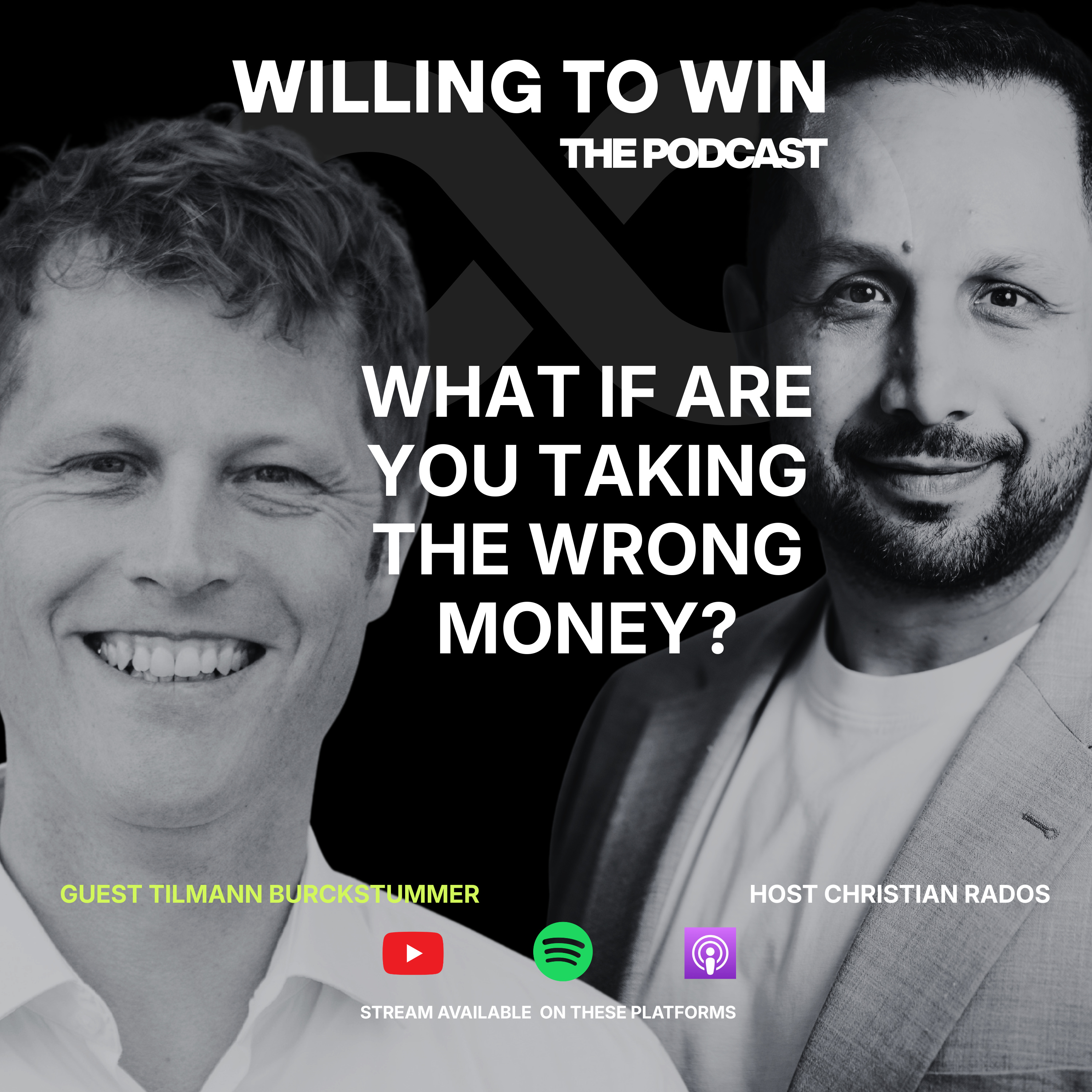
The conversation as it happened, lightly edited for reading. Christian asks, the guest answers.
Christian: Look, when I first met you, I think it was in Vienna at BioEurope last year. I was truly impressed by what you've done. Somebody introduced me to you as a serial entrepreneur. You founded two companies, two different companies. But what I'm interested in first is you started biochemistry back in Tübingen. When was it? 2000?
Tilmann: Some time ago. Yeah. Started in 1997 and finished there in about 2000.
Christian: What was your wildest dream back then, career wise?
Tilmann: Back in those days, I think I really wanted to be a professor, a college professor, a university professor. I had very much this academic path: first do a PhD, then do a postdoc, then become a professor. That was my dream for the longest time, I would say. When I continued with my PhD in Berlin at the Robert Koch Institute, then became a postdoc here in Vienna at CeMM with Giulio Superti-Furga, even towards the end of that time I did my habilitation, so the formal qualification to become a professor, because that was what I thought was in the cards for me. But then it turned out to be very difficult. I met my wife and as a family, it became very difficult to imagine that we would relocate every four, five years. Have a first PI position, let's say in Göttingen, Germany, and then a full on assistant professor position, maybe in Paris, and then have a... So that whole career track became more difficult than I had initially anticipated when family became a topic, let's say.
And then the opportunity arose. I literally recall that this was on May 1st in the year 2010. It was a public holiday. At that time I would always attend the May 1st demonstration, so I was at the May 1st demonstration and I get this phone call by my boss. And Giulio said, Tilmann, we're founding this company called Haplogen, and we thought you could be the first scientist to join the biotech company. Do you want to come to a café and have a chat with the founders? And I went to that café, it was Café Eiles in Vienna, and we had that chat. And after that hour, I said, I'm in. I didn't even negotiate salary. On that day, I said, I want to do this, we'll find the package that makes sense. And I signed up for it. That was within an hour, a decision to completely change the career path, which up to this point had been become a college professor. And after that one hour conversation it was, let's try biotech and see what that looks like.
Christian: So interesting. Tell me more about that. You were a little bit disappointed about not pursuing maybe your college professor career. However, priorities shifted and it wasn't that important anymore, probably. And then this opportunity came, so you actually expected something like that to come. To jump on because you had to be prepared for something like that.
Tilmann: Not really. Not really. I knew that the company was being founded, but I had never even thought that I could do this. It was just not on my radar at all. I really only became aware of the possibility because my supervisor asked me directly, is this something you could do or could think of? And then I realized it actually combines a lot of things I like, which is I've always been very active in research. And that is what I liked about the college professor position, but the company had a very strong research focus. But I also realized that I can do a lot of things well, and I'm maybe not super deep on the academic side. I didn't see myself dedicate my life to one protein in human cells and understand that protein in every possible dimension.
And so with that realization that I have maybe more talents than just the science, I can speak to people, I can present, I can lead people, I have good talent for organization. With all of these different talents, I realized maybe biotech is more for me. And maybe I could do well in that space, which I didn't know at that time, would that experiment work out.
Christian: You just mentioned the capabilities and skills that you noticed in yourself, like communication, leading people, building companies. Did you know that before that moment when you jumped into the industry? Or did you just recognize it in retrospect?
Tilmann: I think a bit of both. I think I had a sense of that beforehand, but I don't think I had it as clearly in front of me as I maybe do in hindsight. In hindsight, you feel this has worked well and that has worked well. People give you feedback and they say, oh, you present well. And then in hindsight, you construct an image of yourself as if it had always been like this. I don't think it has always been like that. But at the same time, some of these elements were there already relatively early on, already during my PhD. For instance, I worked with a lot of interns. I learned relatively early on that I could work with people and show people how to do stuff and they could do meaningful things. So that, for instance, is something I experienced relatively early on. I was always relatively organized. So there were bits and pieces there already.
But then other things, communication, can you solve conflicts? That's an important part of my job today. People come to me. They complain about something. They want to have something or they're frustrated about something. Conflict resolution is a key piece. I don't think I had a lot of experience with that early on. So that is probably a piece that came later.
Christian: If someone wants to copy your path of career, of your success, is it even possible right now to go the same path? Or what is now different for, let's say, people, students, biochemistry, they listen to this and they say, hey, I want to do the same. Is it possible, do you think? Or did something change about AI and so on? I'm trying to understand.
Tilmann: I think, lo and behold, it's still possible. I had a quite conventional university education. That's still possible. Doing a PhD is possible. Doing a postdoc is possible. Starting as a scientist in a biotech is possible, although I would say that in Vienna, the number of opportunities is maybe not that. What I'm trying to say is we have a lot of people graduating with PhDs and maybe not as many startups that are looking for young senior scientists to have their first job. That ratio is mainly not that favorable. And back in those days, there were even fewer startups. Haplogen, the company I joined at the time, was one of very few. So that is, I would say, still difficult.
And then founding your own company, I would say, is more difficult than it was three, four, five years ago. The reason is that, at least my impression is that there is a lot less money in the system. There is a lot less venture capital available, which at least at the start of a new biotech company is a key piece of success, and if you don't find that first investor that gives you a check to start the company, then it's very difficult. At the moment, you might be able to find a business angel that gives you two or 300,000 or maybe 500,000 euros to start, but to find that investor that gives you the first 3 million or 5 million euro check, that, to my understanding, has gotten more difficult. For sure than it was in 2020, 2021, 2022.
Christian: I think that lack of financing also shaped the decisions you made later on, when you progressed in your career, when you founded your own company. You had to pivot a lot and you had to find alternative ways of financing, speaking of bootstrapping and so on. Can you tell me about that, the decisions around it? I mean, it was very pragmatic that you had to make the decision, well, we don't find financing, we have to make revenue in order to survive.
Tilmann: It was almost the other way around. So when we started Myllia in 2018, I teamed up with two guys. One is Christoph from CeMM. He contributed some of his expertise on CRISPR screening, although that was not initially the topic, but maybe we can touch on that later on. And then the other co-founder is the current CEO of Myllia, Thomas Moser, and he had a past in venture capital funding and because of that was very reluctant to even try to bring venture capital on board. He said, before you know it, you spend a lot of time managing investors and that is not healthy for a young company. A young company should get exposed to the market, should build a minimal viable product, get that into people's hands, and should focus on that rather than managing the people that have put the money in. So I think that was one consideration.
And the other consideration was that we wanted to build a technology company and deliberately chose not to do a drug discovery company. So we did not want to develop our own drugs. The reason was that we both had an excitement for technology, in this case CRISPR screening technology. And we figured that if we were to build a drug discovery company, we would be doing a bit of CRISPR screening in year one, maybe a little less in year two. And by year three, the whole company would get valued by investors or by outsiders on the basis of where the drug candidate is. Is that progressing towards the clinic fast enough or is it not, or has it chemical liabilities? The technology part would be lost, would essentially go away. Nobody would care about technology anymore. And we felt that the only way to build a technology company would be to offer the technology to others and essentially secure revenues from day one.
That is how we've always operated. We've tried to go out relatively early on. We benefited from some past relationships where people knew us and trusted us and gave us relatively early on contracts to work with them, and that has allowed us to build the company from revenues from day one. It's not entirely true because we had a small business angel ticket that helped a lot, but we also had to build a lot in these early days. But we deliberately never asked for venture capital. And quite frankly, a venture capital investor would have a hard time to invest in this kind of business model because they are looking for X returns, which are typically to be had if you develop your drug and that drug makes it to the market, and you can expect that company to be at a billion in valuation. And then they have the necessary returns. With the company that we built, which is slowly growing, these types of valuations are just not achievable. And hence, we would have had a hard time finding venture capital.
Christian: One thing I think it would be important to mention, what is Myllia doing? What's the business model? Or what was it back then?
Tilmann: Yeah. So essentially we developed a CRISPR platform, a CRISPR screening platform. CRISPR is the genome scissors. What it allows you to do is you can take a cellular model, you can target a gene of interest, and you can see what happens in the cell more globally. A typical application of that is a pharma company comes to us. They say there is a cellular model, let's say of a pancreatic cell. This is a cell of the pancreas. And they might say, we have an interest in diabetes. We want to cure diabetes. We want to find a new treatment or a new cure for diabetes. Let's apply CRISPR in these cells and let's see what are the genes that affect the phenotype of interest.
And so you then put CRISPR into these cells and instead of targeting one gene at a time, you ideally target all of them. So you target all the genes, each gene next to another gene, and you find out in an unbiased fashion, what are the genes that regulate insulin production? And those genes that regulate insulin production, they have a good chance of being the next drug target that a Roche or a Novartis or a Pfizer will pursue and develop a drug against the gene product. That is what we do in broad strokes. And in terms of business model, we offer this technology platform to pharma companies and biotech companies that want to start their next drug discovery campaign. They come to us, they say this is the disease, this is the model we thought of. Often these models are challenging, meaning we focus a lot on primary human cell models. These are cell models that come out of either healthy volunteers, in case of blood that is easy to imagine, you can donate blood and you get some cells from that person. In some instances we are working with cell models that are from dead people, so people that donated their bodies to research, and you gain some cells from these people and you work with these cells. Very precious materials, but primary materials from humans, to try to answer these questions, to find genes using CRISPR, find genes that regulate key cellular processes, so that these gene products become the next iteration of a drug discovery campaign.
Christian: What I know from other conversations, I know that CRISPR has had its own hype curve. Very hyped in the beginning, a bit lower in expected results, and now again back on track. Can you tell me about that? How did you experience the technology and the potential of that technology right now?
Tilmann: Well, we started using CRISPR very early. CRISPR was discovered by Emmanuelle Charpentier and Jennifer Doudna, and part of that work actually happened here in Vienna. They published a seminal paper in September of 2012 and then about four or five months later the first papers came out that applied CRISPR in human cells and showed that it worked. So by that time we knew you could apply CRISPR to cells, and from that day at Haplogen, back in those days, we implemented CRISPR and started working on CRISPR. The way we used it and the way we're still using it is more as a discovery tool. So we're applying it to cells in order to get new insights into how cells function. What you're referencing is more the therapeutic application of CRISPR, which is exciting but a slightly different beast.
The excitement here is that we might be able to use CRISPR to correct genetic defects. The first defects that people have tackled therapeutically or clinically are the blood disorders, because it is very easy: you take out the blood of a patient. Famous diseases include, for instance, sickle cell anemia, which is a deficiency of blood cells. You take these cells out, they have a mutation, the mutation is very well known already since decades, one of the first mutations that were characterized in humans. You bring in the CRISPR machinery, you correct the cells and you infuse the healthy cells back in. Those types of therapies are being developed and some of them have been very successful in terms of getting market approval, which to me is still a great success story given that CRISPR only came out 13, 14 years ago. The fact that that has already made it to that degree of success.
The next generation of therapies that we want to see are therapies where you're not taking cells out and modifying them and putting them back in, but instead you're giving a patient a cocktail that contains the CRISPR machinery. The CRISPR machinery finds its way into the diseased cells in your body, corrects the change there, you're healthy or you're treated. That is the vision, I think, for the next therapies being developed. They have a lot of challenges, mostly around delivery, because you need to get that machinery in, in a safe way. Obviously you can use viruses for delivery, but nobody likes to be infected with these viruses and these viruses have potential side effects. So delivery is one key challenge, but I think we'll be seeing more of those success stories in the years to come. To me, it's exciting times. But again, that is more on the therapeutic side, where we're using it more as a discovery engine.
Christian: Yes, thank you. I'm trying to understand the business model decisions that you had with Myllia in the beginning and how you had to change it, or maybe you had alternative ways, changing your business model of Myllia and maybe even the whole organization, because the business model also defines what kind of people you need in a company, how big the company should be, are you developing your own therapies? Was this on your radar? Changing the model? And was there a moment when the company had struggles when you had to change it?
Tilmann: Yeah, when we started the company, we were in a bit of a weird position in a way that both Thomas and I were managing directors of Haplogen Genomics. This was a genomic spinoff of Haplogen that had been acquired by Horizon Discovery based in Cambridge, UK. So we were running their Vienna site for two, three years. And then essentially from one day to the other, that Vienna site was closed for good or bad reason. And so Thomas and I then came to realize that we wanted to do something together. We wanted to start something. I think in hindsight it was actually a very fortunate situation because I would have had a very hard time leaving a paid job and founding my own company. Even at that time, founding my own company was not on my radar. It was not something I had always wanted to do or I planned to do. But because this happened, we found ourselves in a situation where we felt, now we're both unemployed. We might as well try something now. And if we fail in six months, nothing is lost really. We're not giving up a paid job because the paid job is gone anyway.
So that was August 2017. But then we were not so sure what we were actually going to do. We realized that some of the things we had done at Haplogen would be difficult to replicate in other contexts. And we essentially started talking to people that we knew in our network. We called up different people. Some of them were at CeMM. Some of them were at the university. And we essentially asked, if you were to found a company, what would you do? And some people said, oh, I have an interest in immunology, I would do this. And some other people said, oh, I have an interest in transporters and so on. And then at the end, we very much liked an idea that Christoph Bock brought forward. And that was an idea which has nothing to do with what we do today at Myllia. It was an idea around antibody engineering.
Antibodies, as you know, are still the biggest and growing class of drugs. And we had an idea of how we could find those antibodies in a quicker fashion. But the idea was essentially a piece of paper. We filed a patent around this because we felt we needed something to document. We had had this idea, but we had no idea if it was going to work. And so we founded this company and even initially the logo had a little antibody in it, one of those Y-shaped antibodies, because we felt it was going to be an antibody company. And then over these first couple of months, and we got some money at this stage already, but essentially it was a business angel that liked us. And he didn't ask a lot of questions. He said, if you guys are fine with it.
Christian: You need that too. You need that likeability too. It doesn't always have to be about numbers.
Tilmann: Yeah, no, he said, if you put your name on the line, if you're in it, I'm in it as well. I give you a little bit of money to start this. Don't underestimate that. That was super nice and super valuable for us. Obviously without that, it would have been very difficult. But then four or five months into it, we realized that none of it was working. We tried in the lab. It was a technology platform that had different elements to it. Aptamers were part of it. These are RNA molecules that we thought were going to bind to antibodies. We needed some antibody models. We needed an NGS workflow, and it just all failed. It was miserable. And at the same time, we had a lot of pressure because we had that business angel money. We had a small grant from AWS and a small grant from FFG. Those were very helpful in these early days, but those don't last long. So you cannot survive for years on that basis. And so about four or five months into it, we came together and we said, can we continue this? Because this is not going anywhere and we'll be out of business in four or five months.
And we essentially felt it was not sustainable. It would have been maybe sustainable if we had 10 million in the bank and we could develop this for three years. Maybe it would have worked, maybe not, but not in our current situation with a couple of hundred K on the bank account. So we sat together for an afternoon with Christoph and he said, let's do something completely different. And then we realized that we had this CRISPR past. We didn't want to do what we had done before, which was essentially to take one cell at a time, put one gene knockout in and sell this to others. This was essentially what Haplogen did. They built products, but the product was a cell line that had a knockout for a different gene. If your favorite gene is P53, you buy a P53 knockout, or if it's another gene, we make that other gene knockout for you. But then when we discussed with Christoph, we felt we want to take this to the next level. And the next level is instead of knocking out one gene at a time, you knock out many. So you build an engine that allows you to discover in an unbiased fashion what the genes are doing in the cell and how they are contributing to a disease relevant process.
And essentially after that afternoon, we said, okay, we change. We had to inform all the grant agencies. We said, the grant needs to stop now. We cannot continue that. It makes no sense. We informed AWS at the time. At the time we had the pre-seed program. We said, this is not working out. We need to change to a completely different topic. And they were all very forthcoming. They understood, they respected the decision. It was also true that we maybe underestimated a little bit that this CRISPR market back in those days was still a relatively immature market. Meaning there were not many established players in the CRISPR space, whereas antibodies were so established that it was super differentiated. People had platforms for anything and everything. Modification, discovery, discovery in E. coli, discovery by phage display, discovery in mammalian cells. It was so differentiated that it was very hard to imagine that even if our idea worked, we could build a strong business out of it. And so it was partly that market feedback or market insight, partly the fact that everything in the lab didn't work, or mostly that.
And then obviously we went back to what we understood best, which was CRISPR. And there we felt more confident that we could build something that is to some extent unique. Nothing's ever fully unique, but something that, at that point in time, yeah, where you have a chance of convincing people to work with you because you bring something that not everybody else can bring.
Christian: Yeah. And that was successful. When did you feel the success?
Tilmann: Again, it was slow. I must say at that time already, we had some support because we had brought over one customer that we had worked with at Horizon Discovery at the time, someone that had worked with me in my capacity in Horizon, and he liked me, and that program at the time was not so interesting to Horizon Discovery anymore. And so he then helped us by getting us a small development project that was a bit off topic at the time, but was very crucial for us, because developing this for this customer allowed us to secure a certain income that would actually sustain the company. And so we had a bit of that. And then we started slowly building relationships around CRISPR and CRISPR engineering and CRISPR screening. And probably the first project we secured was six to 12 months into the new concept.
But we had a first project and then it slowly developed. It was always, you start small, you try it out, and then some additional contracts came in and some slightly larger relationships developed. At that early stage, it was always dependent on personal relationships. These first contracts, they all came in because people had had some degree of exposure with me personally or with Horizon Discovery or with the company, and they thought, let's see what these guys can do, because at that early stage you don't have a track record and it was not easy at that time.
Christian: How many people were there at that time?
Tilmann: We started formally with the company in 2018 with Thomas and myself and three employees, so we were five to start the company. And then the company grew to eight or nine over the course of that first year. So it was eight or nine, then probably another year or two. And then essentially with new contracts coming, we could hire additional people. Essentially, you bootstrap. You offer something that you don't quite yet have based on people that you have not yet recruited, and if you have that contract, you try to bring those people in, try to train them and make sure that they can deliver on that contract.
Christian: At which point would the company have broken down? What were the most fragile elements? I have two or three thoughts. For example, if you and your founder take a break, your team would not have been aligned on a topic, that could be a breaking point. Or if the market didn't appreciate what you did, or if you burned too much cash because you wanted to have a fancy office or something. What do you think about that?
Tilmann: Well, I think in terms of the founder team, we were always very fortunate in a sense that Thomas and I knew each other really well. We had worked together for three years on a daily basis. And I think we're still very good at that. We're able to work out conflicts. We're able to walk into each other's office and say, hey, you said this, so what did you mean? What was that? And then we can work it out. And that I think is a key recipe for success. It never drags on. Christoph has never had an operational role in the company. He's been more scientific advisor, so he's been less involved. But when he is involved, he provides the strategic input that we expect him to provide, which is valuable as well.
Where I could have gone completely off or completely wrong. The beauty with bootstrapping is that you can adjust based on the market feedback. We've not had to let people go so far, meaning we've not been in a situation where market feedback was so terrible or we had so little interest in what we were doing that we had to fire people. But theoretically, that would have been possible, meaning we would not have ended up in a situation where we overspend, because we look at what we spend, we look at what we earn, and the biggest spend is always people. So that would have been adjustable, I would say. At the same time, it's not pleasant. It kills the morale of the team. And the moment you fire people, it creates a sense of, I don't want to be in that place anymore, even with the people that you do not fire. Because they will get this feeling of, man, this is not a pleasant place. It's not growing. It doesn't have a healthy culture. And of course, as a next step, what happens is that those people that you did not fire decide to leave, at least the good people that have options, and we have a lot of good people. So it's an option, but it comes at a very high price if you really have to go down this path.
I think it could have gone wrong in a sense that we decided to focus on a variation of CRISPR screening. Now this gets a bit technical, but we link these CRISPR screens to single-cell RNA sequencing. It's a particular readout, a particular technique that allows us to record transcriptomic snapshots. So snapshots of all the RNA molecules in a cell following CRISPR perturbation. I think what we've seen, either by luck or by good preparation, is that this particular subtype of screens has gained attraction. People find this more and more interesting. So what started as a tiny niche actually grew. We bet on that, but it's a bet. You don't know, because you cannot look into the future, so it could have been a situation where that niche either stays the niche or the niche even disappears. That could have happened at the same time.
I don't think it would have entirely killed the company because in this model that we have, we always have close market feedback, meaning we cannot afford to develop something for a year's time without having a paid customer. So we're always out in the field. We're always out on conferences. We're talking to scientists. We're saying, if we develop this, could you be interested in this? So we get this feedback very early on to prevent a situation where we're developing something and then the world says, ah, well, so what? We couldn't care less. So I think we built in different defense mechanisms, if you like, to prevent this from happening, but at the same time, you're never safe and you're never comfortable in a biotech company. That's at least my feeling.
Christian: This is a very rare example of a biotech company that you are leading. I'm talking about the close relationship in the market, the close relationship with the clients. Usually you have scientists who have a conviction about their product and the market comes, I don't know, 10 years later. What would you tell those companies?
Tilmann: Well, I think these days, the recipe for success from my point of view is try to get that feedback as early as you can. And I think people are adopting this view. It was very different three, four years ago where there was ample money in the system. Then people were even reluctant to have customer relationships. Because the moment you have a customer relationship and you have a million in revenues, people will value your company as a multiple of these revenues. At that time I was aware of biotech companies that had almost no revenues and were valued at 200 million. Once you have 1 million in revenue, people will say, wait a minute, it's a 200 X valuation. So it's 200 fold over revenues. That sounds unrealistic. So at that time, people were sometimes belittling us or were laughing at us and were like, oh, guys, revenues, who needs revenues these days? Rather not have revenues. You need revenues because people look at the next investment round and they say this company cannot be worth 200 million.
That's interesting. Now the situation is very different, because money is a lot more scarce as a resource than it was four years ago, let's say. As a consequence of that, people almost demand revenues even early on, even if it's small checks, but they want to see that you have a relationship with a customer and you're delivering something to them that is of value. Even if it's 50,000 or a hundred thousand. That is little money in the bank, you cannot keep your company going for a long time, but it's a sign of, I'm doing something that somebody else respects to a degree that they put in real money. So I think my advice, but again, it's probably not needed anymore at this stage, is to really try to get that feedback early on and try to get that market exposure early on, because it allows you to sanity check. None of us know for sure whether what they think is cool is actually cool. And the ultimate test is, will someone pay money for it? So getting that exposure early on, I feel is critical.
Christian: You don't sound like a typical scientific person, not disrespectfully, but what I'm trying to put out is you think more in commercial terms than many other scientific experts in their field. How come? Were you forced to think about, you speak like a tech founder with a commercial background, trying to create a company, talking to investors in the company. You know what I mean, right?
Tilmann: I think this essentially happens because you have to do it. Money means freedom. Money means that you have a chance to develop what you would like to develop. Money means that you can pay the people that you like and respect in your company. Money means that you could pay your next family vacation. As a scientist founder, I learned very early on that we need to be sure that money is flowing in, and money is only flowing in if we can offer something where someone in the real market says, I'm going to pay you money for that. So I would say it was really necessity that dictated it. I adopted this view, but me personally, I'm not driven really by money. I'm more driven by curiosity. I like these screens. They're like little presents. Every time you have a new screen, you open up the box. There's always a surprise in it. Sometimes it's a good surprise. Sometimes it's a bad surprise, but that is what's driving me. Really. I don't have much money and I don't think I need much money, but money is the currency that keeps the company going, and so in that sense we need money and we need to make sure the company does something that's attractive to the world.
Christian: It's a realization that makes you very rare, and this is a compliment by all means. What I also see is that your thoughts about your cash restriction gave you more creativity about creating solutions. I think having too much cash makes you blind and a bit lazy. I gave you another answer, but I'm trying to understand what you're thinking.
Tilmann: Yeah, absolutely. I'm always thinking about how can we save money. But not in a small sense, meaning no one would argue with me over a new kitchen shelf. That is not where money is really spent. I'm always thinking about the big chunks of money you spend. A lot of money, for instance, with next generation sequencing providers. I'm always thinking about how can we get those bills down, how can they come down from 200K a year to maybe 100K a year, so that can have an impact. And I always know what the main cost drivers are in my business, in broad strokes at least, and try to think about how to get those costs down, because that will ultimately dictate whether we build a viable business.
Even with something as specialized as the stuff we do, there is fierce competition. We've just had a conversation two days ago with a large pharma company and they said, we look at China these days, and in China an FTE, a full-time equivalent, a year will cost 100,000 dollars and you guys are charging 300,000 dollars, more than that, so I need to understand that discrepancy. And then of course you say, we're delivering so much higher quality than China, but that is only true in part. Sometimes we do and hopefully we do, but the competition is fierce and China is not sleeping. These people are very ambitious. In the meantime they have very good education, they have everything it takes. Maybe communication is still a little bit more difficult, but there is competition. So we need to be mindful of the money we spend and the money we charge our customers, because money doesn't grow on trees. That realization I've always had and I have it every day, because it's dictating whether the business is viable as a business or not.
I cannot be comfortable. I cannot just sit here and believe that the world is sleeping. The world is not sleeping. China is not sleeping. People are very ambitious there. I've seen that on my own. Thomas and I have been to China in 2019. I was really impressed by the ambition that people have there. They're very hard working but dedicated to what they're doing and they want to catch up. And I think that competition is something we start to feel for sure.
Christian: What do you believe are additional points where you can really compete with an offer from China? You said bringing your own cost down, which I believe is working, and only to a limit. Higher quality, perceived quality, is something only to a limit. Where are the real differentiating factors that you believe will hold for the next couple of years?
Tilmann: The next couple of years is a strong statement. In two or three years maybe, not in five or six years. But to me, we need to be able to do experiments that nobody else can do. And in our particular area of biology, this means that we work in cells that nobody else can handle. I mentioned this earlier, these are primary human cells. They're taken out of the human body, they're fragile, they die when you put DNA in, they do not proliferate, they do not grow in the dish. So these are just very difficult models to deal with, and the thinking is that at this stage people can probably not replicate what we do to that degree of sophistication. At the same time, we need to stay alert and we need to stay at the forefront. People will catch up on this. I don't know whether it will take three, four or five years, but I don't think that this protects us for very long. So we need to at the same time develop other aspects of the technology platform that are so advanced that they give us a bit of a head start.
Christian: For like six months, something?
Tilmann: It's like a race. It's like a race and you need to continue running and you need to try to be a little bit ahead at any given time.
Christian: So you always have to bet on the most complex horse in that race.
Tilmann: Let's say the most complex, maybe not, but you have to always bet on a reasonably complex horse. Because of course if it's too complex and you cannot deliver on what you promised, that's also not great. So you need to make a judgment call: what is adding value, what is sufficiently complex for people to pay money for it, but at the same time sufficiently simple so that you can deliver on your promise. That is always the balance. And most of the time we deliver on what we promise, but we've had instances where the model is super complicated and maybe not all the results were 100 percent successful or were 100 percent what we expected.
Christian: Yes. Coming towards the end of this conversation, which I really enjoy, let us talk about winning. What does winning mean for you? What did it mean back in the time when you still thought of going to become a professor? You focus on your family, so it changed. But what does it mean now for you?
Tilmann: I would say when we started Myllia, winning to me meant building a company that has a chance to have a sustainable future and has a chance to exist, to have real world relationships with customers, deliver a real world product or service in this case, and continue to exist. I would say that is still partly what I worry about. Not comfortable yet, maybe. I don't take it for granted and I don't think it's going to be like that if we're lazy and we don't do anything about it. So it's still a matter of constant worry and of constant effort to maintain this.
I think winning also means that, winning is a strong word, but I also enjoy, and that is maybe something that I added more recently, that I like to work with young founders that are only starting now and that have less experience, and I like to spend a bit of time advising them. It's again a strong word because I'm not a huge fan of advising, but giving them feedback, saying this is what I did at the time, looking at what they are thinking about, providing one-to-ones in a coffee house. Not in an advisory function or something like that, but more informally with some people that I know from the past, giving back. Sit with them, have an informal conversation, providing them with a bit of feedback. I think that I came to enjoy more recently.
Christian: I really like that, especially your idea of giving back to younger founders based on your experience. And I think my last question is coming towards the holiday season. Any location in Austria that you would recommend for a vacation?
Tilmann: That's a good question. I spend a lot of time in Burgenland, which is maybe not so popular because there are no mountains. But I like the fact that it's super flat. In fact we just bought a little house just across the border in Hungary and I really think that this flatness, the total absence of traffic, of buzz if you like, it's the exact opposite of what I have during a normal weekday, I would say, that I really enjoy. I also enjoy, I must say, my wife talked me into refurbishing some of the place and I thought initially it was going to be a pain, but it's also fun actually to build something with your hands where at the end of the day, you've just done the floor last weekend, you come out of these two days, you're full of dust from all the floor that you changed. But it's nice. You build something with your hands that you can actually feel and look at and enjoy. So that piece, I also came to enjoy more than I thought. So maybe I'll do a bit more of that.
Christian: Very good. Thank you very much. It was a great conversation. Hopefully we talk again soon and all the best.
Tilmann: My pleasure, Christian. Have a good day.
If you think you need to talk to this guest, reach out to me and I am happy to make a connection. Christian Rados, christian@rados-recruiting.com
All episodes and the problem pages