
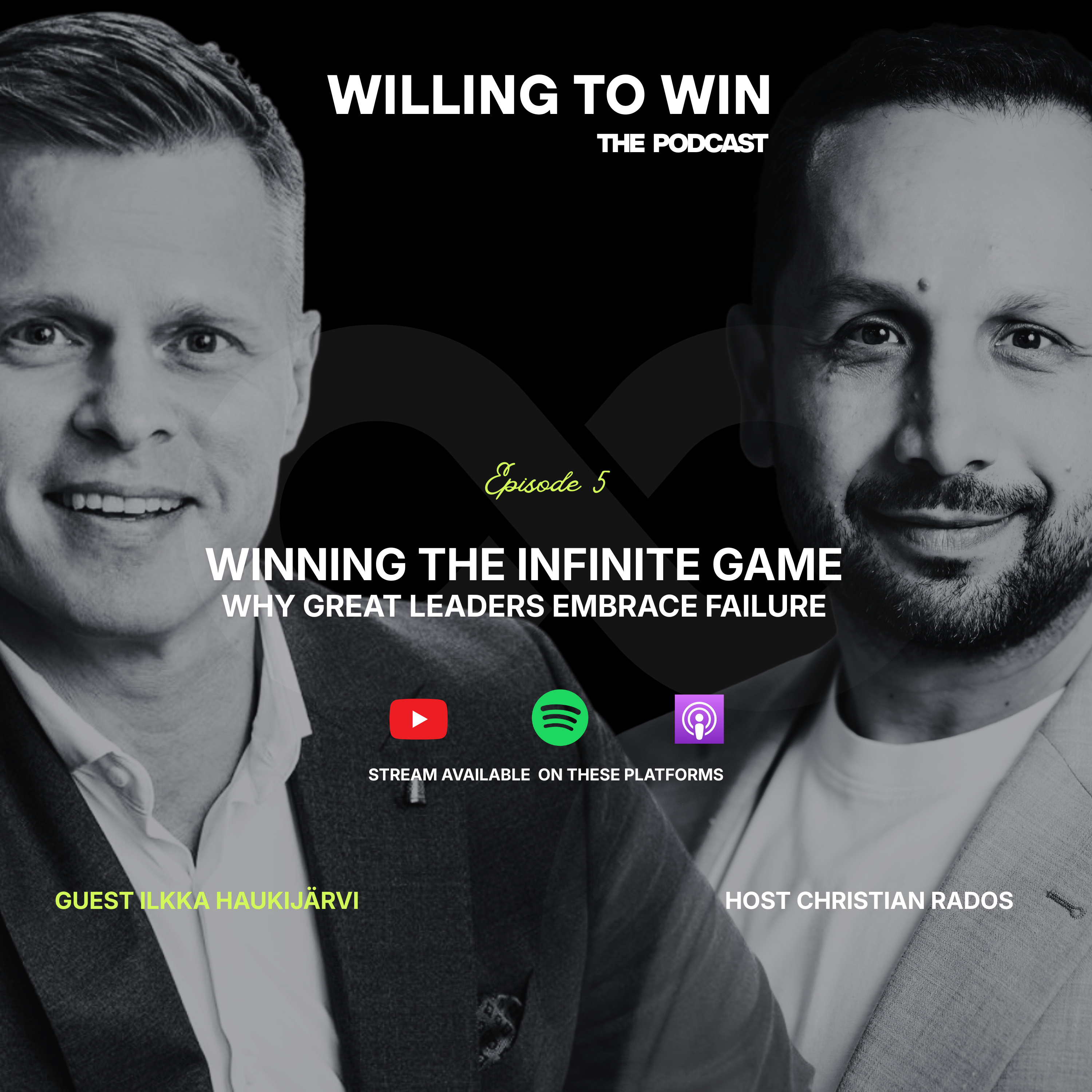
The conversation as it happened, lightly edited for reading. Christian asks, the guest answers.
Christian: Were you a born winner or did you have to learn it the hard way?
Ilkka: I don't think anyone is a born winner, because the more you win, the more you have losses on the way. How I see it is winning is only another side of the very same coin.
Christian: And if you don't lose, you really cannot be a true winner. Let us go back a couple of years, maybe four or five years. 2020. I think it was a pivotal moment in your life, right? The Finnish vaccine research. Tell me something about that. How was this for you?
Ilkka: Yeah. And definitely that has labeled my whole life to its fullest for the last five and a half years. It was fall 2020 when I was getting myself involved in the preparations, the pre-phase of the establishment of Finnish Vaccine Research. And then after that one and a half years, I had to transfer as CEO and take an interim CEO role in building up the company. Since early 2022, I basically started from scratch. The company was existing only on paper, on records, but nothing else, board of directors and so forth.
But everything needed to be built in roughly six months. And why six months? Because there were certain business transactions. And I had to get the first coming from the owner's side by September 1st. Staff, of course, and some project portfolio as well. Since we didn't have anything and we didn't inherit anything else, basically, but the people and the projects, a minimum amount of projects. To be fair, we needed to build the whole modus operandi, so to speak, from the technology platform, from the subcontractors, processes, process architecture, the whole enterprise architecture, actually.
To be quite honest here, and that took place in six months. And we wanted to build an organization that is capable and mature enough from a structural perspective to scale up, so that when the company shifts to the next phases in its evolution, it doesn't have to revise the whole infrastructure, for example, to be more mature, to be more credible, to be more professional in the sense of, for example, how the processes are designed and conducted and how security, for example, information security is handled, how the whole enterprise resource planning, how the whole management system is conducted.
So we wanted to be very professional from the very beginning to avoid possible future ruptures in the evolution of the company. And that we managed to do. When we take this back to the original question on the theme of this whole discussion about winning, and like I explained how I see winning, it's not about winning someone or something, but it's more about enduring and building a legacy. In the context of leadership, I would say that the biggest metric, the measure of impactful leadership is what endures after you have stepped away.
And if the rhythm stays on and keeps on and the company still breathes on its own, you have definitely done something right. You have won something at least. But about winning and about overcoming obstacles, when you think about the whole premise of the initiative, six months building a company which could basically handle at least 500 staff, even though it doesn't have 500 staff at the moment, but build an architecture, overall modus operandi, so that it could, if it should. Six months and everything was ready. That is a big win for the whole team, definitely.
Christian: I'd like to hear more about the beginning of the Finnish Vaccine Research. What's the background?
Ilkka: The background is that in Finland, first of all, there aren't too many operators who conduct clinical vaccine trials in Finland. Both the owners, the Finnish government and the Tampere University Foundation, they did have some commercial activity with regards to clinical trials and R&D studies. But both have their own motives to transfer those operations, which were not, to be fair, too close to the very core purpose of an academic institution or public health institution to conduct sponsored trials or sponsored studies. Let's be fair at that. With that, both have very valid motives to transfer, and they both found the common ground.
One important point is that the company represents the vast majority of the commercial clinical trials on vaccines that are conducted at any time currently. It's a very dominant operator here and also in the Nordics as well, number one in clinical vaccine trials.
Christian: Truly amazing. Within a couple of years. Bringing it back to the beginning, they told you, hey, this is the option. Do you want it or not? What were you thinking at this point?
Ilkka: Yeah, excellent question. Whenever in my life I have been put into that situation, if the challenge is big enough, I tend to say yes immediately or at least in a couple of hours. So that has always been my strength. Nobody could see it as being reckless. So far, it has worked quite well. And I trust that it will carry on in the future as well. But I didn't have to think about it too much because I immediately, first of all, I was involved for the previous year and a half in the preparations.
And during that preparation stage, I started to build up understanding of the context, understanding of the characteristics of the market. And I started to see the beautiful, beautiful purpose behind everything. So it was quite easy for me, very easy to be honest, to say, yes, I will take this job.
Christian: What made you sure? What made you sure that this is going to work out? This is a lot of uncertainty.
Ilkka: Yeah, there is. Maybe that is one of the reasons why I liked it, because I see the challenge. I like challenges. Challenges come with many phases. One of them is the uncertainty. I tend to see the opportunity always. Whether we are talking about my history in competitive sports as a youngster, I always saw the next competition as an absolute opportunity to shine, even though many times I failed. But every time when I went to the stadium, so to speak, I saw it as an opportunity to shine, to impress myself and overcome my personal fears, and this mindset has carried me always and now applied in my professional journey. So I see risks and challenges, most of all I see them as opportunities.
Christian: And it's really astonishing to see that you would rather jump on a new opportunity and not really see all the challenges and problems about that, which many people do, right? What do you want to tell the listeners who see a new opportunity, are not sure if they should jump on it or not?
Ilkka: Excellent question. There is the quote already spreading throughout the internet for the past years, but I don't recall who, some famous entrepreneur, is the one behind it. If somebody asks you to do something that you have no clue about, just say yes and learn to do it afterwards. I think that holds a lot of weight and a lot of truth in it, and sincerity in a way how it describes the dynamics, describes the standpoint when you reach this kind of a situation in your life. Say yes and then start solving the possible gaps and the unanswered questions that you might have.
Christian: And so what you're saying is there are a lot of uncertainties but you do it anyway. Tell me about a situation where it was really difficult for you to move on or you thought about stopping but didn't.
Ilkka: That is a hard question, because like I explained, I have a strong tendency of seeing the positives and the opportunities in the landscape. Some people see them as big risks and something to avoid. I have this tendency, I cannot help it. But it is not about being reckless, it's about some boldness and self-confidence that life has taught me. When you take the first frightening challenges, they tend to develop you, you tend to evolve on the way when you take the next one and the next one. So you build this kind of an invisible muscle in your mindset that every time a greater challenge comes forth in front of you, you see it as an opportunity to make an impact, to leave an imprint in the world.
Christian: Thank you. Yes, and you put this into perspective, whatever challenge comes your way, and nothing is bad enough that is thrown at you.
Ilkka: We need to take into consideration the whole life, the whole life with its aspects. That labels us, that provides the safety nets or it doesn't provide them. That develops our thinking, that develops our perspectives on life overall. And I would state that if your values are sustainable, it is easier for you to also put matters and risks into the right perspective.
Christian: I think many have a fear of humiliation when it comes down to that fear. I think it all has to do with meaning, what meaning you put to things, what meaning you put to the risk, what meaning you put to the achievable outcome.
Ilkka: Well, the basic idea is that all the experiences throughout our lives will help us evolve as individuals. One of the key aspects, whether you're a leader or expert or professional athlete or whatever, you need to have the ability to put yourself in the vulnerable positions. Courage is needed, because vulnerability and courage always come hand in hand. Losing and winning, I see them as two dimensions of the very same phenomenon. So the third dimension is vulnerability, if you ask me. You won't take bold moves if those moves don't put you in vulnerable positions, and humiliation is one of those, of course, being publicly shamed in some negative scenarios.
Athletes throughout their lives put themselves vulnerable many times a week throughout their athletic career. Entrepreneurs as well, taking personal risks when driving the business and so forth. The same virtue is required in every leadership position, so definitely. And to me personally, I have actually talked about vulnerability in leadership since 2012. I've always reflected on this. Opening doors to the unknown comes hand in hand with the good tolerance for personal humiliation, for personal vulnerability.
You need to be comfortable with yourself, with your inner values, then you most likely are vulnerable. And of course you can practice that by taking step by step bigger and bigger unclear challenges, challenges that really push and stretch your current knowledge and capabilities, even credibility, which is another important aspect, especially when switching to different domains. When you have traditionally operated in the specific domain and then you move to a totally different domain, you also need to have high tolerance of being perceived as uncredible, I think.
Christian: Right now the impression is that vulnerable means weak, which isn't the way we should see it. The idea of vulnerability is to connect on a very deep level, right? Maybe you can tell me something about your experience in leadership and how being vulnerable helped you.
Ilkka: I totally agree with you. One aspect of being vulnerable is to open yourself up, not to the extremes. Again, let's remember that when we are talking about vulnerability, and a lot of people are talking about it currently on social media and other media as well, it shouldn't mean that people start oversharing their whole life stories at the workplaces. But they need to bring more transparency in who they are as personalities. They need to bring their authentic personality with its flaws and strengths. I also see that there are so many different kind of people, introverts, extroverts and everything between.
Then the other aspect of vulnerabilities, to lead, to make decisions on behalf of tens, hundreds, thousands, tens of thousands, hundreds of thousands of employees. You carry the accountability, you carry the responsibility of making good judgment calls, of making sufficient high quality preparations behind the decision. A leader who cannot put himself or herself into a vulnerable position will stall the whole decision-making process. And that is the whole point, you cannot be bold if you are not vulnerable, because when you are making bold moves you are vulnerable at the same time. When you are vulnerable, you are making bold moves. They come hand in hand at the very same time and space.
Christian: This is so powerful, because I think this all comes down to who you are as a person, and who is Ilkka. Or whoever, in the best version, right? Is there something that you do on a daily basis in order to show up as your best version? Because I think we all have moments where we are frustrated and we don't want to interact with people when we are frustrated, right? Or when we haven't had enough sleep. So the question is, what are you doing for yourself in order to show up with your best version, in order to have that leadership strength, have that vulnerable, authentic self?
Ilkka: Yeah. First of all, I'm definitely not the best version of myself each day. Definitely not. Nobody should expect of themselves or of anyone else to be the best version of themselves. I'm like any human, and I don't even try to hide that. It would be lying straight to your face and also to the audience's face. But what helps me in tuning up to be the best possible version of myself, whether we are talking about important negotiations or communicating important matters with a larger group or whatever situation where you need positive vibes, positive energy, by far the most effective tool for myself is to have a good 30 to 60 minute, very rough physical exercise.
So that I really put myself sweating and being exhausted during that exercise. And after that, when the endorphins are starting to load up and circulate throughout your body and especially the mind, it really has a tremendous effect on the clarity of mind, and all other aspects. You feel more comfortable with yourself. You feel more confident in yourself. I've tested many things and that is by far the most important routine to myself.
Christian: More and more leaders show up publicly and say, hey, I'm doing this kind of sport in order to start my day. Otherwise I don't have the energy. I think energy is by far underrated.
Ilkka: It is. I totally agree.
Christian: There is the idea of a deadlift ETF that I think you know the idea.
Ilkka: I know the idea of deadlift definitely.
Christian: Right. I think there are companies where the CEOs of the companies are doing deadlifts perform better than the S&P 500. The idea is basically that those leaders who do sports, heavy sport, heavy lifting are better leaders and they have better companies. It's not anymore just a private thing. It's a performance thing, right?
Ilkka: It is a performance, but I wouldn't necessarily say they are better leaders. They are better human beings. Leaders are human beings. Everyone, whether you are a grassroots level expert or middle management or the C-suite, you can be better. You can be more energetic if you engage in physical exercise.
Christian: Yes. Thank you for saying this out loud. So do sports at least every day, right? In order to be better humans.
Ilkka: Well, at least five days a week. Five days a week is a modest amount.
Christian: No, very good. And you tend to jump on new things that are exciting and new and challenging because this is who you are, part of yourself, right? When you achieve things, how do you celebrate?
Ilkka: Well, I don't know. That is funny. I don't know whether we are talking about professional life or way back a couple of, two decades ago, and even more, as a competitive athlete. How I celebrate, so to speak, is that I tend to take distance to the accomplishment, reflect, to have my personal space, to be as still as possible. Just enjoy silently the achievement. Enjoy and relax. And that is the first approach to me to handle this kind of successes. Maybe classically, a glass of wine, but still no festivities.
Christian: Well, I think that's very human. And thank you very much for sharing this. This is so important. So many leaders are still very human, very normal, right? Everybody of us has these daily routines of winding down or energizing themselves. And in your case, you're winding down on your way.
Ilkka: Definitely. You need to wind down. You need to energize yourself. You need to find the tools that work for you specifically. One of the things I have enjoyed a lot that gets me out of the surrounding world is the reading, or actually nowadays I mostly listen to books from a variety of genres.
Christian: Can you recommend a book?
Ilkka: One of the favorite books is definitely Simon Sinek's The Infinite Game.
Christian: Why?
Ilkka: Oh yes. Great. We have talked today, at least briefly, about enduring and what is at the core of true leadership. It's about building the legacy. People change, the system and the rhythm of the system should be everlasting, because the game is never ending, and the strongest organizations understand and value this reality that we are in this game indefinitely. And we should make decisions not merely on short distance analysis and outcomes, but also appreciating the very premise that we are in the never ending game, and that will lead to building the organizational rhythm, so to speak, and culture that will carry through and carry over individuals.
Individuals always change, whether it's a leader, CEO, middle manager, key expert. You cannot avoid that. The longer time span you look at, the more it is a fact that eventually 100% of the staff will change. So that is a good perspective. So if we want to build something sustainable, that should be the key philosophy. And that is the reason why I liked the book. There are plenty of other books as well. Some of Jonah Berger's books on communication have really touched me. Actually now, while I'm studying in the Stanford Graduate School of Business LEAD program, so far I've been very, very satisfied with the overall quality.
Christian: Tell me something about your current situation, about your next steps and about how you want to win in the future.
Ilkka: Yeah, well, at the moment I'm quite confident. I'm very confident in the future. Now it's a good time to focus on myself, my family, and sophisticating myself.
Christian: My last question, leaving the audience with some educational, maybe. What do you think? What should anyone leading a team in pharma, biotech, life science do in times of uncertainty?
Ilkka: The whole key about winning is to endure challenges, endure failures. By learning, reflecting on each failure, you build up the muscle for the next failure. Because what is certain is that the failures will follow each other. We are only talking about with which cycle, what is the time span between the failures. But that is a statistical fact. If you take risks, you will fail. Whether those risks are only concerned with your personal life, personal professional life, or a larger entity surrounding you.
If you take risks, you will eventually, when enough risks have been taken, face a failure. And you need to build up through each failure the muscle of enduring the future failures, the challenges. And so one thing that I really want to say is that be more bold in building up more diverse teams. Take in people with background from different industries, not only from the medical industry or the biotech or pharmaceutical. There are brilliant minds in technology, in manufacturing, in B2B commerce or whatnot. Be open to diversity. In the sense that don't always look inside the box.
So be bold in building teams with enough diversity in education and professional background. Don't just look at a specific industry background or specific university degree. Widen your perspective. And that actually applies to all aspects of management and decision making. Constantly reflect your limitations and try to find the ways to stretch your mind models, so to speak. To be more open for unexpected. To be more welcoming towards the unexpected opportunities. To have a wider perspective on the different valid phenomena influencing the business and influencing the people.
And one thing that helps in that is to bring people outside of the very bubble. To be able to challenge the way of doing things and way of thinking. It definitely brings value.
Christian: You are yourself now on your indefinite game for a couple of years and now leaping into the unknown, which is an excellent situation for you in order to find where your passion lies, how you can fuel your passion, how you can reflect, how you can change a couple of things. Maybe celebrating more. Who knows, right? It was really a joy. And hopefully we see each other again on this podcast or somewhere else. Thank you.
Ilkka: Absolutely. Thank you so much, Christian.
If you think you need to talk to this guest, reach out to me and I am happy to make a connection. Christian Rados, christian@rados-recruiting.com
All episodes and the problem pages